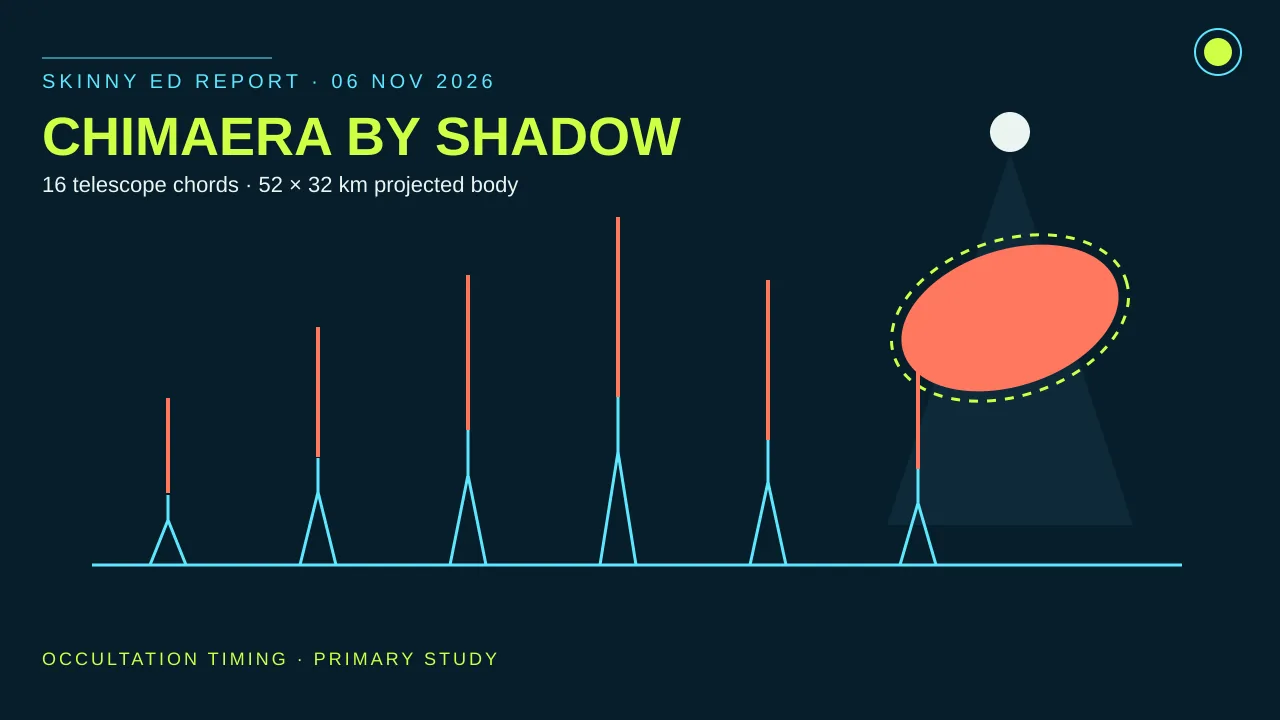
A moving shadow maps asteroid Chimaera
Sixteen useful telescope tracks across the United States reconstruct an elongated asteroid that a spacecraft is expected to visit in the 2030s.
Primary Study · New Measurement
Read the story & sourcesTHE SKINNY ED REPORT · ARCHIVED EDITION
Friday's edition is a lesson in how much careful measurement can wring from small signals. A coordinated line of telescopes turns the shadow of asteroid Chimaera into a measured silhouette. A new astrometric method suppresses a recurring Gaia scanning artifact without erasing real orbital motion. A GPU retrieval framework combines two kinds of exoplanet spectra while exposing uncertainty that still needs work, and an updated population study again finds that stars with known planets tend to rotate more slowly. Taiwan's newly commissioned BURSTT-256 array widens the hunt for nearby fast radio bursts, while the NASA Exoplanet Archive records thirteen newly added planets. One clearly labeled Worth Revisiting study shows why a dot in a single Webb band is not automatically another planet. The official UAP lane is quiet: no new AARO resolution, PURSUE release, or consequential government record cleared verification this morning. None of today's science items detects extraterrestrial life, intelligence, or nonhuman technology.
Sixteen useful telescope tracks across the United States reconstruct an elongated asteroid that a spacecraft is expected to visit in the 2030s.
Primary Study · New Measurement
Read the story & sources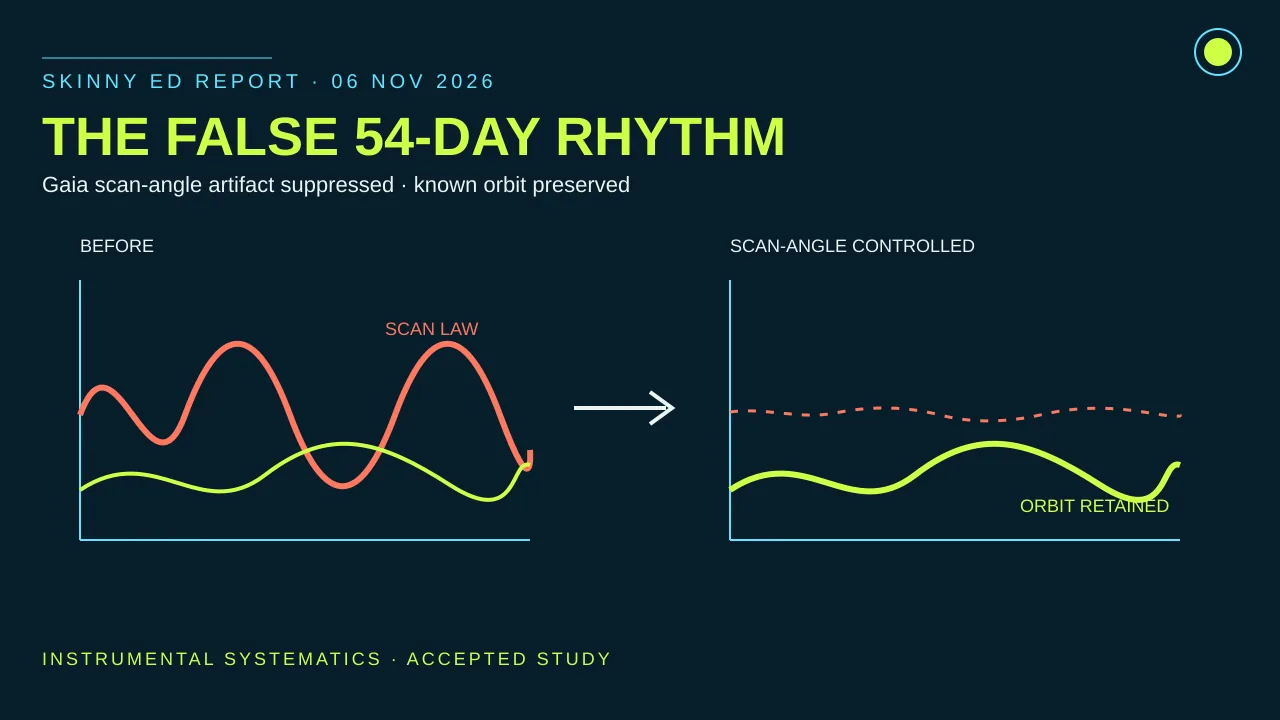
A scan-angle-aware period search removes recurring spacecraft-geometry signals while retaining independently known orbital motion.
Accepted Study · Instrumental Systematics
Read the story & sources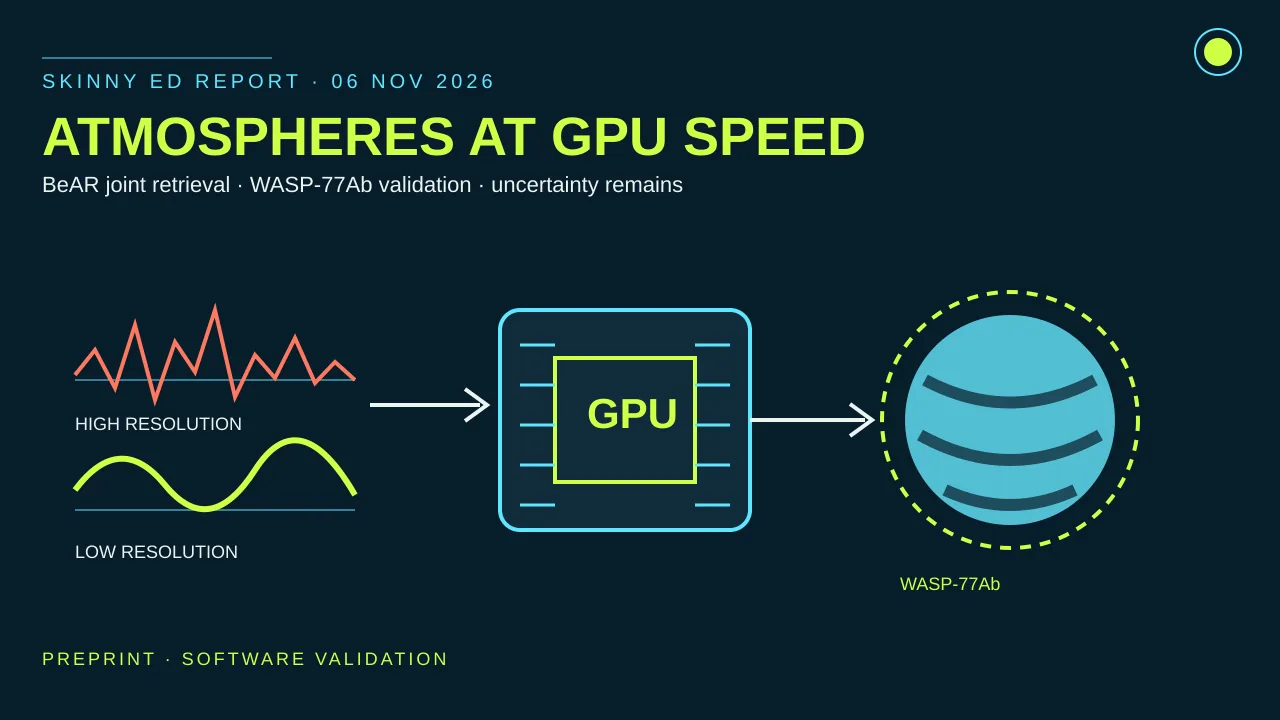
BeAR combines high- and low-resolution spectra using one atmosphere model, reproducing published WASP-77Ab results in substantially shorter runs.
Preprint · Software Validation
Read the story & sources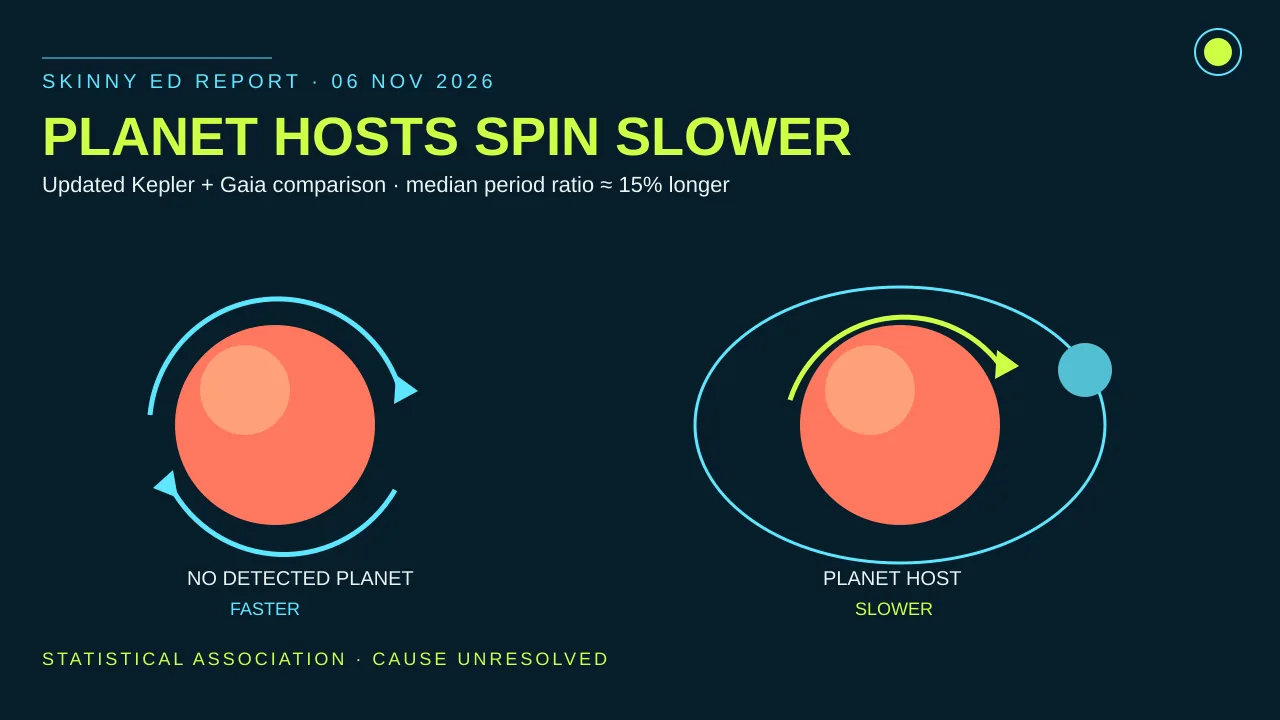
An updated Kepler and Gaia comparison recovers a roughly fifteen-percent rotation-period shift for stars with detected planets.
Accepted Study · Statistical Association
Read the story & sources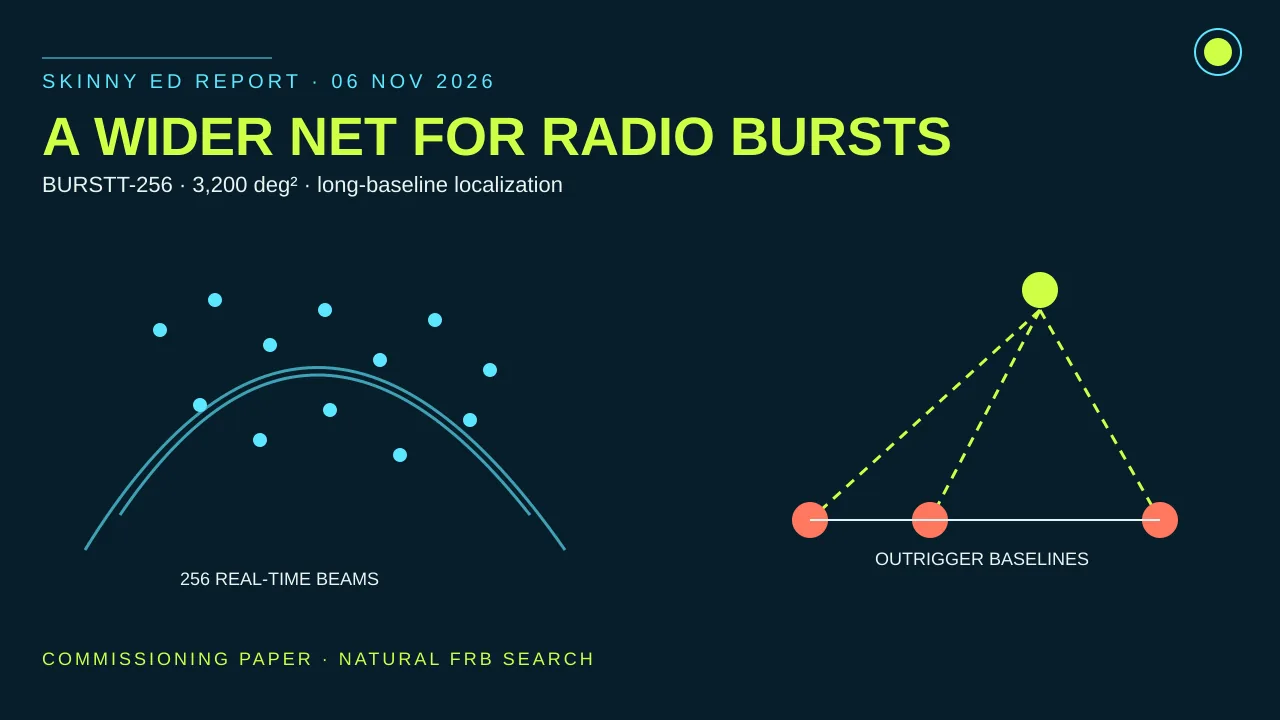
BURSTT-256 commissions 256 real-time beams across roughly 3,200 square degrees, with distant outriggers designed for sub-arcsecond localization.
Commissioning Paper · Submitted to PASP
Read the story & sources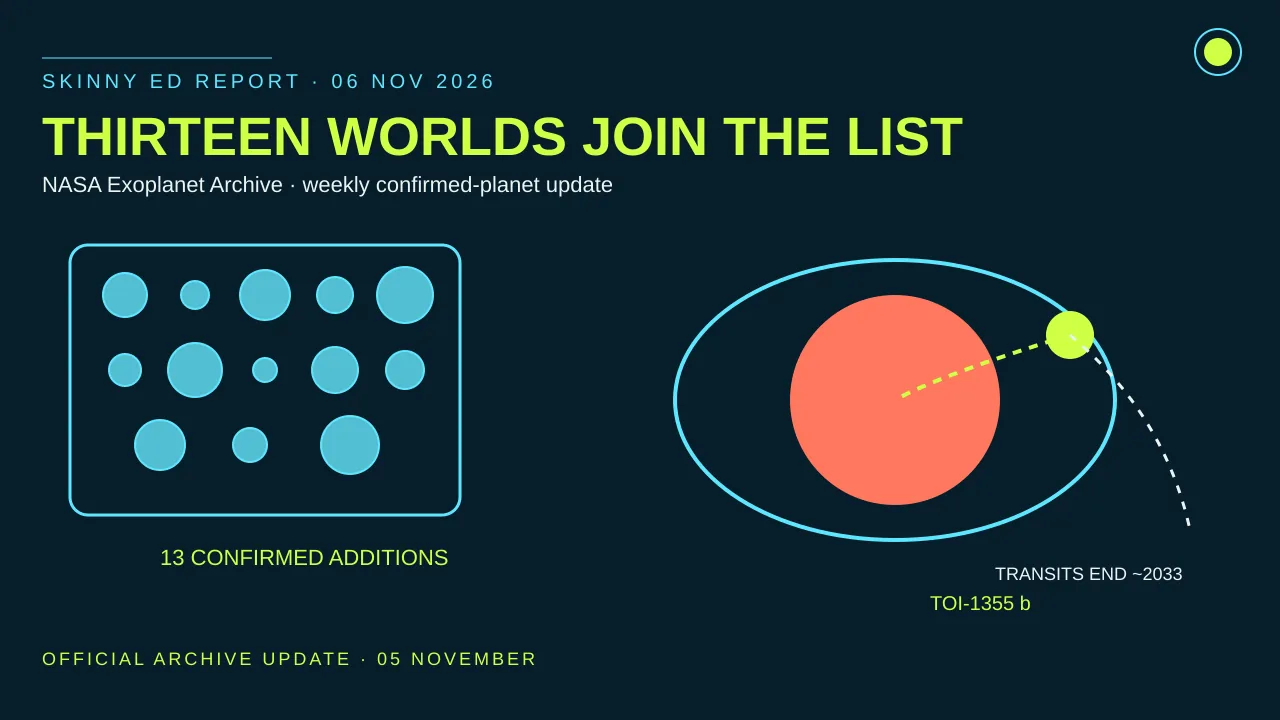
NASA's weekly update includes TOI-1355 b, an eccentric hot super-Jupiter whose changing geometry will end its observable transits around 2033.
Official Archive Update · Confirmed Planets
Read the story & sources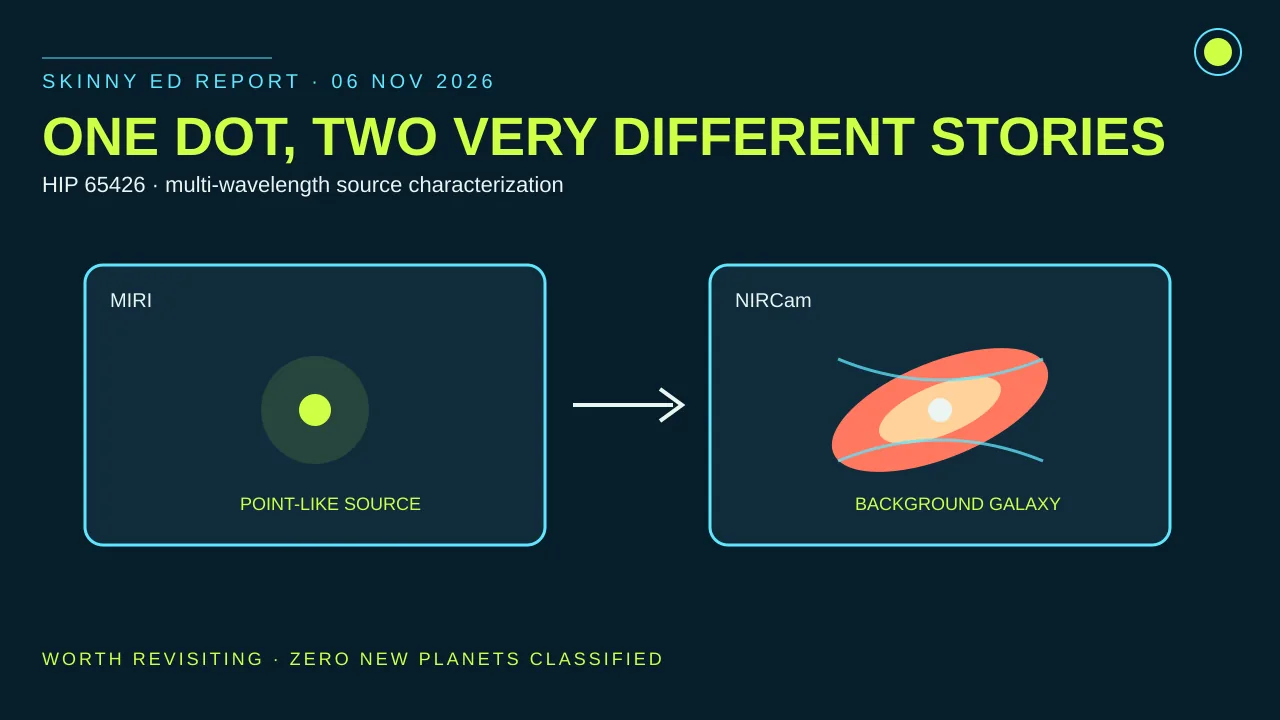
A multi-wavelength review of the HIP 65426 field classifies stars and galaxies that can masquerade as companions in a single band.
Worth Revisiting · Accepted Study
Read the story & sourcesGood morning, investigators. Today's board is less about a spectacular object than the machinery that keeps spectacular claims honest. Sixteen telescopes watched one asteroid shadow cross the United States and reconstructed Chimaera as a dark, elongated body roughly 52 by 32 kilometers in projection. Gaia researchers found that a recurring 54-day signal can come from the spacecraft's scanning geometry, then demonstrated a correction that preserves known orbits. Webb's HIP 65426 field provides the same warning in pictures: one source that looks like a point in mid-infrared data resolves into a galaxy at shorter wavelengths, and none of the classified candidates became a second planet. The planet stories are still genuinely interesting. Host stars rotate about fifteen percent more slowly in one carefully limited comparison, a new GPU framework can combine high- and low-resolution atmosphere spectra in minutes, and the NASA archive added thirteen confirmed planets this week. Meanwhile, BURSTT-256 is commissioning a very wide radio net for nearby fast radio bursts. The recurring theme is not that the universe has become less strange. It is that better calibration tells us which strange thing we are actually looking at.

ED’S HIGH THOUGHT · FICTIONAL HUMOR
Whoa, dude… Webb found a galaxy that looks like one tiny point in one wavelength and a whole extended galaxy in another. Space invented catfishing before fish. Somewhere a planet hunter matched with a cute luminous dot, arrived with spectroscopy, and found 200 billion stars sitting at the bar wearing one photon as a profile picture. That's why aliens never answer Earth: our profile photo is the Blue Marble from 1972, and eight billion humans keep photobombing behind it.
Published by Aliens in the Clouds. These AI-assisted summaries link to their sources and distinguish reported claims from established findings. Skinny Ed is a fictional mascot; High Thoughts are comedy. Send a correction with its source.