Exoplanet Atmospheres
A GPU framework accelerates alien-atmosphere retrievals
BeAR combines high- and low-resolution spectra using one atmosphere model, reproducing published WASP-77Ab results in substantially shorter runs.
Briefed November 6, 2026 · Aliens in the Clouds
Preprint · Software Validation
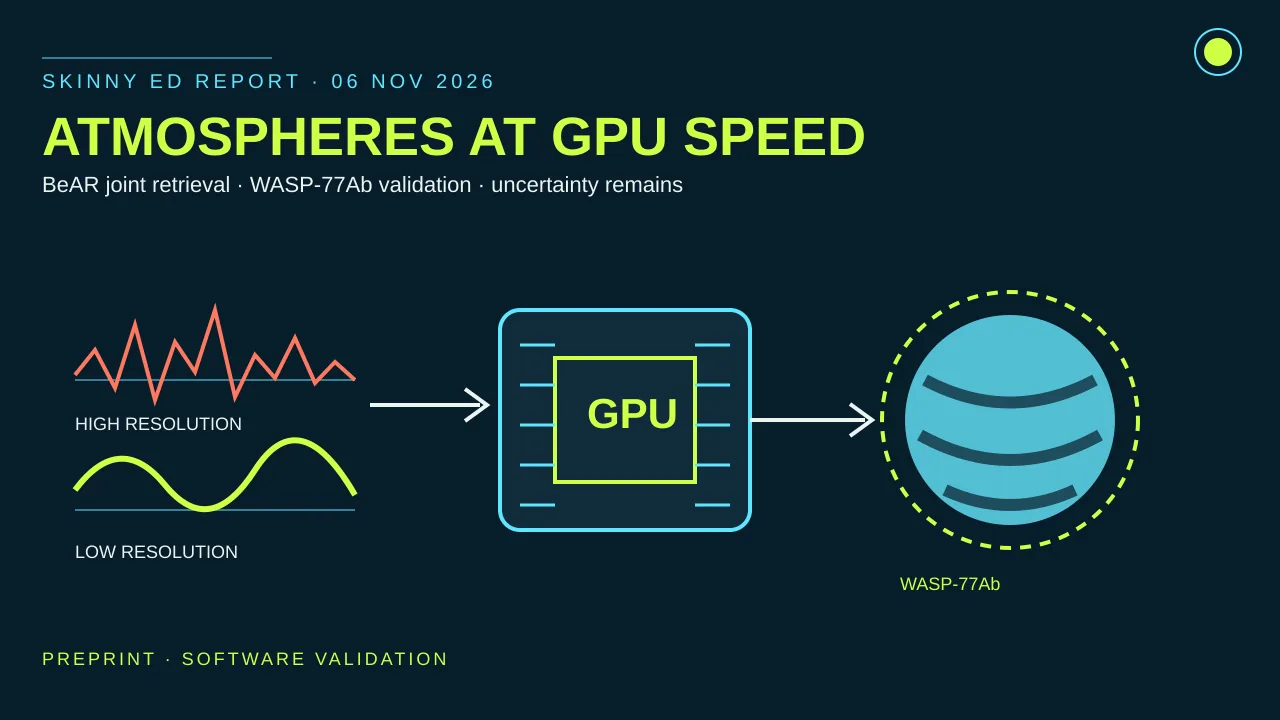
Esther Wang and colleagues introduce BeAR, a GPU-based atmosphere-retrieval framework that can fit high-resolution cross-correlation data, lower-resolution spectra, or both together. The forward model runs in about one millisecond on an NVIDIA GH200, allowing millions of trial atmospheres per minute on a cluster.
Separate fits to Gemini South/IGRINS and Webb/NIRSpec observations of hot Jupiter WASP-77Ab reproduce previously published abundances, carbon-to-oxygen ratios, metallicity, and thermal structure within the quoted comparisons. A seventeen-parameter IGRINS retrieval takes 27 to 42 minutes on one RTX 5080, but injection tests show that some abundance-ratio uncertainties are underestimated by roughly a factor of two.
Why it matters
Faster joint retrievals could make it practical to compare different instruments without forcing them into separate atmospheric stories. The disclosed uncertainty shortfall is equally important because speed does not replace calibration.
What the source establishes
Primary preprint submitted November 5 and listed as submitted to Astronomy & Astrophysics. Validation uses an already studied hot Jupiter; the framework does not report a new biosignature or atmospheric detection.
Published by Aliens in the Clouds. These AI-assisted summaries link to their sources and distinguish reported claims from established findings. Skinny Ed is a fictional mascot; High Thoughts are comedy. Send a correction with its source.