Worth Revisiting · Direct Imaging
Worth Revisiting: Webb turns planet candidates into backgrounds
A multi-wavelength review of the HIP 65426 field classifies stars and galaxies that can masquerade as companions in a single band.
Briefed November 6, 2026 · Aliens in the Clouds
Worth Revisiting · Accepted Study
An updated analysis of Webb coronagraphic images revises the astrometry and photometry of known giant planet HIP 65426 b after changes to the Webb and spaceKLIP processing pipelines. The planet remains consistent with a cloudy atmosphere near 1,436 kelvin, while some measured values shift meaningfully between processing versions.
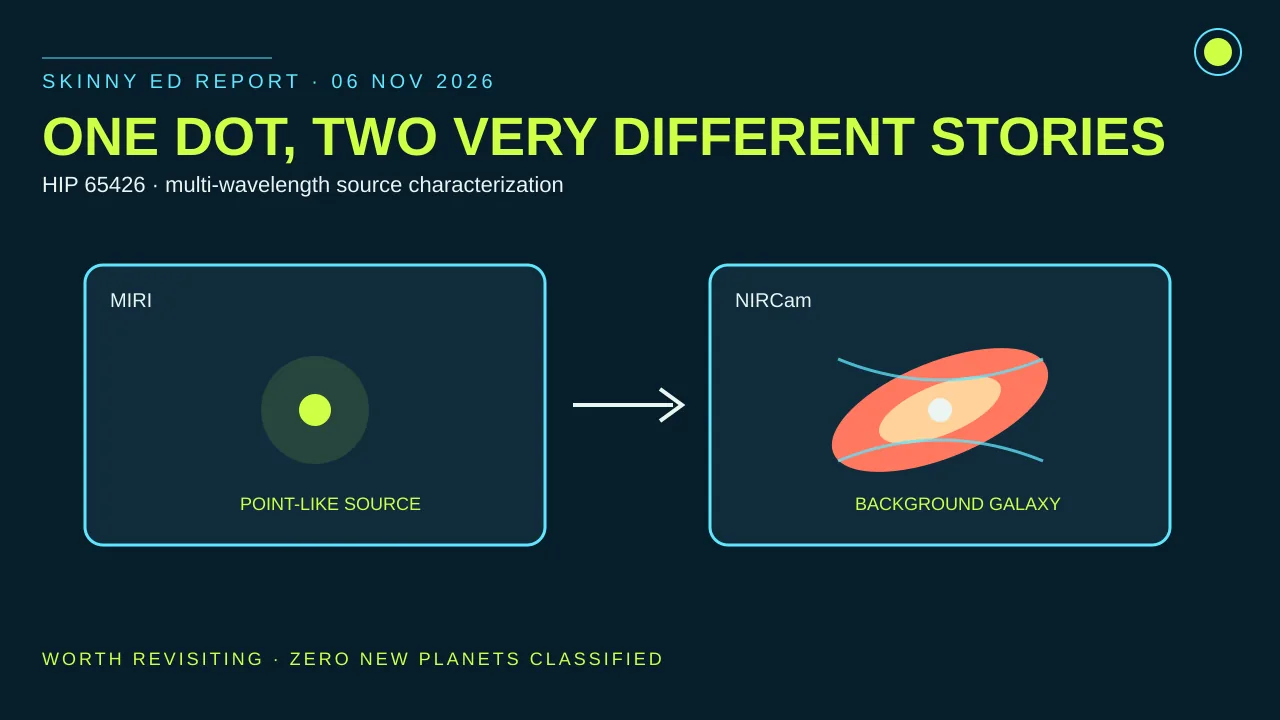
The team identified twenty-one additional candidate sources across NIRCam and MIRI data. Thirteen could be classified: eight background stars, four galaxies, one still unknown, and zero additional planets. One galaxy appears point-like in MIRI but extended in NIRCam, demonstrating why a single epoch and wavelength can make a background object look deceptively companion-like.
Why it matters
The same discipline applies across anomaly research: a point of light is a candidate until color, shape, motion, and repeated observations constrain what it is. Multi-wavelength context prevents one-band appearances from hardening into false discoveries.
What the source establishes
Accepted for publication in The Astrophysical Journal Letters and submitted November 4. The classifications are based on Webb's multi-wavelength data; eight sources remain unclassified pending additional astrometry or characterization.
Published by Aliens in the Clouds. These AI-assisted summaries link to their sources and distinguish reported claims from established findings. Skinny Ed is a fictional mascot; High Thoughts are comedy. Send a correction with its source.