Radio Astronomy
Taiwan opens a wider radio net for nearby bursts
BURSTT-256 commissions 256 real-time beams across roughly 3,200 square degrees, with distant outriggers designed for sub-arcsecond localization.
Briefed November 6, 2026 · Aliens in the Clouds
Commissioning Paper · Submitted to PASP
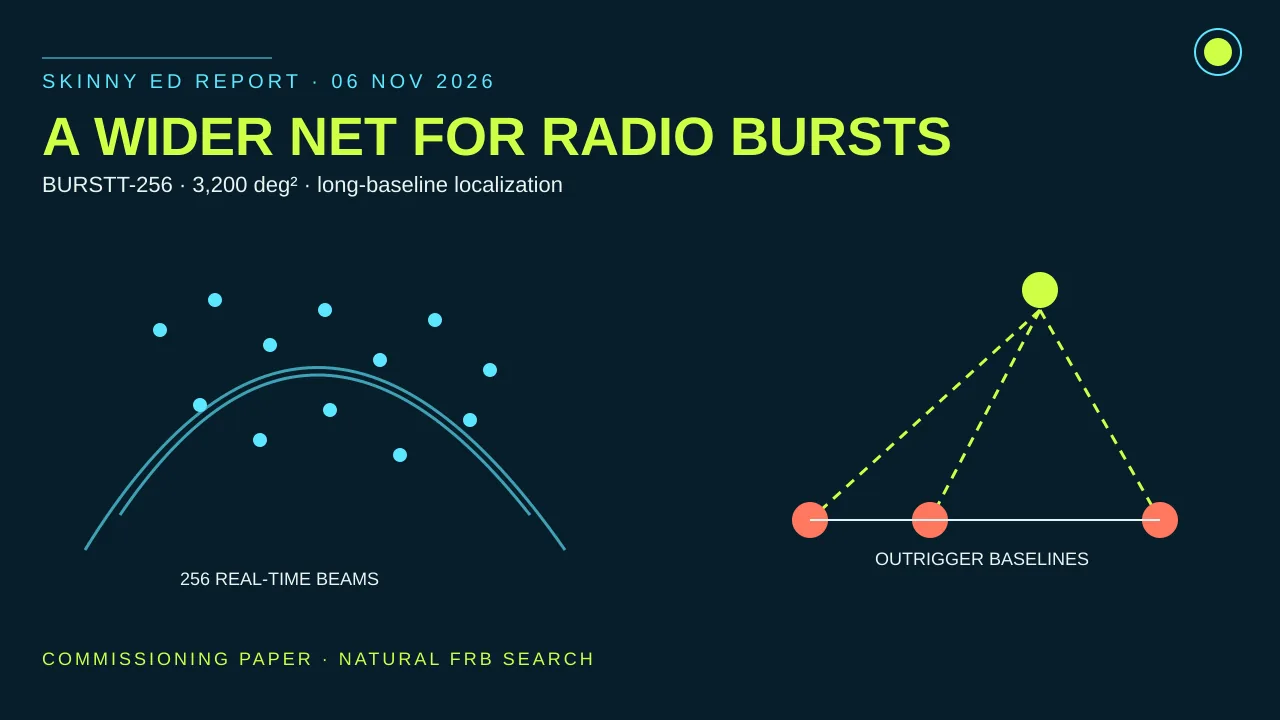
The BURSTT collaboration describes the design, deployment, and commissioning of its 256-antenna main array in Taiwan. The current system observes from 400 to 800 megahertz and forms 256 beams in real time, covering about 3,200 square degrees at once while searching for fast radio bursts.
Smaller outrigger stations separated by hundreds to thousands of kilometers are intended to localize detections through very-long-baseline interferometry. The commercial-antenna configuration has a reported system-equivalent flux density near 11 kilojanskys, with custom antennas expected to improve sensitivity later in 2026. The paper documents commissioned hardware and calibration, not an extraterrestrial signal or a completed 2,048-element array.
Why it matters
Fast radio bursts are brief enough that a wide field and real-time localization matter. Pinning nearby bursts to precise host environments can help identify their natural engines and prevent mystery from persisting solely because the sky position is vague.
What the source establishes
Primary instrumentation paper submitted to PASP and posted November 5. The 256-element main array has calibrated on-sky performance; the larger planned expansion and optimized sensitivity remain future work.
Published by Aliens in the Clouds. These AI-assisted summaries link to their sources and distinguish reported claims from established findings. Skinny Ed is a fictional mascot; High Thoughts are comedy. Send a correction with its source.