Exoplanet Populations
Planet-hosting stars again look slower on the spin
An updated Kepler and Gaia comparison recovers a roughly fifteen-percent rotation-period shift for stars with detected planets.
Briefed November 6, 2026 · Aliens in the Clouds
Accepted Study · Statistical Association
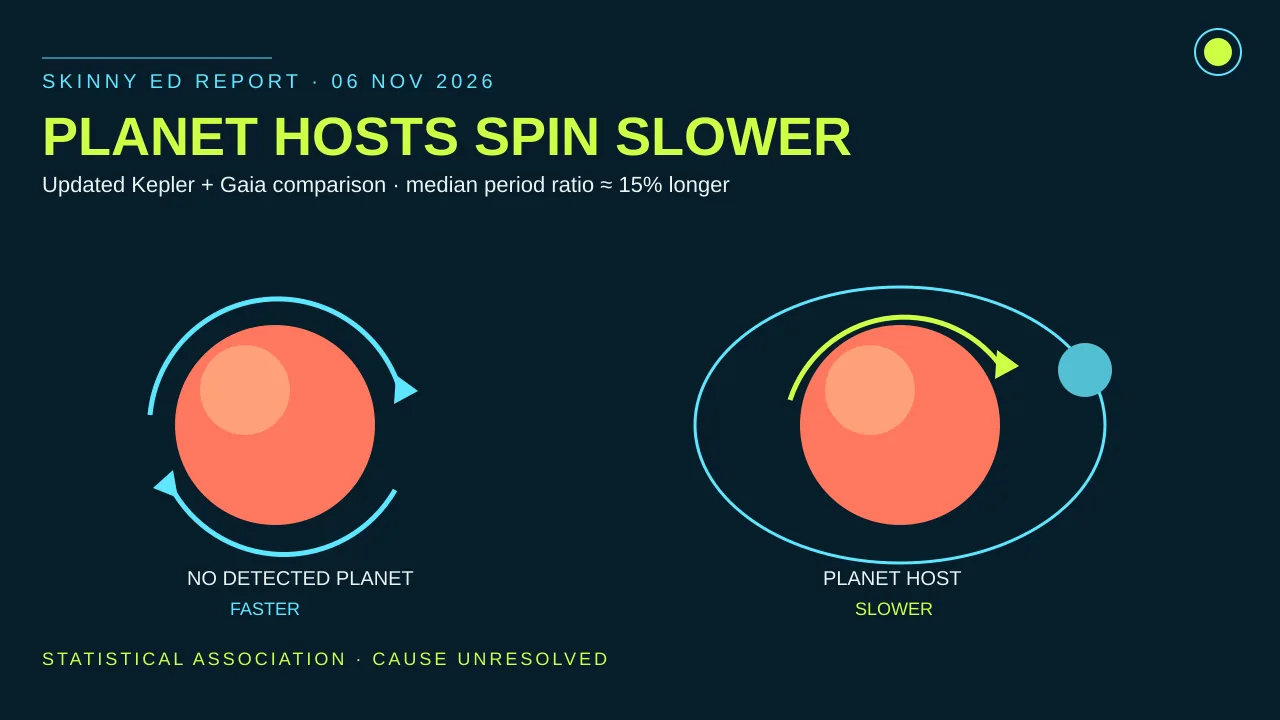
Researchers revisited an earlier claim using Kepler rotation periods, Gaia DR3-based stellar parameters, and an updated exoplanet catalog. They modeled expected rotation as a function of temperature and compared the observed-to-expected period ratios of stars with and without detected planets.
For rotation periods shorter than twenty days, the median ratio for planet hosts is about fifteen percent larger, with a reported Kolmogorov-Smirnov probability of 2.4 times 10 to the minus four. A TESS rotation sample shows a similar tendency, but its structured period distribution prevents the authors from treating that second comparison as robust. The association does not by itself reveal whether planets alter stellar spin or selection effects favor slower hosts.
Why it matters
A real connection between stellar rotation and planet occurrence could affect how systems form, evolve, and are selected by surveys. Establishing cause will require more than a population-level correlation.
What the source establishes
Accepted for publication in Monthly Notices of the Royal Astronomical Society and submitted to arXiv November 5. The association is statistically reported; its physical cause remains unresolved.
Published by Aliens in the Clouds. These AI-assisted summaries link to their sources and distinguish reported claims from established findings. Skinny Ed is a fictional mascot; High Thoughts are comedy. Send a correction with its source.