Anomaly Screening
A Gaia correction suppresses a false 54-day rhythm
A scan-angle-aware period search removes recurring spacecraft-geometry signals while retaining independently known orbital motion.
Briefed November 6, 2026 · Aliens in the Clouds
Accepted Study · Instrumental Systematics
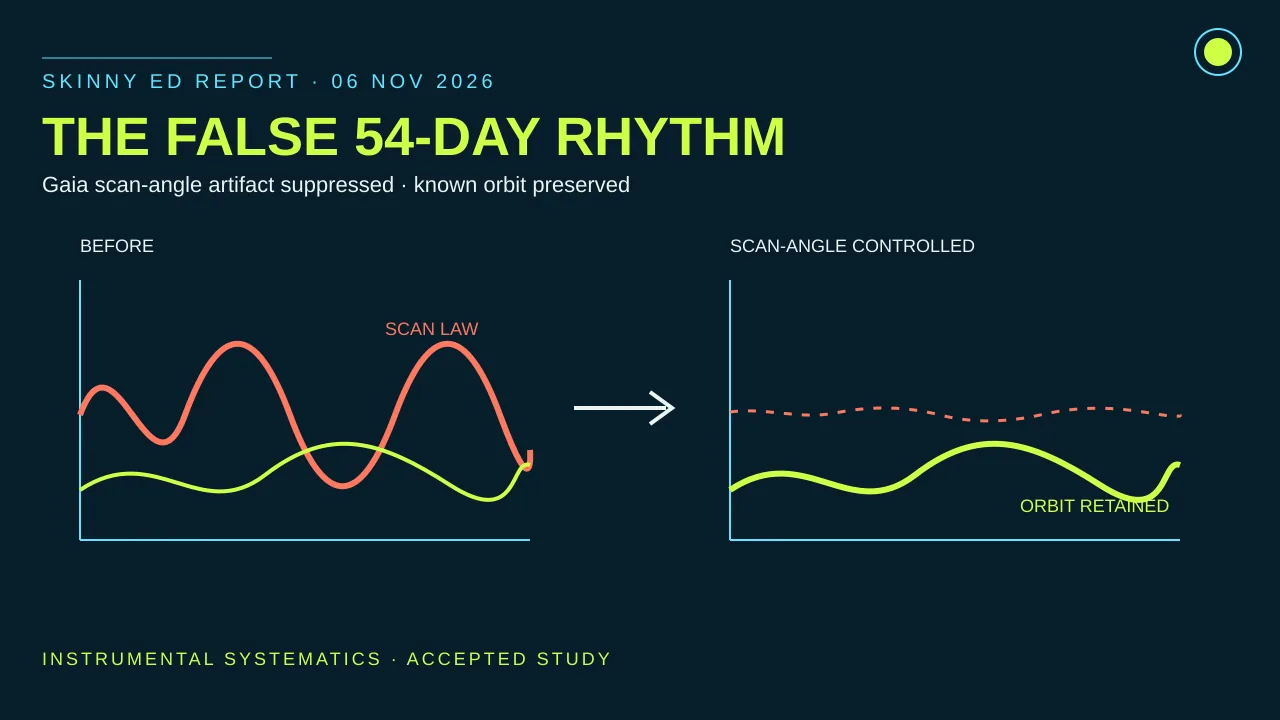
Avraham Binnenfeld and colleagues extend a phase-distance-correlation periodogram so it can measure and reduce dependence on a telescope's scan angle. One-dimensional scanning missions couple observation times to viewing geometry, which can create periodic patterns that resemble physical motion in the target.
Tests on Hipparcos data suppress recurrent scanning-law periods, and an application to prerelease Gaia DR4 epoch astrometry reduces a roughly 54-day feature across several sources while independently known orbital signals remain detectable. The method is a diagnostic and mitigation tool; it does not guarantee that every surviving period is astrophysical or that every artifact has been removed.
Why it matters
Gaia DR4 will enable enormous searches for planets, stars, and dormant black holes. Separating spacecraft cadence from true orbital motion is essential before a periodic anomaly becomes a discovery claim.
What the source establishes
Accepted for publication in Astronomy & Astrophysics and submitted to arXiv November 5. The reported suppression is demonstrated on Hipparcos and prerelease Gaia data; full public DR4 performance remains to be tested at scale.
Published by Aliens in the Clouds. These AI-assisted summaries link to their sources and distinguish reported claims from established findings. Skinny Ed is a fictional mascot; High Thoughts are comedy. Send a correction with its source.