A live scholarly reading circle and a new U.S. Army counter-drone sensor report lead a quiet morning. Four clearly marked identification resources cover Remote ID, the International Space Station, atmospheric reentries, and bright meteors.
The Society for UAP Studies hosts an August 20 discussion of Michael P. Masters' ‘Identified Flying Objects,’ treating an anthropological time-travel proposal as a theory to examine rather than a finding to announce.
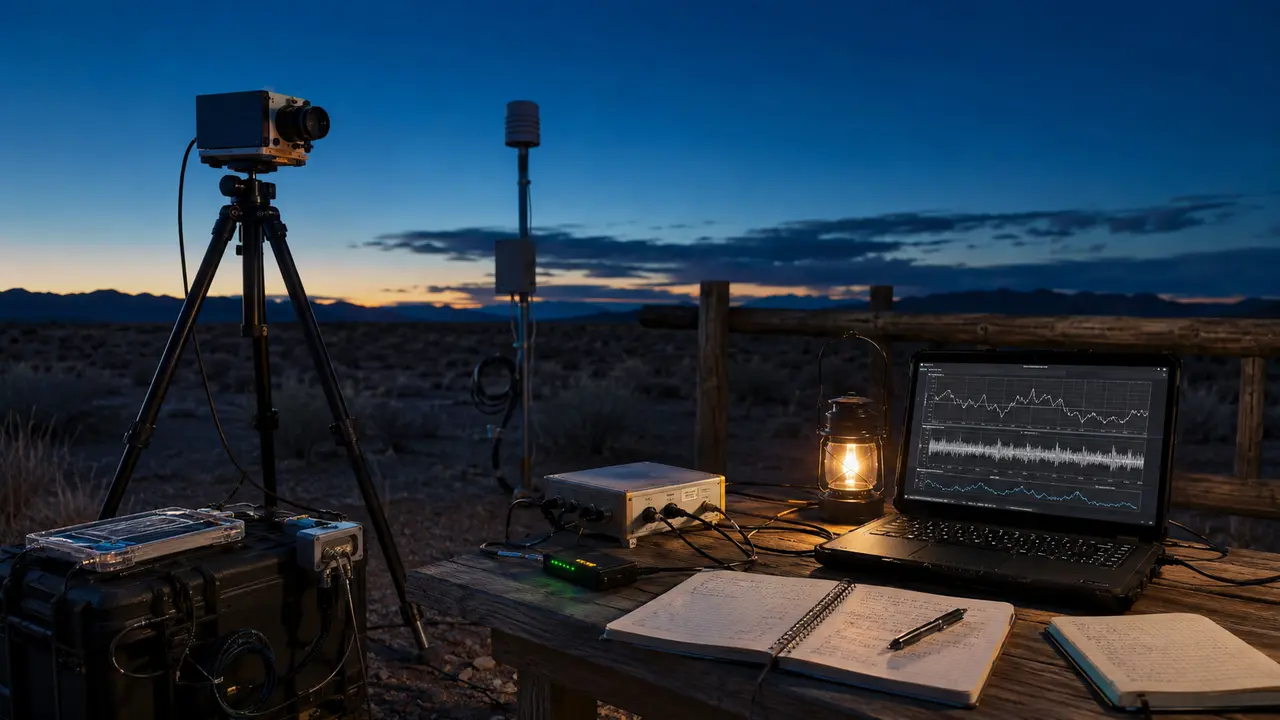
A newly published XVIII Airborne Corps report describes live evaluations of counter-drone sensors and the effort to fuse their different strengths into one usable airspace picture.
Worth Revisiting: the FAA explains which drones broadcast identification and location data, the three compliance paths, and the legitimate exceptions that keep a missing signal from becoming a verdict.
Worth Revisiting: NASA's Spot the Station service provides local ISS pass times, trajectory tracking, and a simple visual profile for checking a fast-moving light.
Worth Revisiting: ESA explains how satellites, rocket stages, and fragments reenter, why timing windows tighten late, and where public reentry information can test a luminous event.
Worth Revisiting: CNEOS publishes U.S. Government sensor detections with times, locations, energy estimates, and occasional velocities—while warning that the list is incomplete and subject to revision.
Good morning, investigators. Today's board begins with a useful contrast. The Society for UAP Studies is holding a live reading circle on Michael P. Masters' future-human hypothesis—an imaginative anthropological argument that belongs in the speculation column unless evidence can move it elsewhere. The U.S. Army, meanwhile, has published a very terrestrial lesson from its counter-drone work: no single sensor sees everything, so a dependable airspace picture has to combine detections, tracking, characterization, communications, and context. The rest of the desk turns that principle into practical checks: FAA Remote ID can identify many registered drones, NASA can tell you when the International Space Station should cross your sky, ESA tracks the ordinary but dramatic return of space hardware, and NASA's CNEOS catalog records some of the brightest meteors. One recycled alien-bodies headline did not make today's edition because its underlying interviews were older and no new public evidence accompanied the rewrite. Quiet mornings are excellent for calibrating instruments—and for confiscating the refresh button from whoever keeps calling it a sensor.
ED’S HIGH THOUGHT · FICTIONAL HUMOR
Whoa, dude… if UFOs are future humans visiting their ancestors, then every sighting is historical tourism. Of course they hover over military bases—future museums charge forty thousand credits for a Cold War reenactment, but time travel lets you watch the original through the windshield. The gray skin and giant eyes aren't evolution; that's what happens after six hours in a temporal airport lounge. Somewhere in 3126, a family album is Dad photobombing Area 51, Mom complaining Roswell is commercialized now, and three exhausted future-kids asking why every century's gift shop sells the same inflatable cow.
Published by Aliens in the Clouds. These AI-assisted summaries link to their sources and distinguish reported claims from established findings. Skinny Ed is a fictional mascot; High Thoughts are comedy. Send a correction with its source.