Asteroid Survey Methods
Interplanetary dust remains a weak spot for near-Sun asteroid surveys
One zodiacal-emission model works to roughly 10 percent at moderate elongations, but larger discrepancies persist closer to the Sun.
Briefed September 18, 2026 · Aliens in the Clouds
Accepted Manuscript · Foreground Uncertainty Measured
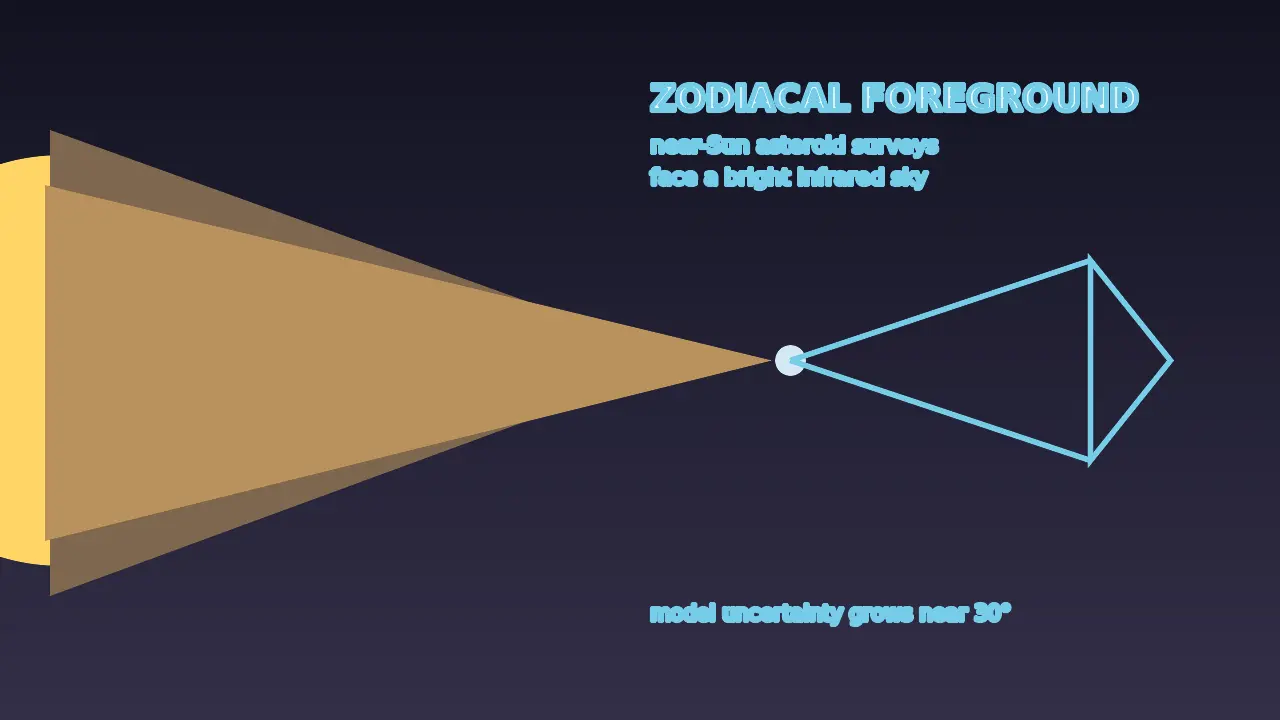
Future infrared asteroid missions such as NEO Surveyor and NEOMIR must search through visible and thermal emission from interplanetary dust at solar elongations of roughly 30 to 60 degrees. Most current foreground models were constrained at larger angles, leaving their accuracy in the missions' key observing zone uncertain.
An accepted PASP study reanalyzed the available small-elongation measurements and compared two models derived from COBE/DIRBE data. The model based mainly on spatial and temporal brightness changes performs better and generally agrees within about 10 percent at eight-to-ten-micron wavelengths between 40 and 60 degrees. Significant discrepancies remain near 30 degrees, where new mid-infrared observations are still needed.
Why it matters
An uncertain foreground changes how faint an asteroid a survey can recover and how confidently a dim infrared source can be separated from the dusty sky behind it.
What the source establishes
Accepted methods study validating existing models against archival measurements. The better model is useful but does not fully constrain the near-Sun infrared background.
Published by Aliens in the Clouds. These AI-assisted summaries link to their sources and distinguish reported claims from established findings. Skinny Ed is a fictional mascot; High Thoughts are comedy. Send a correction with its source.