Brown Dwarf Atmospheres
JWST tracks water clouds and chemical weather on the coldest brown dwarf
Eleven hours of spectra show carbon monoxide and phosphine varying together above patchy water-cloud layers on WISE 0855.
Briefed September 18, 2026 · Aliens in the Clouds
Accepted Manuscript · Patchy Water Clouds Inferred
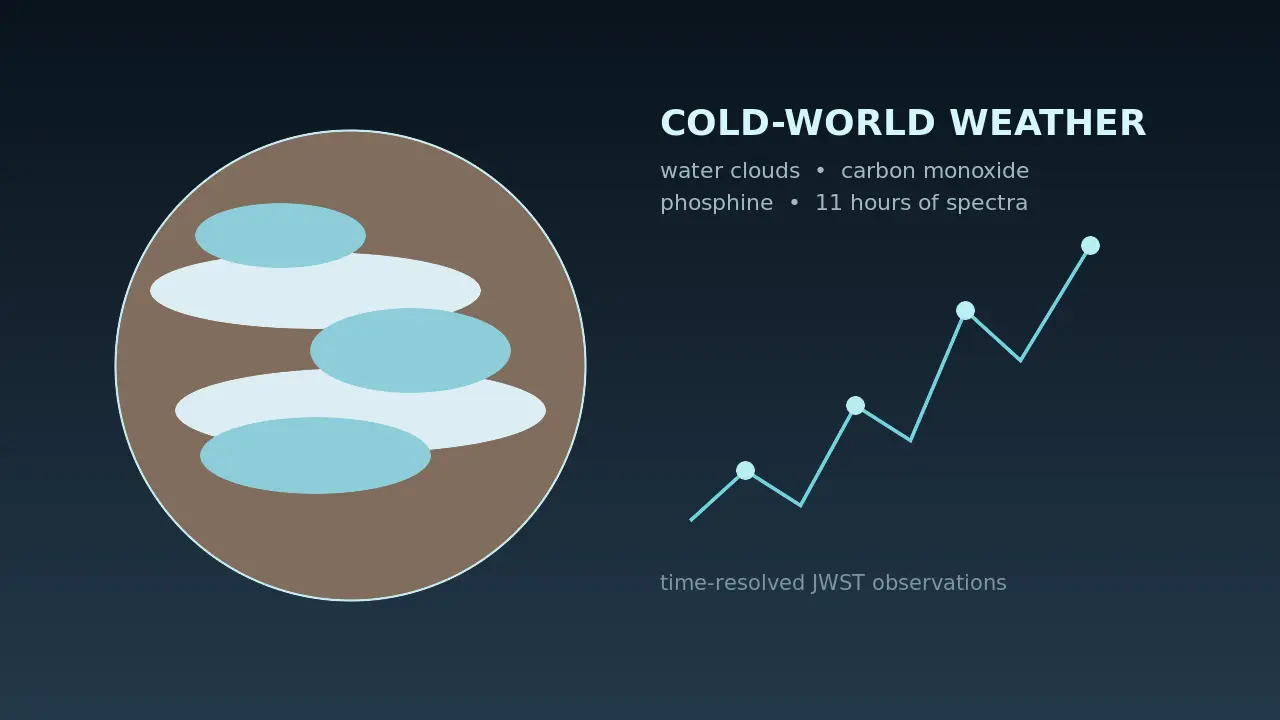
JWST/NIRSpec watched WISE 0855, a 265-kelvin brown dwarf, for 11 hours at 15-minute cadence. The largest changing spectral feature comes from carbon monoxide absorption, which varies by as much as 10 percent from peak to peak at some wavelengths; phosphine changes in step with it.
Comparisons with atmospheric and interior models indicate that the carbon monoxide and phosphine variations arise from deeper, chemically quenched layers while water-cloud thickness changes higher in the atmosphere. The accepted manuscript presents evidence for patchy water clouds, not a direct photograph of cloud shapes or a claim involving biology.
Why it matters
A world roughly as cool as Earth's polar air gives astronomers a nearby laboratory for separating chemistry, circulation, and condensate clouds in giant-planet-like atmospheres.
What the source establishes
Accepted Astronomical Journal manuscript using time-resolved JWST spectra. The variability is measured; the vertical cloud-and-chemistry structure is inferred through atmospheric models.
Published by Aliens in the Clouds. These AI-assisted summaries link to their sources and distinguish reported claims from established findings. Skinny Ed is a fictional mascot; High Thoughts are comedy. Send a correction with its source.