Accepted Exoplanet Dynamics Study
White-dwarf dust could expose planets too faint to see
An accepted study finds that unseen Mercury-, Earth-, and Neptune-mass bodies can shift dusty transit periods by measurable seconds to minutes.
Briefed September 22, 2026 · Aliens in the Clouds
Peer-Reviewed Model · Detection Method Proposed
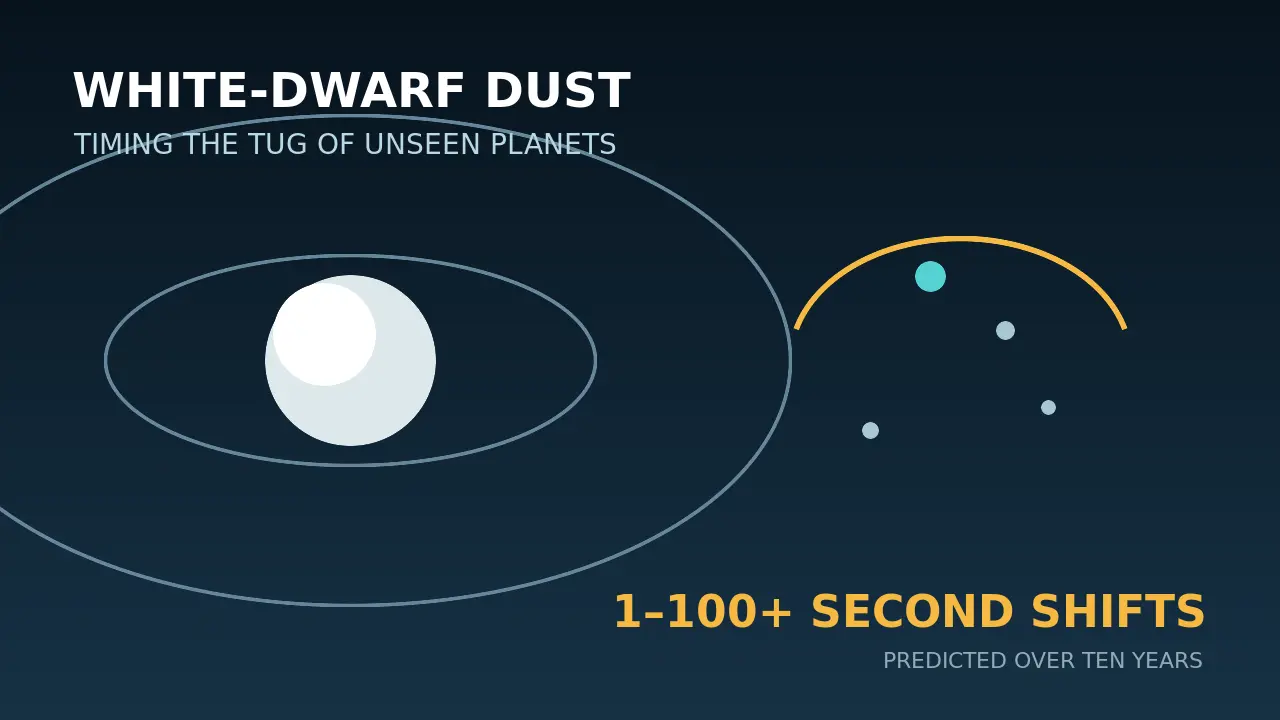
Dusty debris passing in front of white dwarfs often produces complicated, drifting transit signals. Researchers modeled dust sharing a one-to-one orbital resonance with an intact body and mapped stable planar and three-dimensional configurations across masses from Ceres through Neptune. Their calculations identify new periodic-orbit branches and connect those dynamical families to signals an observer could time.
In ten-year N-body simulations, Mercury analogues shift the dust's orbital period by roughly 1 to 10 seconds, Earth analogues by 10 to 100 seconds, and Neptune analogues by more than 100 seconds. Those are predicted signatures, not new planet detections. The accepted paper proposes a route for inferring otherwise hidden co-orbiting bodies from long-baseline transit timing, provided real systems can be separated from dust production, collisions, and other sources of drift.
Why it matters
Dead-star debris systems can hide the surviving architecture of planetary systems; a quantitative timing test gives observers a way to search that clutter for intact worlds.
What the source establishes
Accepted theoretical and numerical research. The timing amplitudes come from models; no previously unknown planet is claimed as detected.
Published by Aliens in the Clouds. These AI-assisted summaries link to their sources and distinguish reported claims from established findings. Skinny Ed is a fictional mascot; High Thoughts are comedy. Send a correction with its source.