Substellar Astronomy
Webb measures its most distant ultra-cold Y dwarf
A two-year parallax baseline places JADES-GS-BD-5 about 64 parsecs away—roughly three times farther than earlier Y dwarfs with measured parallaxes.
Briefed November 7, 2026 · Aliens in the Clouds
Primary Study · Robust Parallax
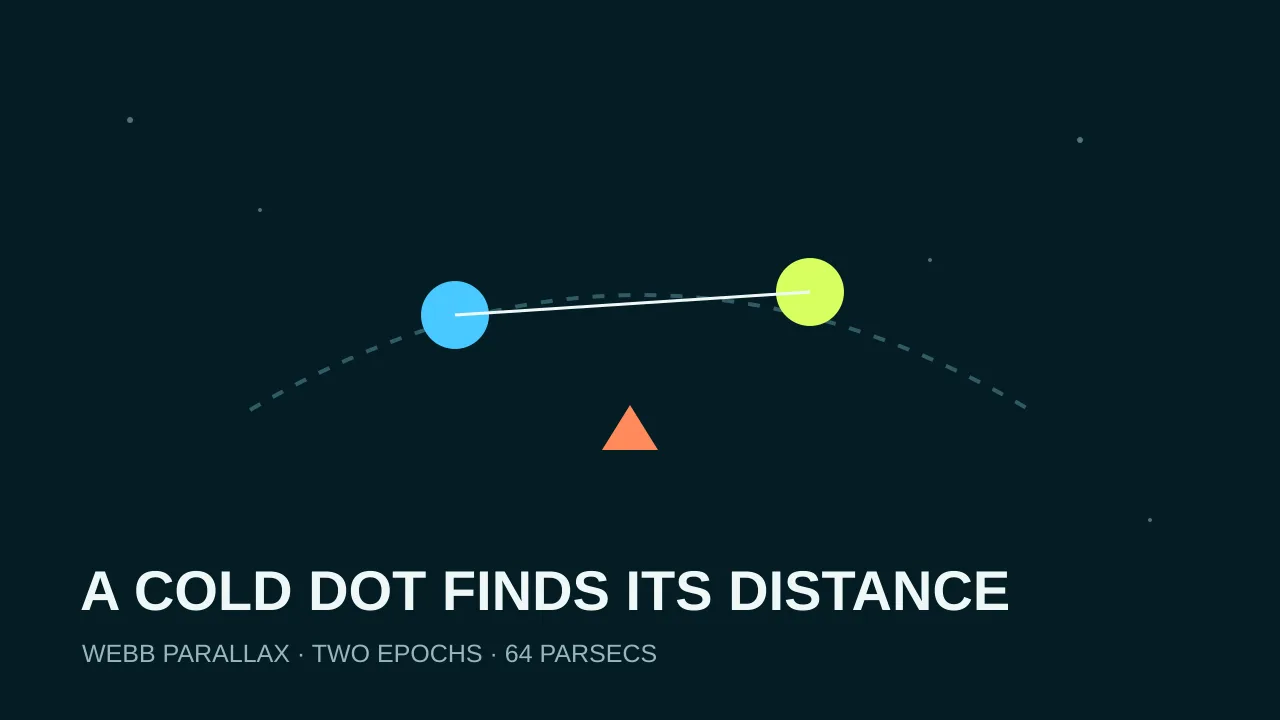
Feng-Yuan Liu and colleagues used multi-epoch Webb NIRCam imaging of the JADES/GOODS-South field to measure the motion and parallax of JADES-GS-BD-5. The fit gives a parallax of 15.7 plus 1.4 or minus 1.3 milliarcseconds, corresponding to a geometric distance of 64 plus 6 or minus 5 parsecs, along with a tangential speed consistent with a thin-disk Milky Way object.
Its near-infrared spectrum matches very late Y-dwarf templates, and evolutionary models place it in the planetary-mass regime. The team finds no convincing host, binary acceleration, or significant variability. Current atmosphere models do not reproduce its full spectral-energy distribution, so disequilibrium chemistry and vertical mixing are proposed as missing ingredients rather than directly observed processes.
Why it matters
A precise distance turns an unusually faint point into a calibrated test of cold giant-planet atmospheres. It also shows how extragalactic surveys can uncover nearby substellar objects that ordinary searches miss.
What the source establishes
Primary preprint submitted November 5 and listed as submitted to MNRAS. The parallax, proper motion, and distance are measured; the planetary-mass estimate and atmospheric explanation depend on evolutionary and spectral models.
Published by Aliens in the Clouds. These AI-assisted summaries link to their sources and distinguish reported claims from established findings. Skinny Ed is a fictional mascot; High Thoughts are comedy. Send a correction with its source.