Planetary Dynamics
Venus could have destroyed a moon—but only under limited conditions
A peer-reviewed tidal model finds that some starting spins and moon masses end in a Roche-limit breakup rather than long-term survival.
Briefed September 15, 2026 · Aliens in the Clouds
Peer Reviewed · Historical Scenario Inferred
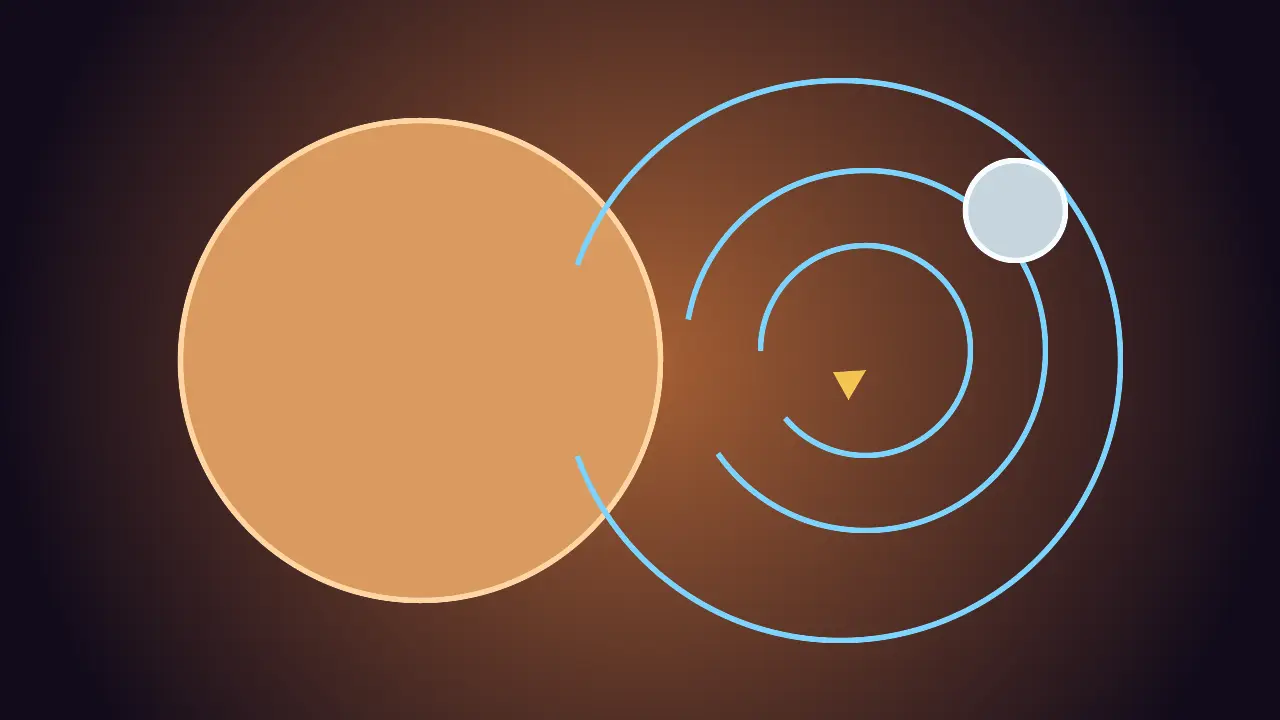
Stephen Kane and colleagues modeled Venus, a hypothetical moon, and the Sun together across a wide range of starting spin periods, moon masses, eccentricities, and tidal assumptions. A lunar-mass moon can survive for the age of the solar system when Venus begins with a sufficiently rapid spin, while slower starting rotation or a moon above roughly two lunar masses can let the synchronous orbit overtake the satellite and drive it toward destruction.
The model reproduces both the loss of a moon and Venus' slow present rotation only within a restricted region of the tested parameter space. Depending on the tidal prescription, some massive moons could instead persist in near-synchronous states. The paper therefore offers a plausible history, not evidence that Venus definitely formed a moon or that any debris signature has been observed.
Why it matters
Venus and Earth began with broadly similar ingredients yet kept very different companions and climates. The model identifies physical conditions that future atmosphere and geology measurements could test indirectly.
What the source establishes
Peer-reviewed Astrophysical Journal study published September 14. Moon loss is a conditional tidal-model result; no former Venusian satellite or impact debris has been detected.
Published by Aliens in the Clouds. These AI-assisted summaries link to their sources and distinguish reported claims from established findings. Skinny Ed is a fictional mascot; High Thoughts are comedy. Send a correction with its source.