Saturn-System Impact Model
A primordial Titan collision could seed an Iapetus-building debris cloud
Three-dimensional impact simulations eject Saturn-bound ice and excite Titan's orbit, but another mechanism is still needed to finish the delivery route.
Briefed September 25, 2026 · Aliens in the Clouds
Numerical Scenario · Formation Path Incomplete
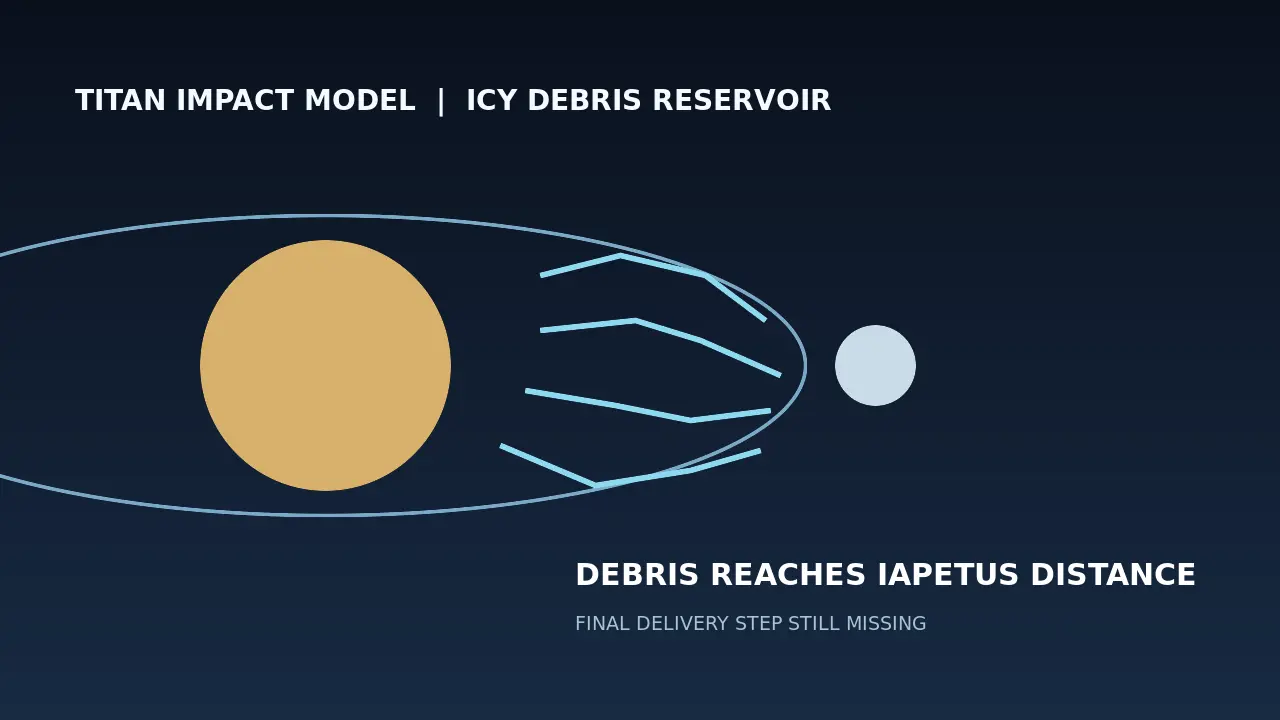
A new preprint tests whether a large early collision involving Titan could simultaneously explain ice-rich Iapetus and Titan's unusual orbital eccentricity. In one three-dimensional simulation, an unbound differentiated impactor about one-tenth Titan's mass arrives at 10 kilometers per second; a selected outgoing population totaling about 3.5 Iapetus masses remains bound to Saturn for days, with some icy debris reaching beyond Iapetus's orbital distance.
A second case sends a bound companion one-quarter Titan's mass into a 45-degree collision at about 3.7 kilometers per second. It ejects 0.60 Iapetus masses of ice, with additional icy material retained after the rocky core returns 6.9 years later, and leaves the merged Titan with eccentricity near 0.10. These calculations establish that such impacts can make an icy reservoir and disturb Titan's orbit; they do not yet form Iapetus end to end, because the debris still needs gas drag or dynamical friction to raise its periapsis and survive.
Why it matters
A single dynamical event that links a moon's composition with another moon's orbit is testable, but its missing transport step keeps a promising scenario from becoming a completed origin story.
What the source establishes
Fresh impact-and-trajectory preprint. Ice production and orbital excitation are simulation results; impactor choice, debris survival, and final Iapetus assembly remain uncertain.
Published by Aliens in the Clouds. These AI-assisted summaries link to their sources and distinguish reported claims from established findings. Skinny Ed is a fictional mascot; High Thoughts are comedy. Send a correction with its source.