Anomaly Screening
A new test pulls structure from noisy planet-forming disks
Structure functions recover correlation scales and directional patterns in velocity residuals that otherwise look disordered.
Briefed November 7, 2026 · Aliens in the Clouds
Accepted Study · Method Demonstration
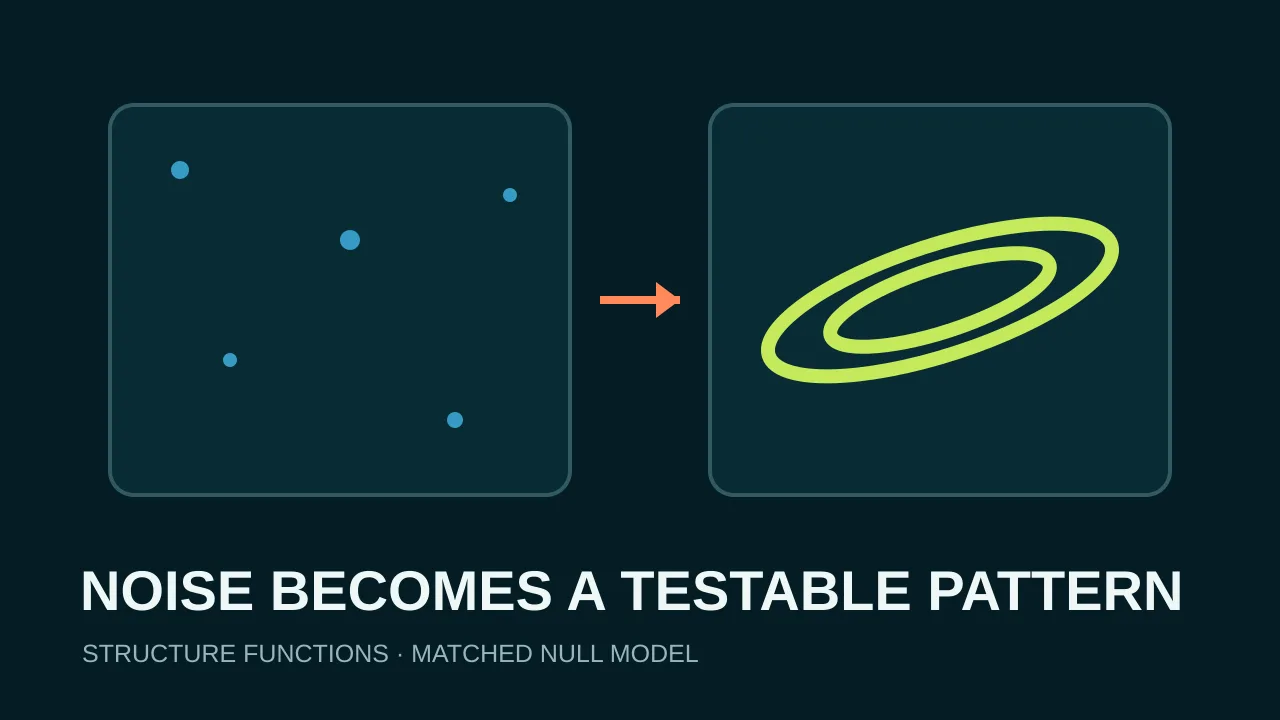
Richard Teague and colleagues adapt second-order structure functions to characterize non-Keplerian velocity residuals in protoplanetary disks. Their workflow measures correlation length, radial scaling, and anisotropy, then compares those quantities against matched null models so noise is less likely to masquerade as organized motion.
Tests on degraded simulations recover and distinguish gravitational, magneto-rotational, and vertical-shear instabilities, although the last two become harder to separate at observational quality. Applied to carbon-monoxide data from TW Hya, the method finds azimuthally elongated structure that remains after a large one-armed component is removed. That pattern is characterized, not uniquely assigned to one physical cause.
Why it matters
Small velocity anomalies are often cited as evidence for hidden planets or disk instabilities. A quantitative null-tested method helps decide whether a pattern is real before anyone argues about what made it.
What the source establishes
Accepted in The Astrophysical Journal and submitted November 5. The framework succeeds on controlled simulations and one real dataset; broad performance across diverse disks and observing geometries remains to be demonstrated.
Published by Aliens in the Clouds. These AI-assisted summaries link to their sources and distinguish reported claims from established findings. Skinny Ed is a fictional mascot; High Thoughts are comedy. Send a correction with its source.