Solar System Dynamics
A dying Sun may scramble the giant planets sooner than smooth models predict
Discrete, asymmetric mass ejections turn the outer planets' future into a random walk and sharply shorten modeled stability.
Briefed September 15, 2026 · Aliens in the Clouds
Accepted Manuscript · Far-Future Model
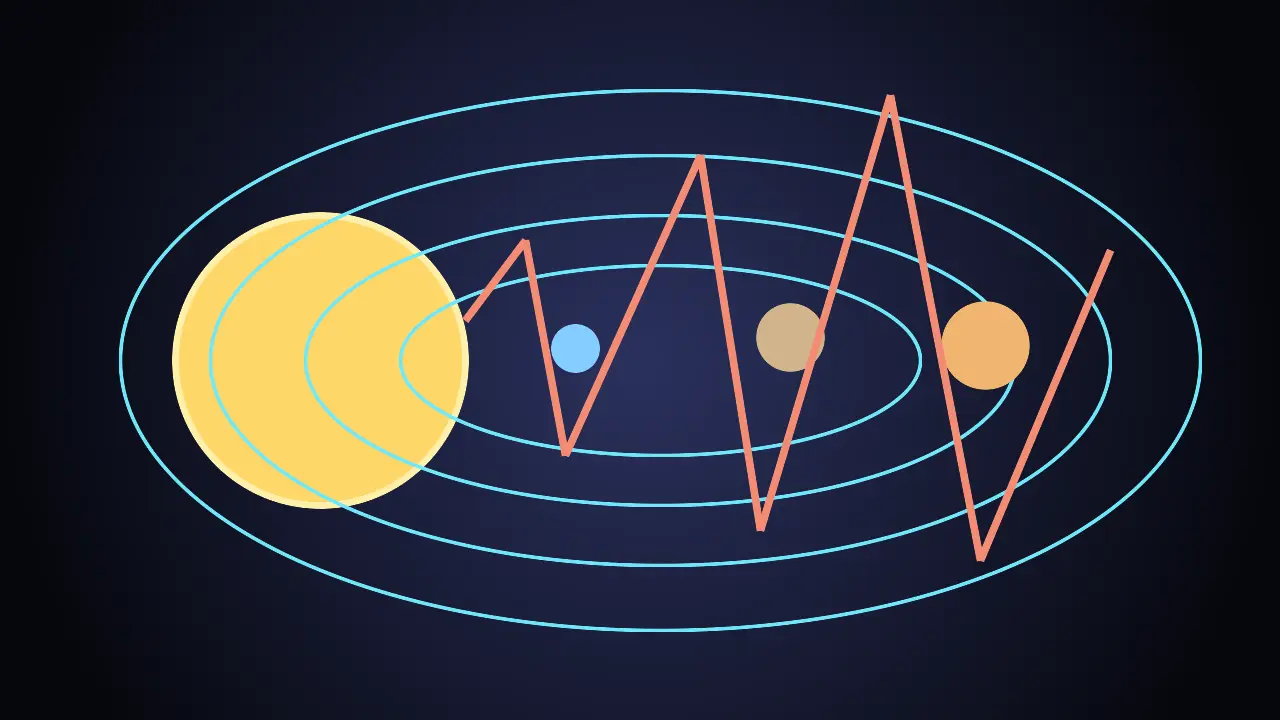
Konstantin Batygin, Jim Fuller, and Fred Adams revisited the outer solar system's far-future stability by replacing the usual assumption of smooth solar mass loss with discrete, randomly directed ejections. The change is motivated by observed recoil velocities of white dwarfs, which can be produced when dying stars shed material asymmetrically.
In their numerical experiments, the resulting kicks make the planets' orbits random-walk as the Sun crosses the red-giant and white-dwarf stages. About 40 percent of modeled systems experience disruption or violent scattering before white-dwarf formation, and roughly 90 percent destabilize within three billion years afterward. Those are ensemble outcomes under allowed assumptions, not a timetable for one known future event—and the relevant epoch is billions of years away.
Why it matters
The study shows how a small change in the physics of stellar mass loss can dominate a stability forecast that once looked almost permanent.
What the source establishes
Accepted Astrophysical Journal Letters manuscript listed September 14. The percentages come from numerical ensembles and permitted white-dwarf kick scales; they do not predict which planet will move or when.
Published by Aliens in the Clouds. These AI-assisted summaries link to their sources and distinguish reported claims from established findings. Skinny Ed is a fictional mascot; High Thoughts are comedy. Send a correction with its source.