Planetary Exploration
A laser scout could read three worlds without landing
Today's SETI Live examines a NASA Innovative Advanced Concepts study for mapping minerals from tens of kilometers away during one multi-destination mission.
Briefed November 5, 2026 · Aliens in the Clouds
Current Event · NASA-Funded Concept Study
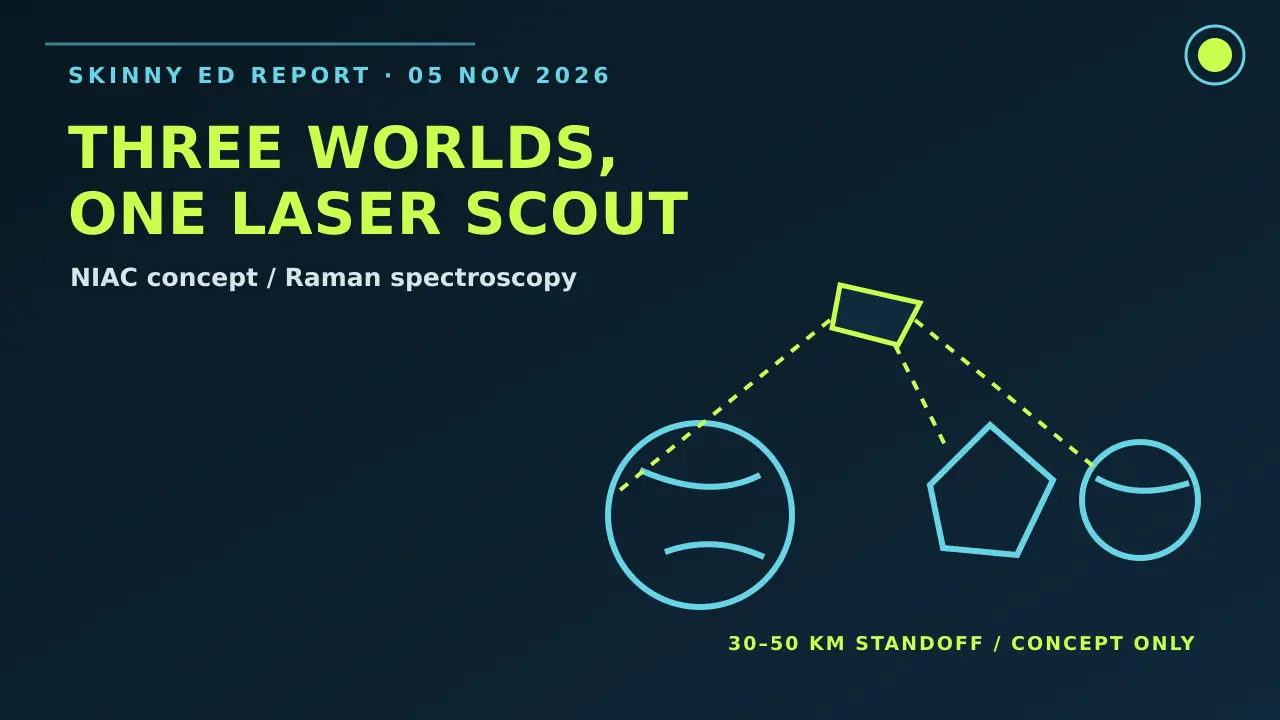
The SETI Institute scheduled a November 5 conversation with planetary scientist Pablo Sobron about Interworld Slingshot Resource Surveys, a NASA Innovative Advanced Concepts Phase I study. The reference mission would use active Raman spectroscopy from orbit or fast flybys to identify ice and ilmenite at the Moon, metals and organics at a near-Earth asteroid, and volatile-bearing minerals at Phobos or Deimos.
Planetary Raman instruments have so far worked from meter-scale distances on rovers. The study asks whether a pulsed laser, time-gated photon detector, beam steering, and a roughly 300-kilogram solar-electric spacecraft could collect useful molecular fingerprints from 30 to 50 kilometers away. The broadcast explains a feasibility study, not approved flight hardware or a scheduled mission.
Why it matters
If the physics and pointing close, one instrument could add molecular specificity to rapid reconnaissance at several destinations—useful for science, landing-site decisions, and resource planning without the cost of multiple landers.
What the source establishes
The SETI Institute event is current and the NASA NIAC Phase I study is real. The architecture remains an early concept whose signal-to-noise, pointing stability, power, trajectory, and mass budget are being evaluated.
Published by Aliens in the Clouds. These AI-assisted summaries link to their sources and distinguish reported claims from established findings. Skinny Ed is a fictional mascot; High Thoughts are comedy. Send a correction with its source.