Direct Exoplanet Imaging
JWST survey directly images a young giant planet and its debris disk
A second epoch shows RX J0534 b moving with its red-dwarf host, while models place the unusually faint world near 2.8 Jupiter masses.
Briefed September 18, 2026 · Aliens in the Clouds
Accepted Manuscript · Planet Confirmed by Common Motion
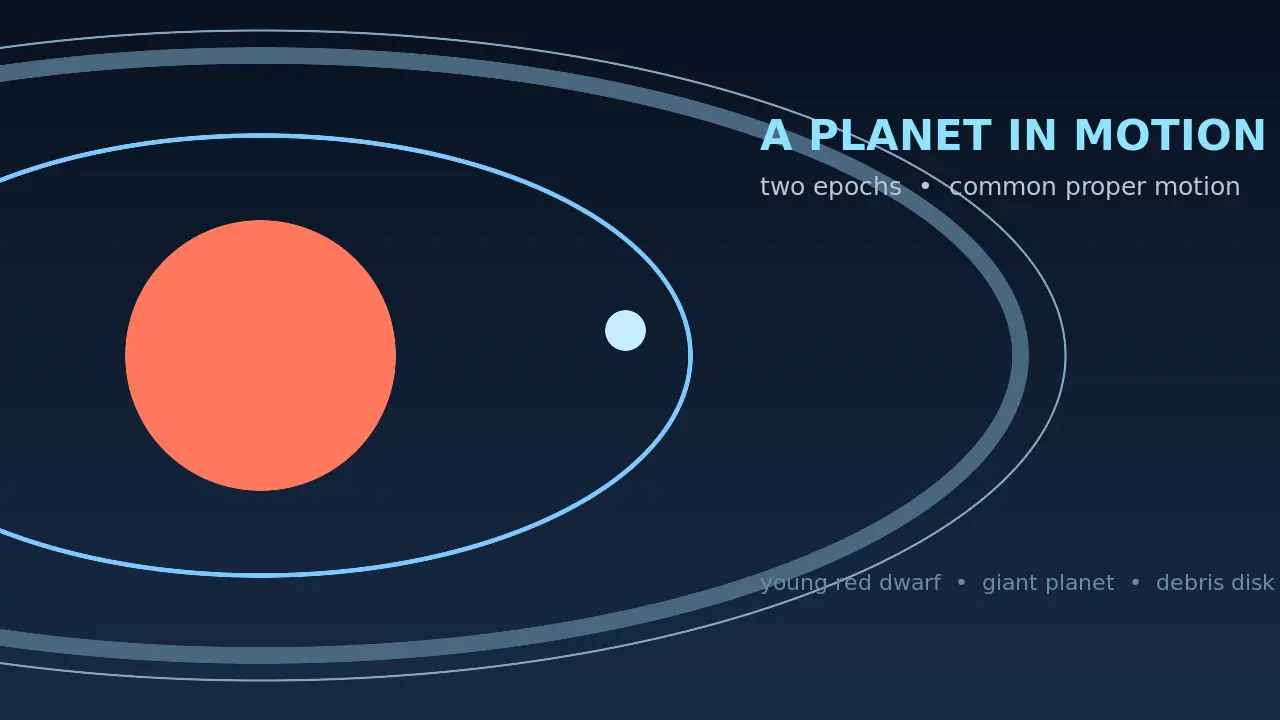
JWST/NIRCam found a point source beside the young M dwarf RX J0534.0-0221 at a projected separation of about 14 astronomical units. A follow-up observation with the Large Binocular Telescope redetected the source 16 months later and supports common proper motion over a chance background alignment at the six-to-seven-sigma level.
Hot-start evolutionary models, using the system's estimated age of 18 to 26 million years, give the planet a mass of about 2.8 plus or minus 0.5 Jupiter masses and a temperature near 674 kelvin. JWST also resolves a debris disk with peak density near 79 astronomical units. The accepted paper describes RX J0534 b as one of the lowest-mass planets directly imaged to date; its modeled mass and atmospheric chemistry remain dependent on age and model assumptions.
Why it matters
Directly imaged planets around low-mass stars are rare, and this system offers both a young atmosphere and a debris environment that can test how giant planets form around red dwarfs.
What the source establishes
Accepted ApJ Letters manuscript with two-epoch imaging and statistically reported common proper motion. The companion is strongly supported as a planet, while its mass, temperature, and atmospheric composition are model-derived.
Published by Aliens in the Clouds. These AI-assisted summaries link to their sources and distinguish reported claims from established findings. Skinny Ed is a fictional mascot; High Thoughts are comedy. Send a correction with its source.