Planetary Survival
Worth Revisiting: three planets survived where models say they shouldn't
Asteroseismology places three close-in planets around stars that have already expanded beyond the planets' present orbits.
Briefed November 5, 2026 · Aliens in the Clouds
Worth Revisiting · Published Study
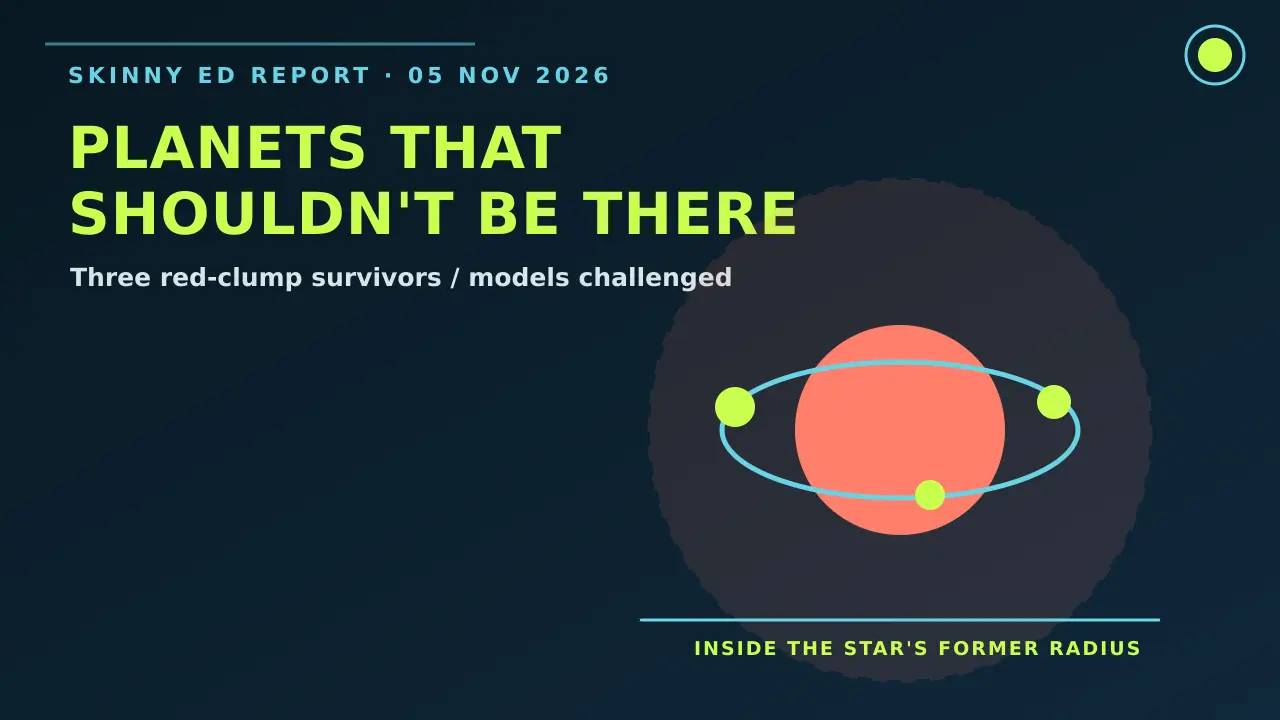
Wen-Xu Lin and colleagues use stellar oscillations to confirm that the hosts of 24 Boo b, HD 12648 b, and TYC 4282-605-1 b are red-clump giants: stars that expanded dramatically on the red-giant branch, ignited helium, and then contracted. Each planet's current orbit lies inside the host's inferred maximum earlier radius.
Standard tidal-engulfment calculations predict that planets this close to Sun-like progenitors should have been consumed. The three systems expand a puzzle previously represented by only one strong example, with 24 Boo b orbiting at just 0.183 astronomical units every 30 days. The observations establish the conflict with current models, not how the planets survived or whether their orbits changed after the giant phase.
Why it matters
An emerging population of apparently forbidden survivors could expose missing physics in tides, mass loss, orbital evolution, or the reconstruction of stellar history.
What the source establishes
Worth Revisiting. The preprint was submitted November 3 and links to a PNAS publication. The red-clump classifications and present orbits are observationally constrained; the former stellar radii and engulfment expectation depend on evolutionary models.
Published by Aliens in the Clouds. These AI-assisted summaries link to their sources and distinguish reported claims from established findings. Skinny Ed is a fictional mascot; High Thoughts are comedy. Send a correction with its source.