Planet-Formation Simulation
Tiny grains may still feed moons around PDS 70 c
Three-dimensional simulations show a planet-carved gap filtering out most solids while a persistent trickle can still build a circumplanetary disk.
Briefed September 22, 2026 · Aliens in the Clouds
Preprint · Model Result
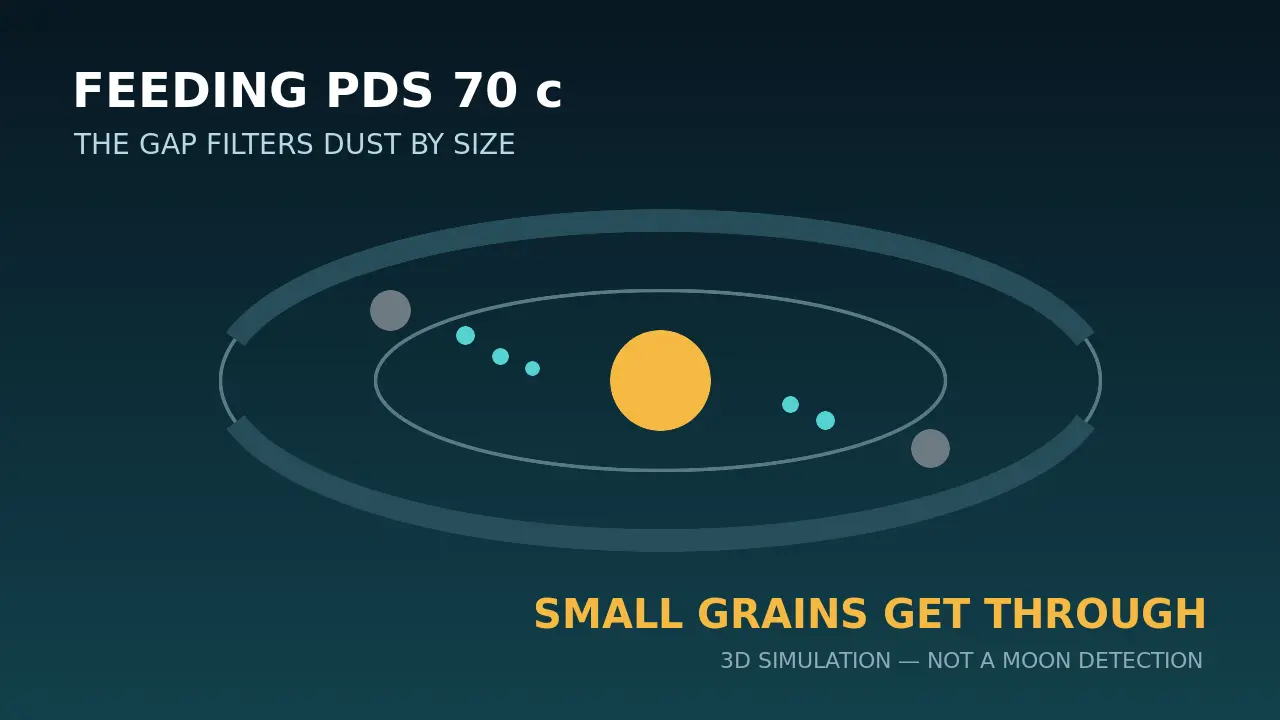
Researchers ran high-resolution three-dimensional hydrodynamic simulations of gas and multiple dust sizes moving from the PDS 70 disk toward the giant planet PDS 70 c. A pressure maximum at the edge of the planet-carved gap strongly filters incoming solids, reducing the dust-to-gas ratio of material reaching the planet by roughly two orders of magnitude relative to the outer disk.
In the simulations, grains smaller than about 61 micrometers accrete efficiently for a one-Jupiter-mass planet, while the threshold falls to about 10 micrometers for a 2.5-Jupiter-mass case. Despite that severe filtering, continuous inflow can still deliver enough solid material within a few million years to build the observed circumplanetary disk or a Galilean-like satellite system. These are model outcomes tied to assumed masses, disk conditions, and grain behavior—not direct observations of moons.
Why it matters
The work connects planet formation to the next scale down: how the raw material for large moons crosses a gap and enters a disk around a young giant planet.
What the source establishes
Fresh three-dimensional simulation preprint anchored to observed PDS 70 parameters. Dust filtration and moon-building times are modeled, not directly measured.
Published by Aliens in the Clouds. These AI-assisted summaries link to their sources and distinguish reported claims from established findings. Skinny Ed is a fictional mascot; High Thoughts are comedy. Send a correction with its source.