Accepted Young-System Study
A 16-hour eclipse cycle may reveal a tiny disk around a young companion
A decade of changing, asymmetric eclipses in Orion favors a compact circumsecondary disk, but spectroscopy is still needed to confirm the system.
Briefed September 23, 2026 · Aliens in the Clouds
Observed Eclipses · Disk Candidate
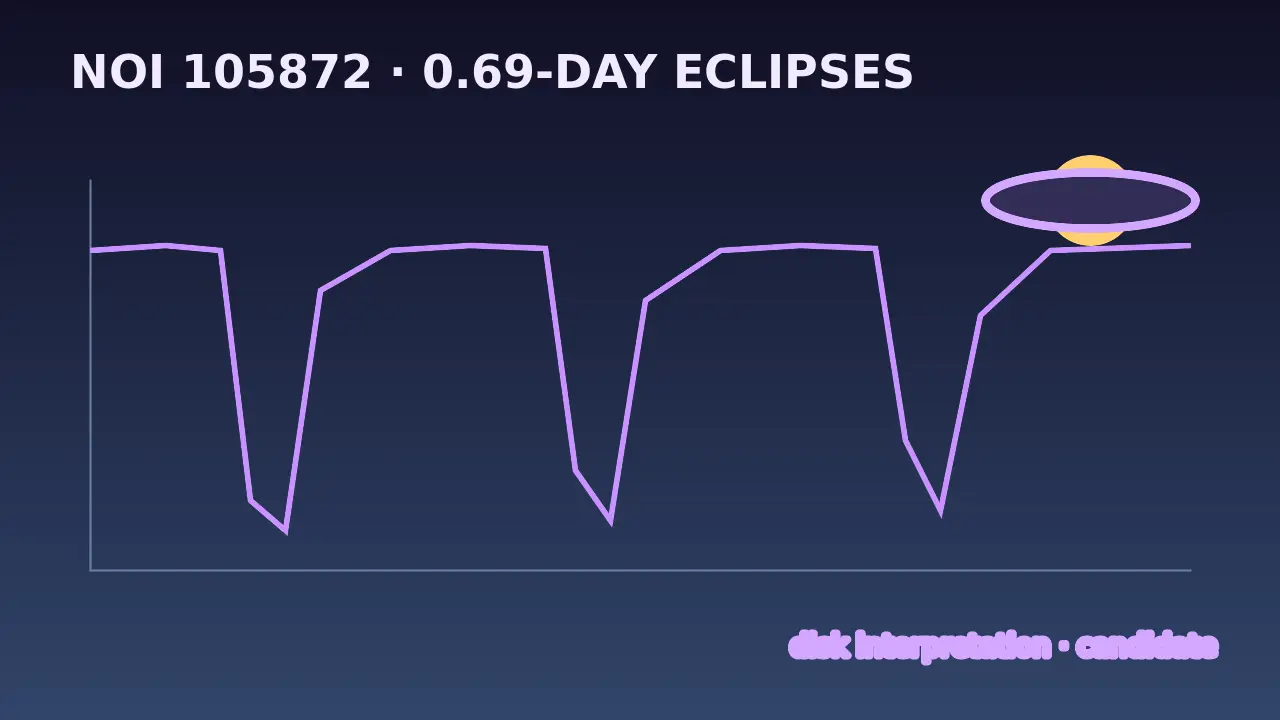
NOI 105872 is a roughly 4.1-million-year-old M-type star in the Orion Nebula Cluster. Observations from the Next Generation Transit Survey and other ground- and space-based facilities show deep, asymmetric eclipses repeating about every 0.69 days, with the eclipse shape changing across a photometric record spanning approximately ten years.
The accepted study tests several physical scenarios and favors a disk around a companion orbiting the primary star. A six-parameter model returns a disk radius near 0.005 astronomical units—about 0.98 times the primary star's radius—and Hill-radius constraints point to a very-low-mass stellar companion. The disk and companion are a preferred interpretation, not yet a direct detection; continued photometry and spectroscopy are required.
Why it matters
If confirmed, such a compact, rapidly orbiting disk would offer an unusually fast laboratory for studying companion formation, disk precession, and evolving eclipses in a young stellar system.
What the source establishes
Accepted analysis of decade-long photometry. The eclipse pattern is observed; the circumsecondary disk and companion properties come from the favored model and remain candidate-level.
Published by Aliens in the Clouds. These AI-assisted summaries link to their sources and distinguish reported claims from established findings. Skinny Ed is a fictional mascot; High Thoughts are comedy. Send a correction with its source.