JWST Atmosphere Research
JWST maps heat and rock clouds on an ultra-hot Jupiter
NGTS-10 Ab's reflected light and thermal glow point to silicate clouds that disappear across its hottest region.
Briefed September 16, 2026 · Aliens in the Clouds
Accepted Manuscript · Clouds Inferred
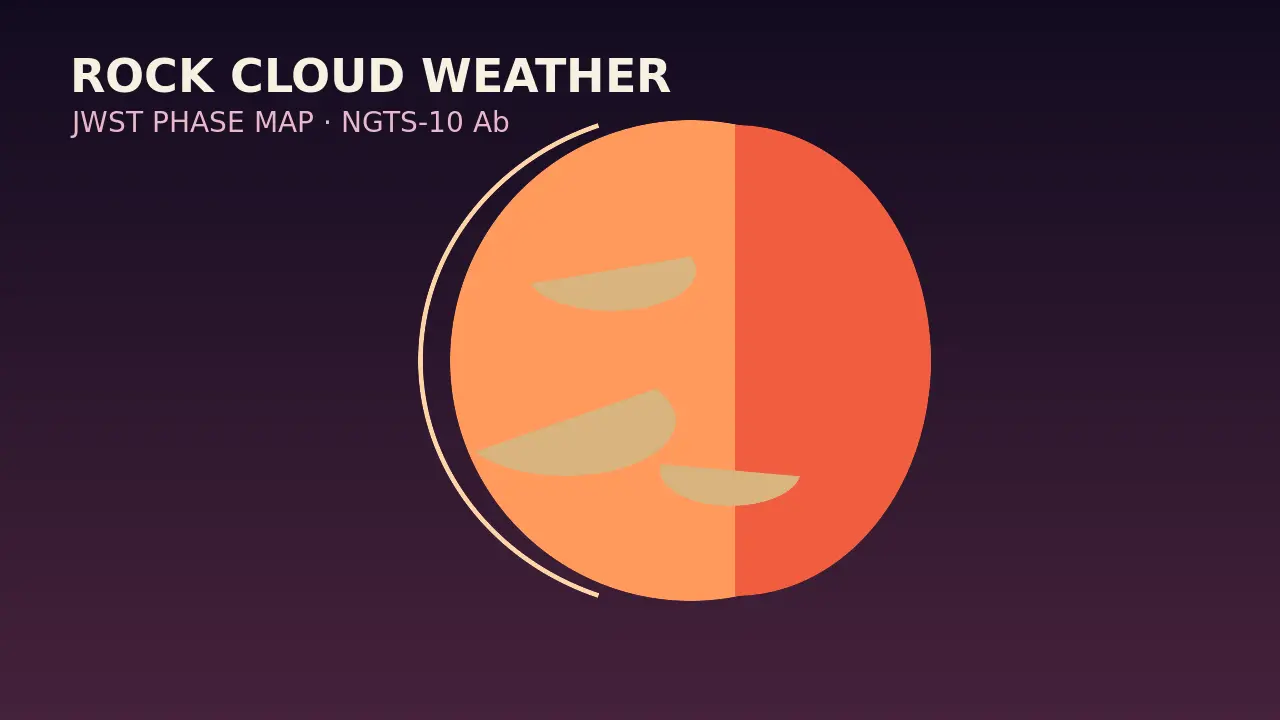
Researchers used JWST's NIRSpec instrument to build an optical-to-infrared phase curve of NGTS-10 Ab, a hot Jupiter locked with one side facing its star. By separating reflected light from thermal emission across wavelengths from 0.5 to 5.5 microns, the team produced maps of both the planet's temperature and reflectance.
The maps are anticorrelated: the brightest reflected regions are cooler, while clouds appear to evaporate across the hottest eastern portion of the dayside. Comparisons with three-dimensional circulation models favor patchy clouds made of micrometer-scale silicate particles, weak atmospheric drag, and heat transport that becomes more efficient deeper in the atmosphere. The paper is accepted by PASP; the cloud composition remains a model-based interpretation rather than a sampled material.
Why it matters
Separating light reflected by clouds from a planet's own heat turns a one-dimensional spectrum into a weather map and improves models of extreme atmospheres.
What the source establishes
Accepted manuscript based on JWST phase-curve observations and atmospheric modeling. Silicate clouds are the favored explanation, not direct collection or proof of an exotic process.
Published by Aliens in the Clouds. These AI-assisted summaries link to their sources and distinguish reported claims from established findings. Skinny Ed is a fictional mascot; High Thoughts are comedy. Send a correction with its source.