Satellite Tracking & Identification
Moonlight can keep large satellites visible after midnight
First quantitative observations of moonlit space stations show how reflected light extends optical tracking beyond the usual twilight window.
Briefed September 9, 2026 · Aliens in the Clouds
Developing Research · Known Spacecraft
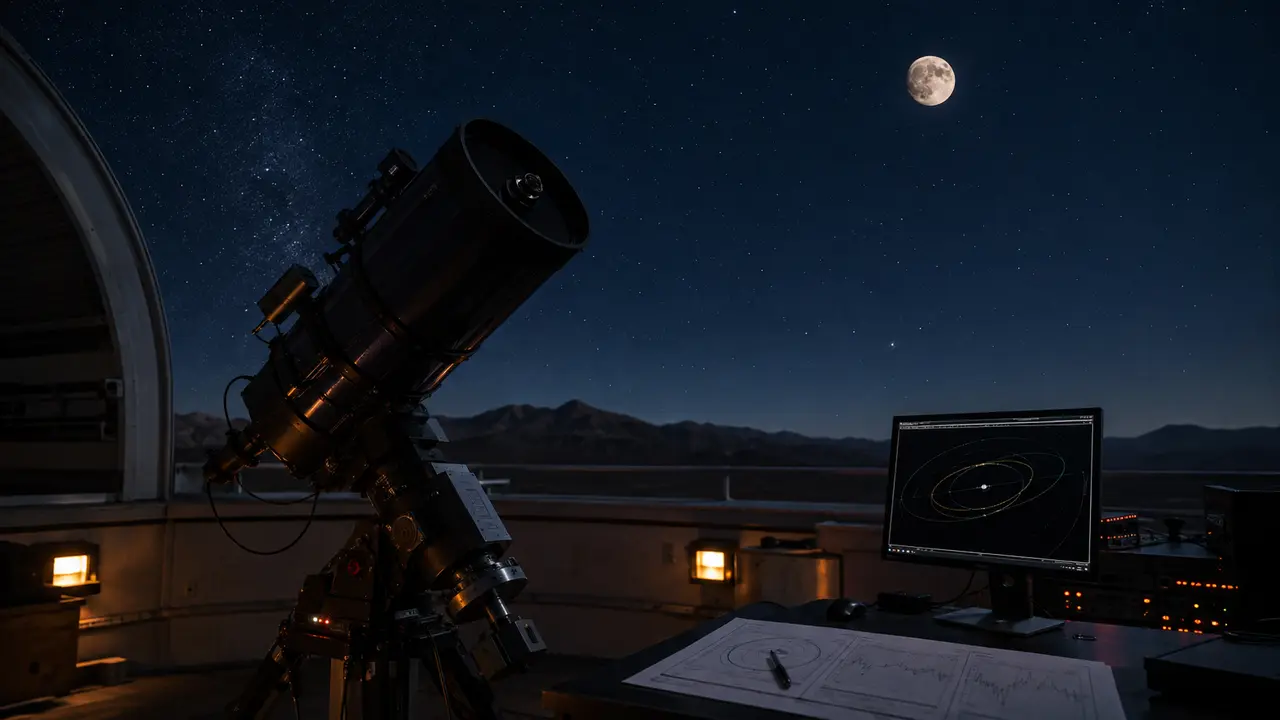
Researchers report 147 detections of the International Space Station using a 0.6-meter telescope when its illumination came only from moonlight and lunar-earthshine. The ISS had a median visual magnitude of 12.02, roughly 13 magnitudes fainter than in daylight. The team also reports observations of the Chinese Space Station and says these are the first quantitative measurements of large low-Earth-orbit spacecraft under this nighttime illumination regime.
The authors extended a satellite-brightness model to include direct moonlight and sunlight first reflected from the Moon to Earth-facing spacecraft surfaces. Their simulations indicate that lunar-earthshine can make nadir-facing components at least 100 times brighter than starlight alone. Under favorable geometry, large current and proposed spacecraft could remain within reach of modest optical tracking systems at local midnight for up to about 11 nights per lunar month; this improves attribution capability but does not make every nighttime light a satellite.
Why it matters
Satellite visibility is not limited to obvious sunlit passes. Better illumination models give investigators and space-domain-awareness teams another conventional comparison for faint, persistent nighttime observations.
What the source establishes
Verified preprint submitted to a journal. The observations concern known spacecraft under modeled illumination; they do not explain every UAP report or announce an anomalous object.
Published by Aliens in the Clouds. These AI-assisted summaries link to their sources and distinguish reported claims from established findings. Skinny Ed is a fictional mascot; High Thoughts are comedy. Send a correction with its source.