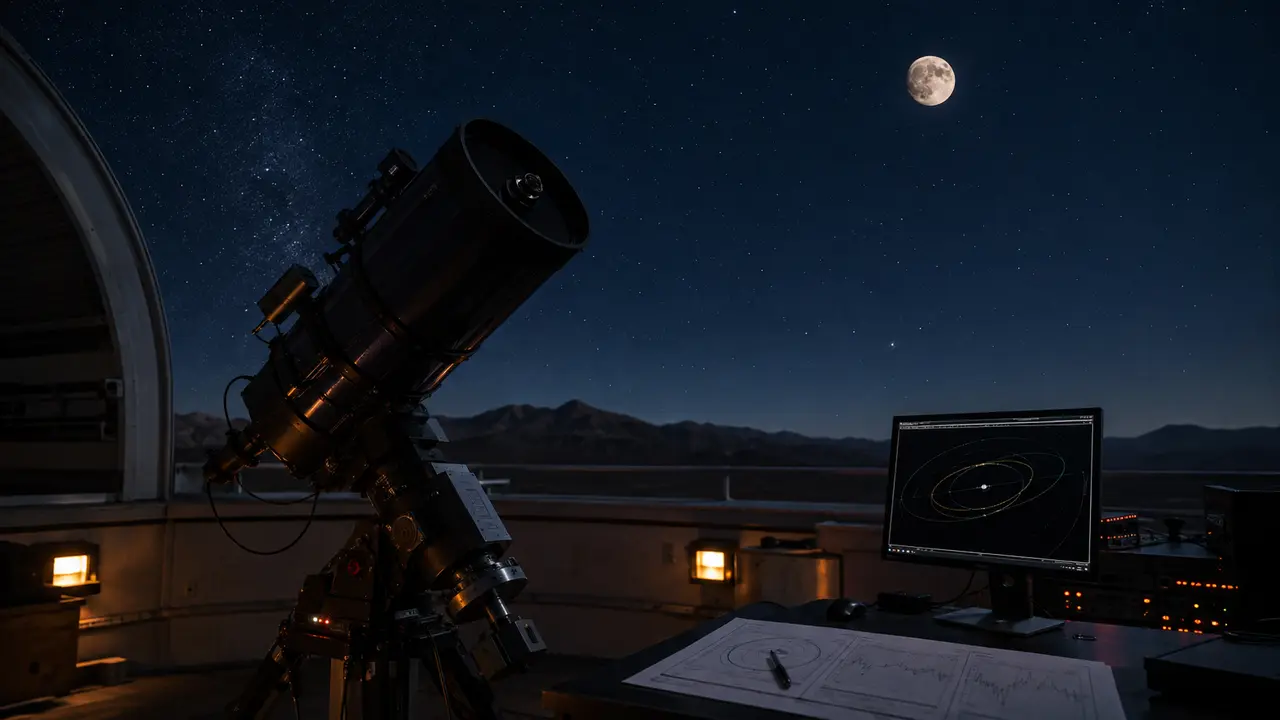
A cubic metre of Moon dust could test a new SETI idea
Researchers propose searching lunar soil for durable engineered grains—and explicitly report that none has been found.
Confirmed Proposal · No Detection · Under Review
Read the story & sourcesTHE SKINNY ED REPORT · ARCHIVED EDITION
The Moon leads Wednesday's evidence board as researchers turn a wonderfully strange SETI idea into a measurable proposal: search a cubic metre of lunar soil for microscopic engineered particles, while being explicit that none has been found. Five fresh papers reinforce the day's practical theme. Fireball speeds need independent uncertainty-bearing trajectories before an interstellar label is secure; moonlight can make large satellites trackable through the night; a new maneuver dataset gives orbital analysts better comparison material; incoming dust may seed silicate clouds on exoplanets; and sea ice could concentrate ingredients for prebiotic chemistry on ocean worlds. Six research signals, no new official UAP release, and no detected alien technology.
Researchers propose searching lunar soil for durable engineered grains—and explicitly report that none has been found.
Confirmed Proposal · No Detection · Under Review
Read the story & sources
A 19-event comparison finds useful catalog performance, a measurable speed bias, and no substitute for an independent 3D trajectory.
Developing Research · Interstellar Status Unconfirmed
Read the story & sourcesFirst quantitative observations of moonlit space stations show how reflected light extends optical tracking beyond the usual twilight window.
Developing Research · Known Spacecraft
Read the story & sources
MAD-LEO checks mission-published maneuver histories against multiple orbit sources and adds a 6,785-satellite operational comparison set.
New Dataset · Conventional Space Operations
Read the story & sources
An accepted model shows how incoming particles could make high-altitude mineral clouds visible where internal cloud chemistry alone would not.
Accepted Research · Natural Mechanism
Read the story & sources
An accepted study models how freezing, melting, and impact fragments could concentrate prebiotic ingredients at an ice-ocean boundary.
Accepted Research · Modeled Habitability
Read the story & sourcesGood morning, investigators. Today the smallest proposed clue sits inside the largest available evidence locker: lunar soil. A SETI team calculates that durable engineered grains could cross interstellar distances and accumulate in the Moon's unusually stable surface, then gives future sample-return missions a concrete test instead of announcing a discovery that did not happen. Two orbital studies sharpen the identification toolkit from opposite directions. One shows that moonlight and light bounced from Earth can keep the ISS and other large satellites optically visible long after the usual sunlit window; another publishes maneuver labels checked against several tracking sources. A fireball calibration paper reaches the same methodological conclusion at higher speed: a catalog can nominate an interstellar candidate, but only an independent three-dimensional trajectory with uncertainties can secure the classification. Beyond Earth, incoming dust may help create silicate clouds, while freezing and melting at an ocean world's ice edge may concentrate prebiotic ingredients. The board is full of plausible mechanisms and empty of confirmed extraterrestrial artifacts—which is exactly how a useful research morning should look.

ED’S HIGH THOUGHT · FICTIONAL HUMOR
Okay, hear me out… the Moon is the galaxy's couch cushion. Four billion years of cosmic dust means every civilization's tiny lost junk has slid into the same gravity crack: nanobots, one zirconium earring, enough snack crumbs to date three extinct species. Scientists will scan a cubic metre expecting a technosignature and find a screw stamped LEFT WARP NACELLE. Somewhere in Andromeda, an alien dad has been flying with the dashboard rattling for 600 million years, insisting, ‘It came like that.’
Published by Aliens in the Clouds. These AI-assisted summaries link to their sources and distinguish reported claims from established findings. Skinny Ed is a fictional mascot; High Thoughts are comedy. Send a correction with its source.