Fresh Lunar Modeling
A new map shows which lunar interior properties tides can reveal
A differential method links simplified tidal-response parameters back to layers inside the Moon and identifies the directions the data cannot resolve.
Briefed October 3, 2026 · Aliens in the Clouds
Preprint · Local Sensitivity Analysis
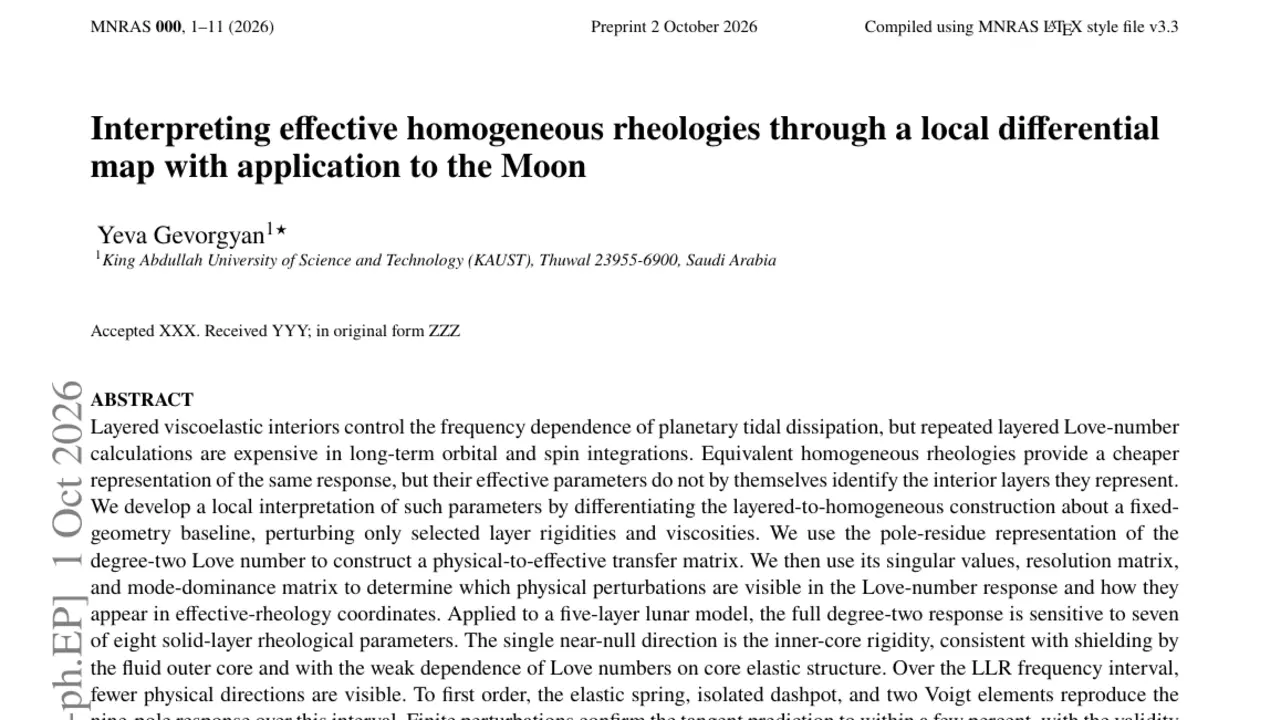
Planetary-dynamics models often replace a layered, viscoelastic interior with a cheaper homogeneous approximation, but the fitted effective parameters do not automatically identify which physical layer they represent. This study differentiates the layered-to-homogeneous transformation around a five-layer Moon model, then uses singular values and resolution diagnostics to ask which changes in layer rigidity and viscosity remain visible in the degree-two Love-number response.
Across the full modeled frequency response, seven of eight solid-layer rheological parameters were locally recoverable. Inner-core rigidity formed the near-null direction because the fluid outer core shields its elastic signature. Over the narrower lunar-laser-ranging frequency interval, fewer independent combinations remain visible, although a four-element effective model reproduces the nine-pole response to first order. The method tests local sensitivity around a fixed geometry; it is not a new direct measurement of the Moon's core.
Why it matters
Inverse problems can look more informative than they are. Explicitly showing which interior properties tidal data can and cannot distinguish keeps a compact fit from being mistaken for a unique lunar structure.
What the source establishes
Fresh mathematical and modeling preprint. Recoverability is calculated for a specific five-layer baseline and frequency range; geological interpretation remains model-dependent.
Published by Aliens in the Clouds. These AI-assisted summaries link to their sources and distinguish reported claims from established findings. Skinny Ed is a fictional mascot; High Thoughts are comedy. Send a correction with its source.