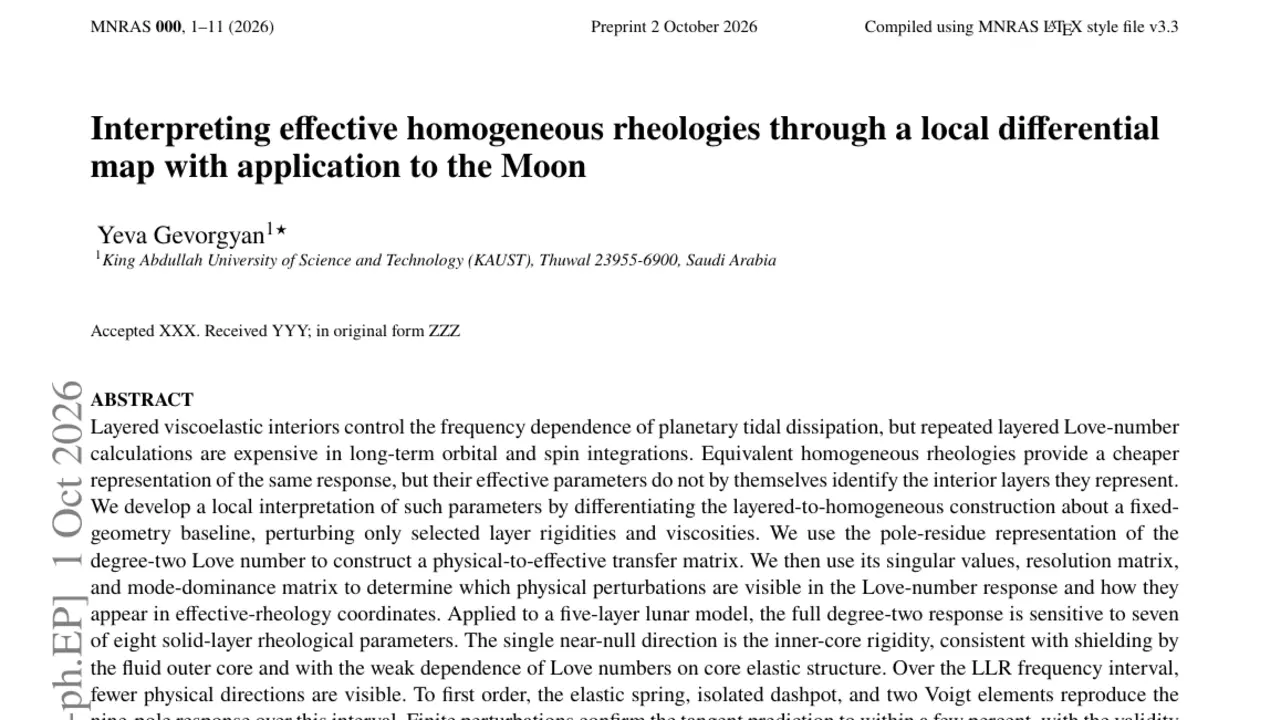
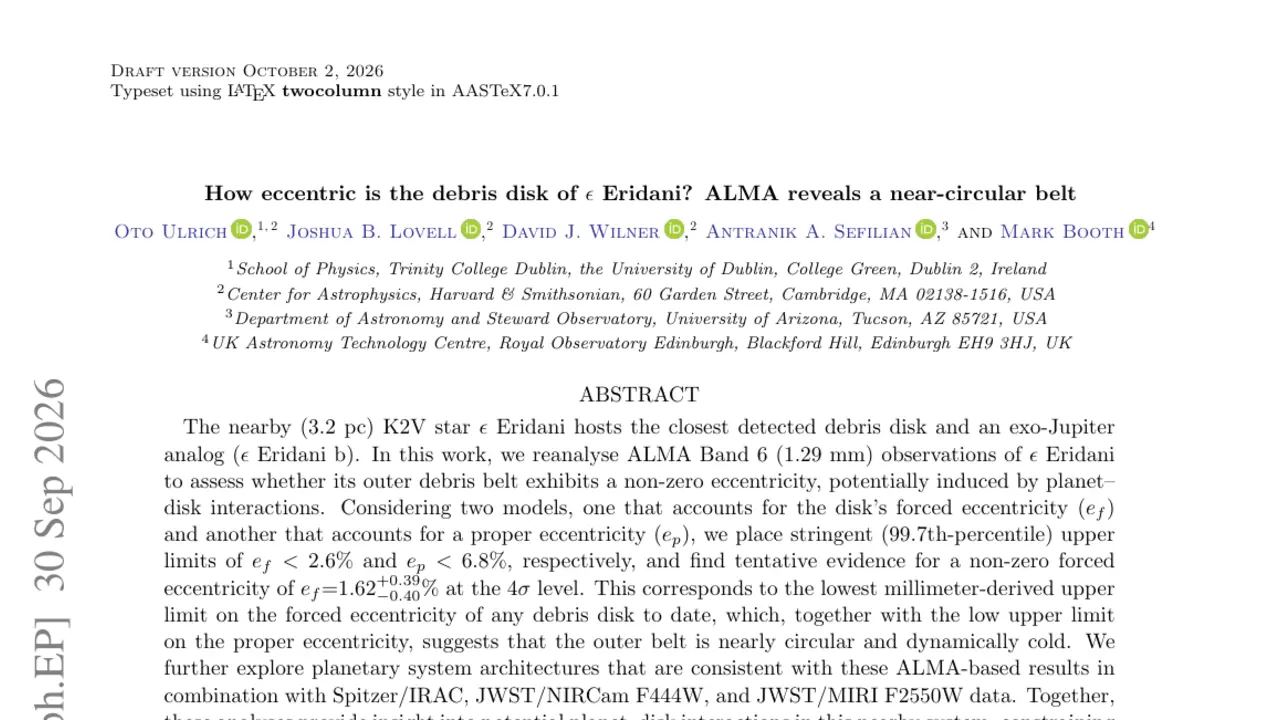
Saturday's board starts with collisions we cannot see directly but can read in their dust. Webb and Spitzer spectra divide 21 extreme debris disks into silica-rich systems consistent with violent impacts between Mars-sized bodies and silica-poor systems associated with smaller, grazing collisions. Four manuscripts posted after the previous report's cutoff then sharpen how investigators handle uncertainty: a radio-survey study explains why incomplete interferometer coverage can manufacture convincing false sources; a comet-transport model finds that mildly eccentric planets deliver more comets inward but fewer gentle, chemistry-preserving impacts; simulated asteroid penetrators can distinguish broad regolith-stiffness ranges; and a new lunar-interior method identifies which material properties can actually be recovered from tidal response. One clearly labeled Worth Revisiting analysis constrains epsilon Eridani's nearby debris belt to be almost circular. No new official UAP release, case resolution, or independently verified extraordinary evidence cleared the desk.
Fresh Peer-Reviewed Research · NASA Science · The Astrophysical Journal
An accepted VLA study finds correlated sidelobes—not just random noise—behind the excess of spurious detections in deep, high-resolution radio surveys.
A 64,000-comet simulation finds that modest orbital eccentricity increases inward transport while cutting slow impacts and modeled hydrogen-cyanide survival.
Worth Revisiting: ALMA places the tightest millimeter upper limit yet on a debris belt's forced eccentricity and narrows the room for unseen outer planets.
Good morning, investigators. Today's strongest result is a real demonstration of what remote evidence can and cannot say. Webb's mid-infrared spectra reveal mineralogical patterns in extreme debris disks, letting researchers infer two broad impact regimes without pretending they watched the collisions happen. The same discipline runs through the rest of the edition. High-resolution VLA images contain more false sources than Gaussian noise alone predicts because sparse sampling leaves correlated sidelobes; an isolated bright spot therefore needs survey-aware validation before it becomes an object. A compact-planet simulation produces a similarly counterintuitive result: modest eccentricity sends more comets toward the inner system while selectively removing the slow approaches most likely to preserve hydrogen cyanide on impact. Asteroid-penetrator simulations suggest that the first milliseconds of deceleration can narrow a rubble pile's stiffness range, though real regolith still has to validate the model. The lunar rheology paper asks which interior properties Love-number data can resolve and finds that the inner core's rigidity is largely hidden behind the fluid outer core. Finally, epsilon Eridani's millimeter belt looks dynamically cold and nearly circular, placing useful limits on any unseen outer planet without detecting one. The common thread is not mystery solved by confidence; it is mystery reduced by knowing exactly what the instrument can recover.
ED’S HIGH THOUGHT · FICTIONAL HUMOR
Whoa, dude… Webb says Mars-sized worlds keep smashing together and leaving warm dust, which means rocky planets are cosmic piñatas and moons are the candy that falls out. Earth got one Moon because Theia took one swing; Saturn has 146 because that birthday party got completely out of hand. Somewhere an alien mom is sweeping a ring system into a dustpan while yelling, ‘I told you children—no gravity assists in the house!’
Published by Aliens in the Clouds. These AI-assisted summaries link to their sources and distinguish reported claims from established findings. Skinny Ed is a fictional mascot; High Thoughts are comedy. Send a correction with its source.