Planet-Formation Modeling
Magnetic winds help dust—but only in the tightest corner
Models favor planet-building dust concentration in wind-dominated disks, yet reach streaming-instability conditions only under extreme inner-disk settings.
Briefed November 7, 2026 · Aliens in the Clouds
Accepted Study · Model Constraints
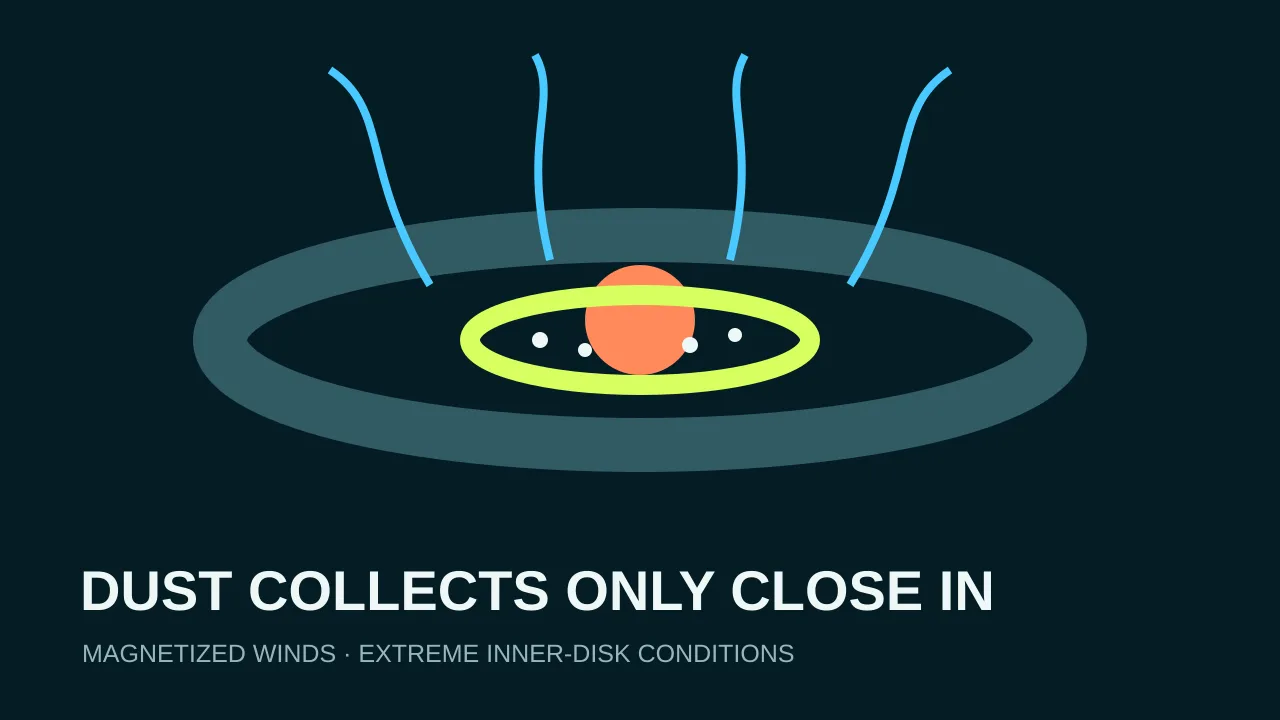
Olcay Goksu and colleagues modeled dust evolution in disks where magnetized winds carry angular momentum and remove mass. Their parameter study varies total accretion, wind-driven mass loss, and turbulence to test whether the resulting dust-to-gas ratios can trigger the streaming instability that helps assemble planetesimals.
Wind-dominated cases grow and concentrate dust more effectively than turbulence-dominated disks, but the threshold appears only within the inner few astronomical units and only when turbulence is exceptionally weak and wind mass loss rivals wind-driven accretion. Beyond that limited regime, the simplified models do not spontaneously produce the long-lived dust traps needed for efficient planetesimal formation.
Why it matters
The first solid bodies in a planetary system need a way around the meter-size growth barrier. Finding where a popular disk-wind model succeeds—and where it does not—narrows the search for that mechanism.
What the source establishes
Accepted for publication in The Astrophysical Journal and submitted November 5. These are results from a parametric model, not a direct observation of planetesimals or a universal limit on all wind-driven disks.
Published by Aliens in the Clouds. These AI-assisted summaries link to their sources and distinguish reported claims from established findings. Skinny Ed is a fictional mascot; High Thoughts are comedy. Send a correction with its source.