Exoplanet Composition
Forty red stars sharpen estimates of unseen rocky interiors
Infrared spectra measure oxygen, magnesium, silicon, and iron in M-dwarf planet hosts and imply broad—but still model-dependent—planet core fractions.
Briefed November 7, 2026 · Aliens in the Clouds
Accepted Study · Stellar Abundance Survey
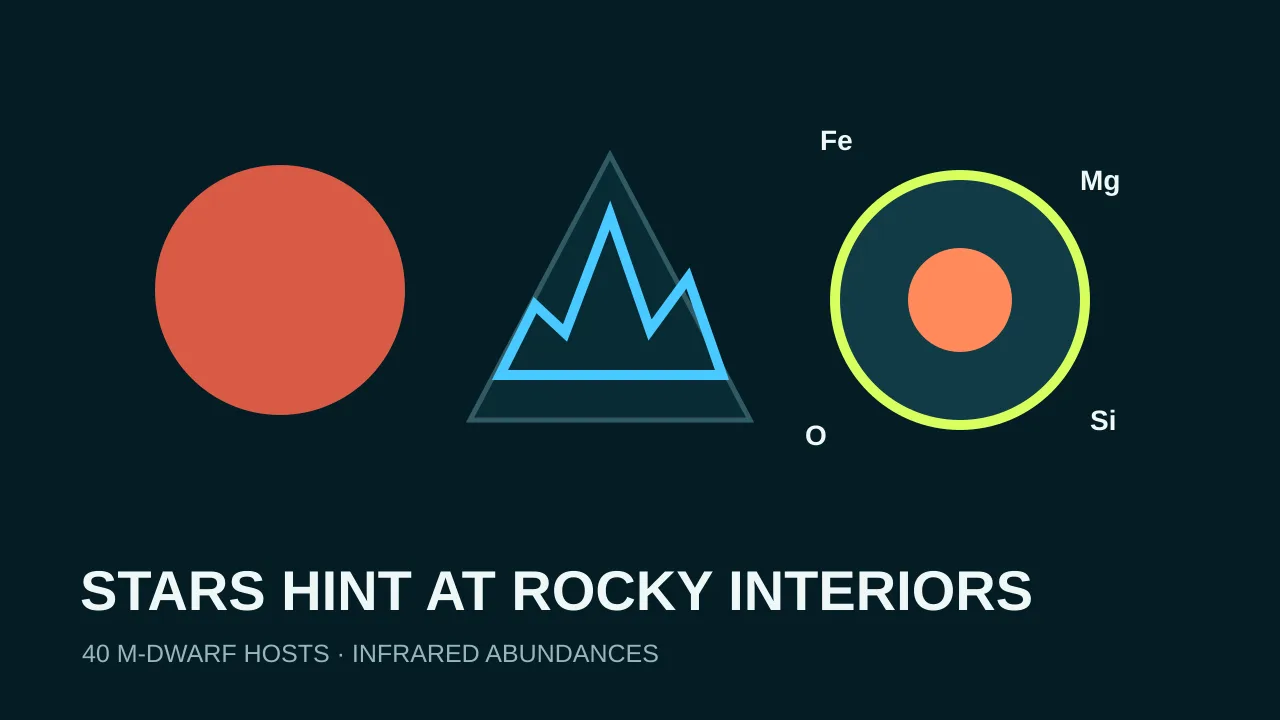
Zachary Maas and colleagues analyzed high-resolution H-band spectra of forty planet-hosting M dwarfs plus two M dwarfs in wide binaries. Molecular and atomic features observed with Gemini South, McDonald Observatory, and Keck constrain stellar temperatures and abundances of oxygen, magnesium, silicon, and iron despite the crowded spectra of these cool stars.
The abundance patterns broadly agree with earlier work and identify likely thick-disk membership for several systems. Ratios of silicon and iron to magnesium imply potential rocky-planet core-mass fractions spanning roughly twenty to forty percent. Those values describe the building inventory available around the stars; they do not measure the interiors of individual planets or prove that every system assembled planets with those exact proportions.
Why it matters
M dwarfs host many of the nearby small planets targeted for atmospheric study. Better stellar chemistry provides a firmer starting point for models of those planets' mineralogy and internal structure.
What the source establishes
Accepted for publication in The Astrophysical Journal and submitted November 4. The stellar abundances are spectroscopically derived; inferred planet core fractions depend on composition and formation assumptions.
Published by Aliens in the Clouds. These AI-assisted summaries link to their sources and distinguish reported claims from established findings. Skinny Ed is a fictional mascot; High Thoughts are comedy. Send a correction with its source.