Exoplanet Atmospheres
Ultrahot Neptune shows dayside water but no helium escape
CRIRES+ spectroscopy detects a combined molecular signal at 4.8 sigma while placing a tight upper limit on helium absorption during transit.
Briefed October 7, 2026 · Aliens in the Clouds
Accepted Study · Water Detected, Helium Not Detected
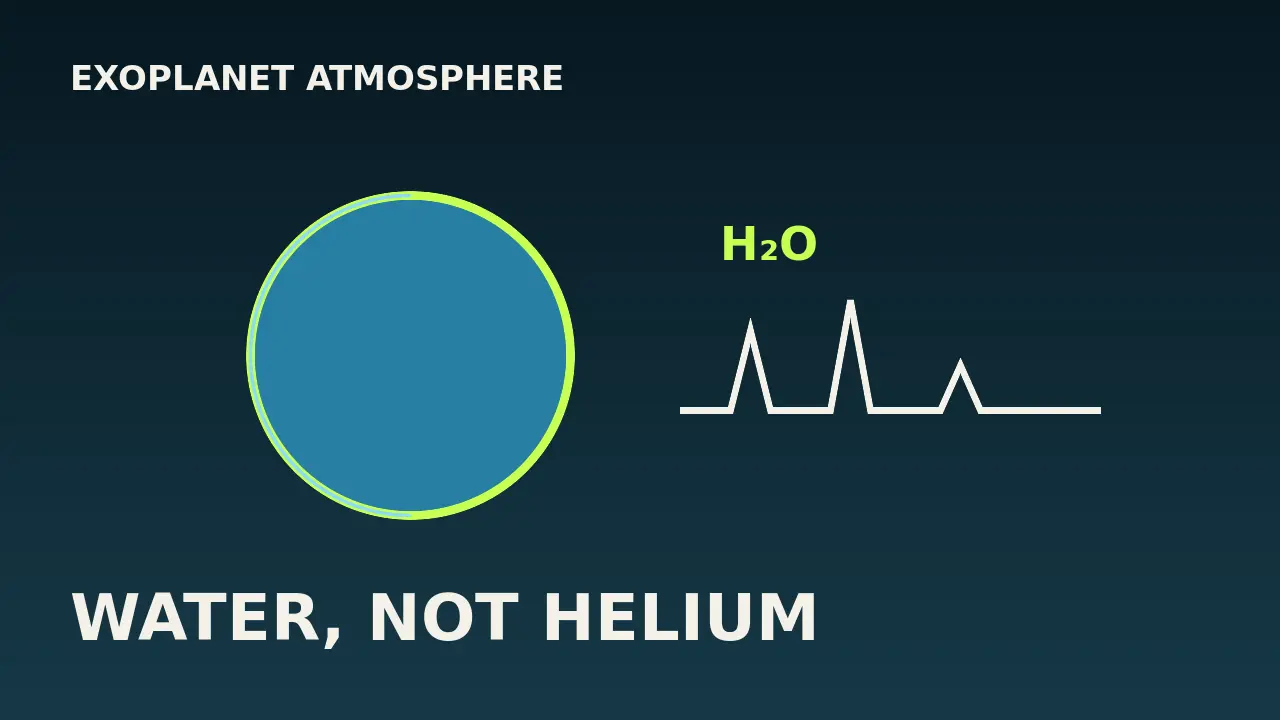
Researchers observed LTT 9779 b in transit and near secondary eclipse with the CRIRES+ high-resolution spectrograph. They found no significant absorption from metastable helium at 1,083 nanometers, limiting excess depth to below 0.45 percent at three sigma and reinforcing earlier results that suggest weak present-day atmospheric escape.
On the dayside, cross-correlation analysis detects water absorption and a tentative carbon-monoxide feature, with the combined molecular signal reaching 4.8 sigma. A joint retrieval with existing Webb data favors a low water abundance and leaves carbon monoxide poorly constrained. The inferred rotation is compatible with tidal locking, but its uncertainty is too large to establish the planet's spin state.
Why it matters
The result shows why detection and non-detection can belong in the same atmospheric portrait: one instrument can identify molecules while also ruling out a proposed escape tracer at useful precision.
What the source establishes
Accepted Astronomy & Astrophysics paper posted October 5. Water drives the reported combined significance; carbon monoxide and rotation remain tentative or weakly constrained. This is atmospheric chemistry, not a biosignature.
Published by Aliens in the Clouds. These AI-assisted summaries link to their sources and distinguish reported claims from established findings. Skinny Ed is a fictional mascot; High Thoughts are comedy. Send a correction with its source.