Exoplanet Validation
A Kepler false positive may hide a giant planet in a triple-star system
Updated astrometry and high-contrast imaging place the 111-day transit around a companion star—and suggest dozens of rejected Kepler candidates deserve another look.
Briefed September 16, 2026 · Aliens in the Clouds
Accepted Manuscript · Planet Candidate
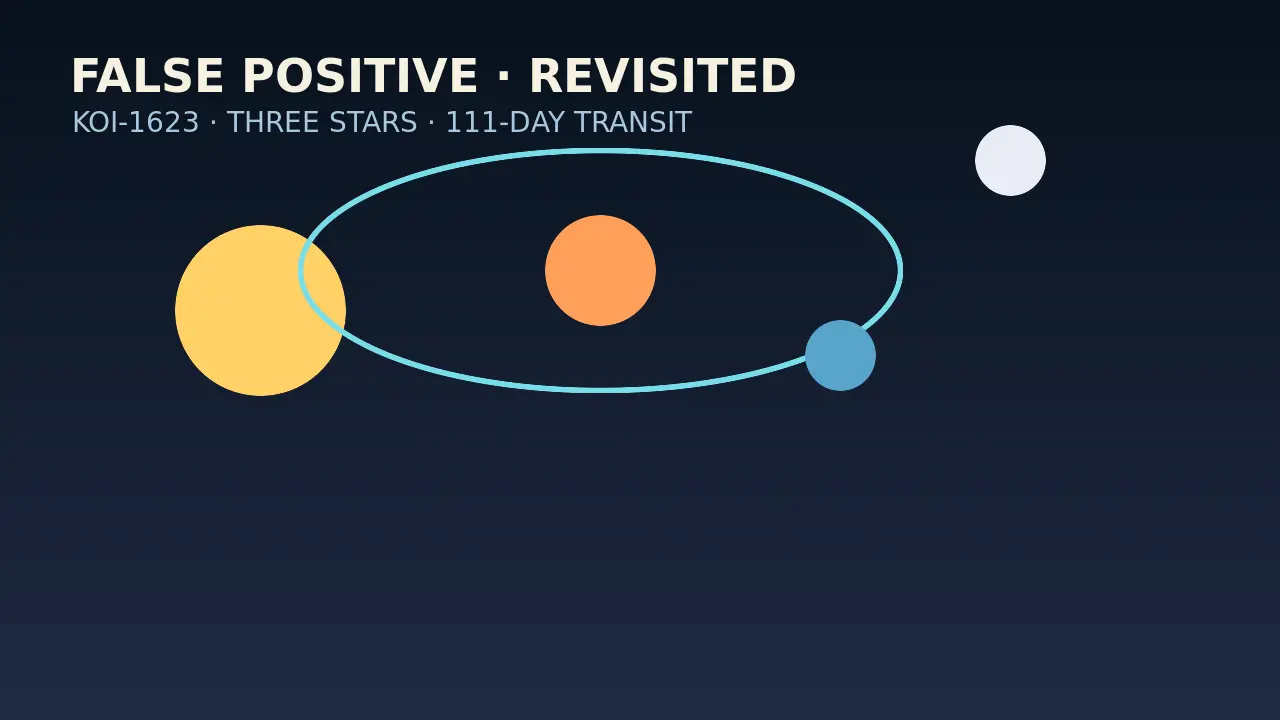
An accepted Astronomical Journal manuscript reexamines KOI-1623.01, a 111-day transit that Kepler classified as a centroid-offset false positive. Keck imaging resolves a close G-star and K-dwarf pair separated by 0.704 arcseconds, while Gaia identifies a third, more distant companion sharing the system's motion.
Combining the transit, pixel-level Kepler data, direct imaging, and Gaia astrometry, the researchers find that the signal is consistent with a planet about 10 Earth radii across orbiting in the K-dwarf's habitable zone. Their wider review estimates that roughly 70 of 515 Kepler centroid false positives may instead be planets in unresolved binary systems. This candidate is a gas giant; its location in a habitable zone does not make the planet itself Earth-like or inhabited.
Why it matters
Correcting blended-star mistakes could recover real worlds and repair biases in the planet populations inferred from Kepler's rejected candidates.
What the source establishes
Accepted manuscript and multi-instrument candidate analysis. KOI-1623.01 is consistent with a giant planet, not yet an independently confirmed habitable world or a life detection.
Published by Aliens in the Clouds. These AI-assisted summaries link to their sources and distinguish reported claims from established findings. Skinny Ed is a fictional mascot; High Thoughts are comedy. Send a correction with its source.