Accepted JWST Data Method
JWST detector reads can uncover moving objects hidden in the archive
An accepted method shortens trails inside individual NIRCam exposures and improves sensitivity by roughly 1.1 to 1.4 magnitudes in typical ecliptic data.
Briefed September 24, 2026 · Aliens in the Clouds
Validated Technique · Archive Search Enabled
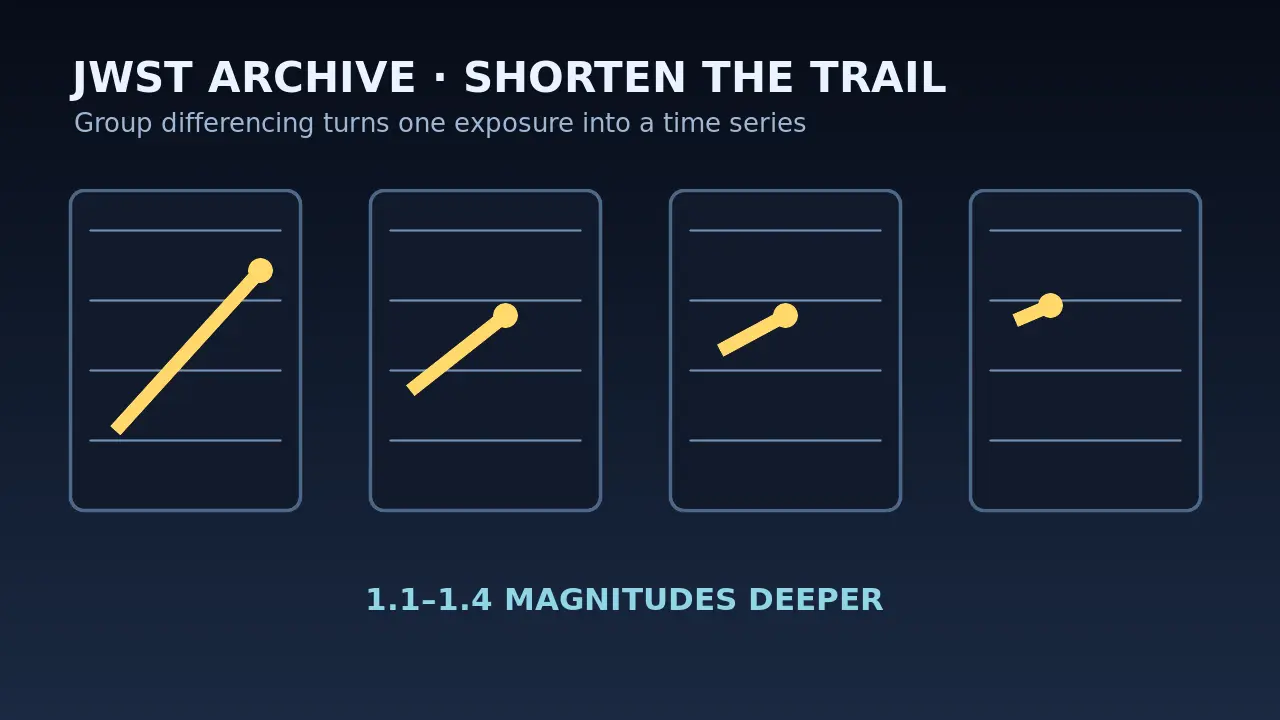
A standard JWST image fits one slope through a sequence of cumulative detector reads, which can smear a moving asteroid into a faint trail. Researchers instead subtract adjacent reads to create a calibrated, higher-cadence sequence from each exposure, then fit along a possible trajectory so the object's light adds coherently rather than spreading across the full integration.
The team validated the method on 13 moving objects already present in archival NIRCam images and tested completeness by injecting synthetic sources. For common four- or six-group ecliptic exposures, simulations give sensitivity gains of about 1.1 to 1.4 magnitudes over standard products. The accepted technique finds Solar System bodies incidentally captured by JWST; it is not a UAP detector or evidence that any object moves anomalously.
Why it matters
Thousands of existing exposures can become a deeper Solar System survey without new telescope time, improving the census of small, faint bodies that ordinary reductions miss.
What the source establishes
Accepted Astronomical Journal method validated on 13 real moving objects plus injection-recovery tests. Sensitivity gains depend on exposure structure and trail length.
Published by Aliens in the Clouds. These AI-assisted summaries link to their sources and distinguish reported claims from established findings. Skinny Ed is a fictional mascot; High Thoughts are comedy. Send a correction with its source.