Planetary Defense Research
JWST pins down 2024 YR4's size, spin, and century-long safety margin
The asteroid is about 61 meters wide and turns every 19.46 minutes; February astrometry rules out an Earth or Moon impact for at least 100 years.
Briefed September 15, 2026 · Aliens in the Clouds
Accepted Manuscript · No Century-Scale Impact Risk
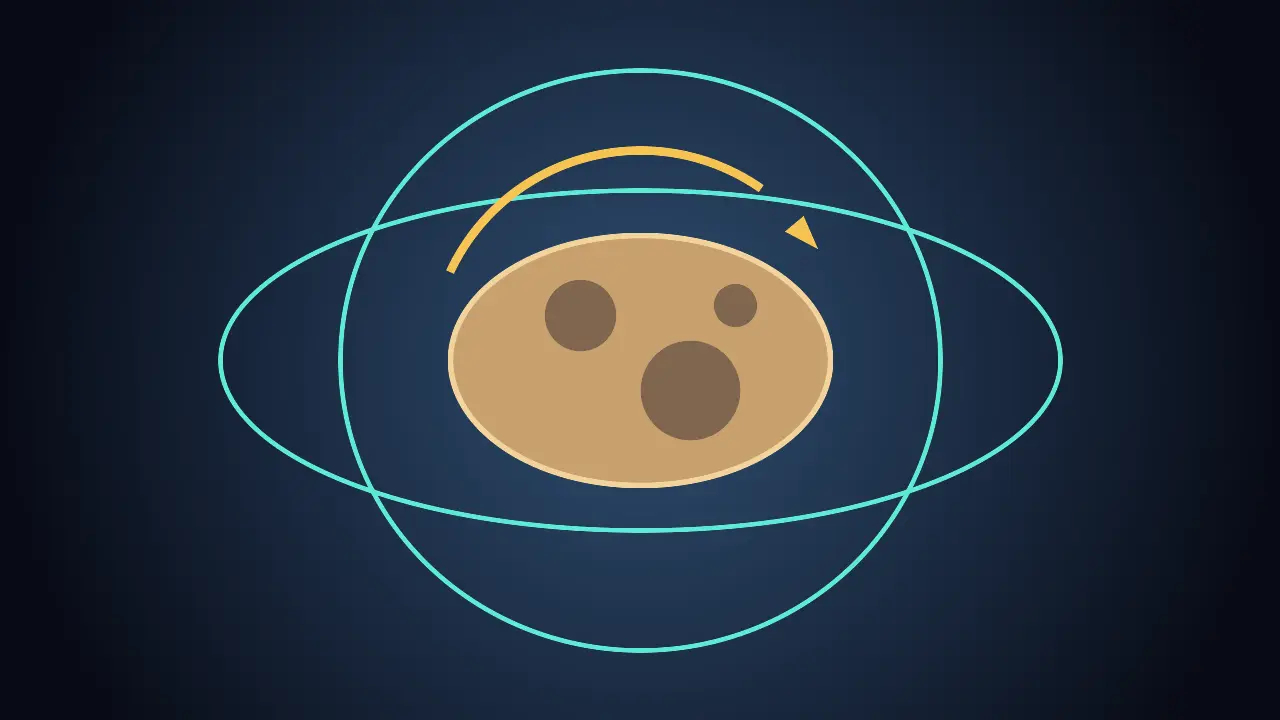
A newly listed study combines optical light curves, JWST NIRCam data, and three-band MIRI thermal measurements to characterize the near-Earth asteroid 2024 YR4. The preferred model gives an equivalent-volume diameter of about 60.8 meters, a sidereal rotation period of 19.4633 minutes, an elongated convex shape, high thermal inertia, and relatively low surface roughness.
The authors find that a standard near-Earth-asteroid thermal model requires an implausibly extreme beaming parameter, while fast-rotator and full thermophysical models agree more closely. They also expect seasonal Yarkovsky drift to dominate the asteroid's smaller day-night component and possibly become measurable during later encounters. Crucially, JWST astrometry from February 2026 rules out any Earth or Moon impact for at least the next century.
Why it matters
The work shows how better infrared data can turn an alarming probability headline into measured physical properties and a durable benchmark for future planetary-defense cases.
What the source establishes
Accepted A&A manuscript submitted September 14. Size, spin, shape, and thermal properties are modeled from calibrated observations; Earth and Moon impacts are excluded for at least 100 years.
Published by Aliens in the Clouds. These AI-assisted summaries link to their sources and distinguish reported claims from established findings. Skinny Ed is a fictional mascot; High Thoughts are comedy. Send a correction with its source.