Laboratory Ice Spectroscopy
Radiation can make deuterated water vanish from a spectrum
Laboratory ice experiments show that amorphization suppresses the 4.14-micrometer HDO band and can make an icy world's deuterium ratio look too low.
Briefed September 25, 2026 · Aliens in the Clouds
Measured Phase Effect · Planetary Bias Estimated
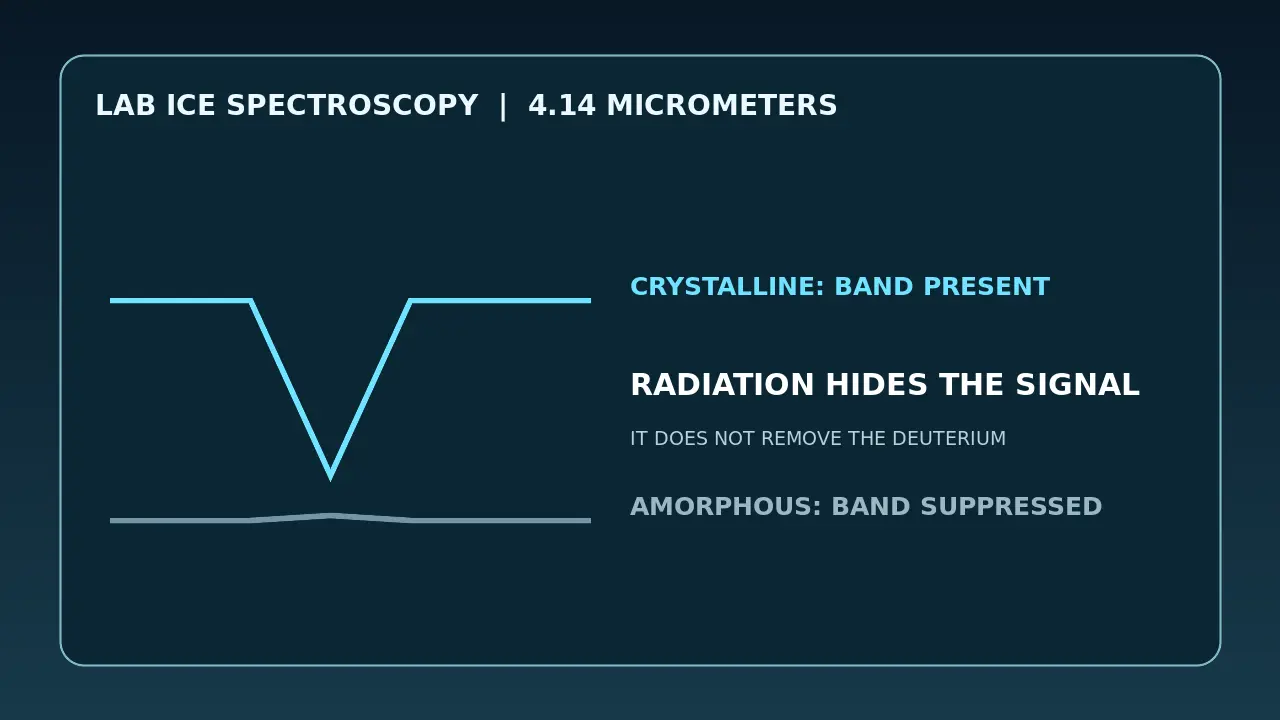
Researchers measured the 4.14-micrometer absorption band of deuterated water in laboratory ice while changing the ice phase and exposing samples to 10-kiloelectronvolt electrons as a proxy for space radiation. The HDO band remains visible when the water ice contains a crystalline component but was not detected in amorphous samples. Irradiating crystalline ice quickly erased the feature at a rate consistent with amorphization.
When the irradiated sample was warmed and recrystallized, the band returned to nearly its original depth, showing that its disappearance does not necessarily mean the deuterated water was removed. For Mimas, the team estimates a factor-of-two reduction in the remotely sensed feature over roughly 10,000 years at relevant depths. D/H estimates from mixed or amorphous surfaces could therefore be severely low unless observers independently constrain crystallinity. This is a laboratory calibration warning, not a revised D/H measurement for a particular moon.
Why it matters
Deuterium-to-hydrogen ratios are used to reconstruct where icy bodies formed; a phase-dependent hidden band can bias that history unless surface processing is included.
What the source establishes
Fresh laboratory preprint measuring crystalline, amorphous, irradiated, and recrystallized ice. The spectral effect is observed; the Mimas timescale is an environmental estimate.
Published by Aliens in the Clouds. These AI-assisted summaries link to their sources and distinguish reported claims from established findings. Skinny Ed is a fictional mascot; High Thoughts are comedy. Send a correction with its source.