Disk Reanalysis
A few degrees erase a disk spiral's apparent spin
Revised geometry makes IM Lup's previously reported Keplerian-like spiral motion consistent with no rotation within the uncertainties.
Briefed November 7, 2026 · Aliens in the Clouds
Preprint · Previous Motion Revised
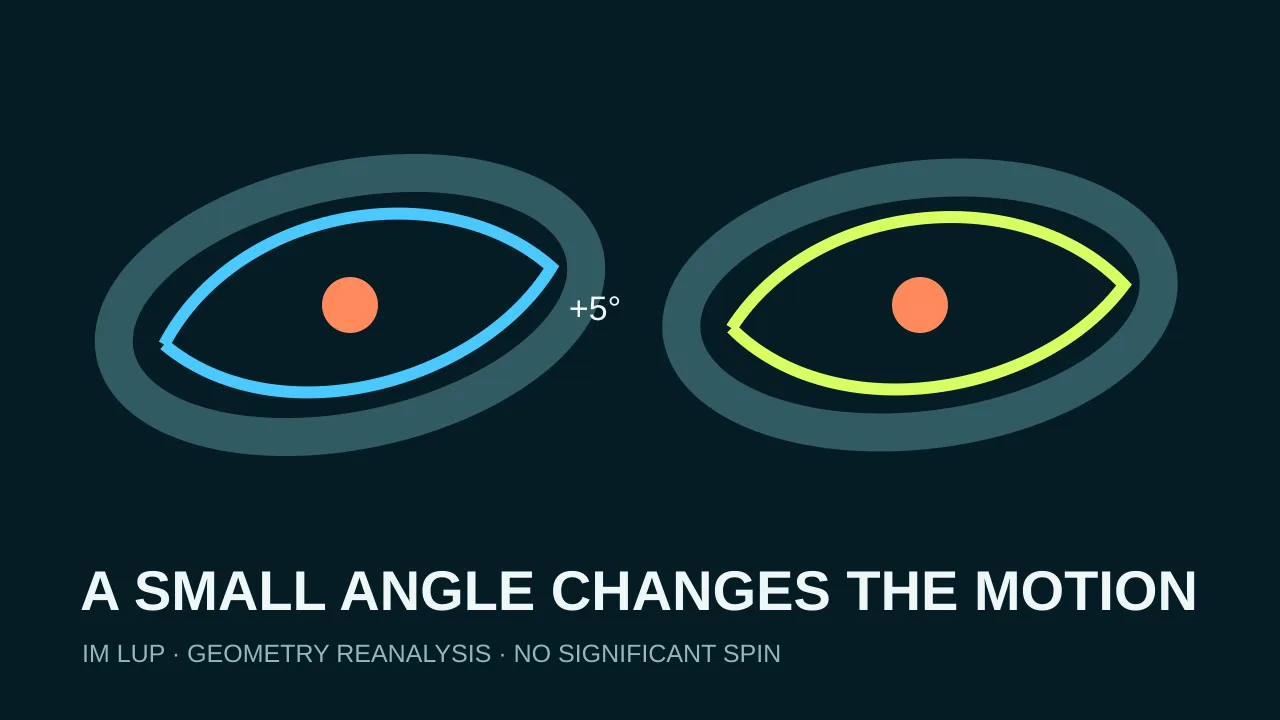
Yuto Hiraide and colleagues reanalyzed multi-epoch ALMA continuum observations of the IM Lup protoplanetary disk after newer work revised its inclination and position angle. Visibility-based fits shift the adopted geometry by only a few degrees but produce weaker residuals and more physically consistent spiral-phase profiles.
With that geometry, the two-armed spiral's pattern speed is consistent with zero rather than local Keplerian rotation. The authors argue that comparing different ALMA bands with a mismatched disk orientation created the earlier apparent motion. They also report a tentative larger one-armed feature that could reflect an embedded planet or late infall, but neither possibility is established.
Why it matters
This is a clean example of how a modest geometric assumption can manufacture apparent motion. Rechecking the coordinate frame is as important for disk spirals as it is for any claimed anomaly in the sky.
What the source establishes
Primary preprint submitted November 5 to AAS Journals. The reanalysis finds no significant rotation in the existing data; the outer one-armed feature and any embedded planet remain tentative.
Published by Aliens in the Clouds. These AI-assisted summaries link to their sources and distinguish reported claims from established findings. Skinny Ed is a fictional mascot; High Thoughts are comedy. Send a correction with its source.