Accepted Observatory Strategy
HWO planners put numbers on the cost of chasing more molecules
Eight survey strategies show how detection, orbit measurement, and atmospheric characterization trade exoEarth yield against chemical depth.
Briefed September 23, 2026 · Aliens in the Clouds
Modeled Yield · Mission Design In Progress
The Habitable Worlds Observatory's Exoplanet Survey Strategies Task Group assembled eight possible sequences for detecting candidates, measuring photometry and orbits, and characterizing atmospheres. The accepted study compares selected approaches with two mission-yield tools, AYO and EXOSIMS, while including early treatments of detector noise and thermal emission.
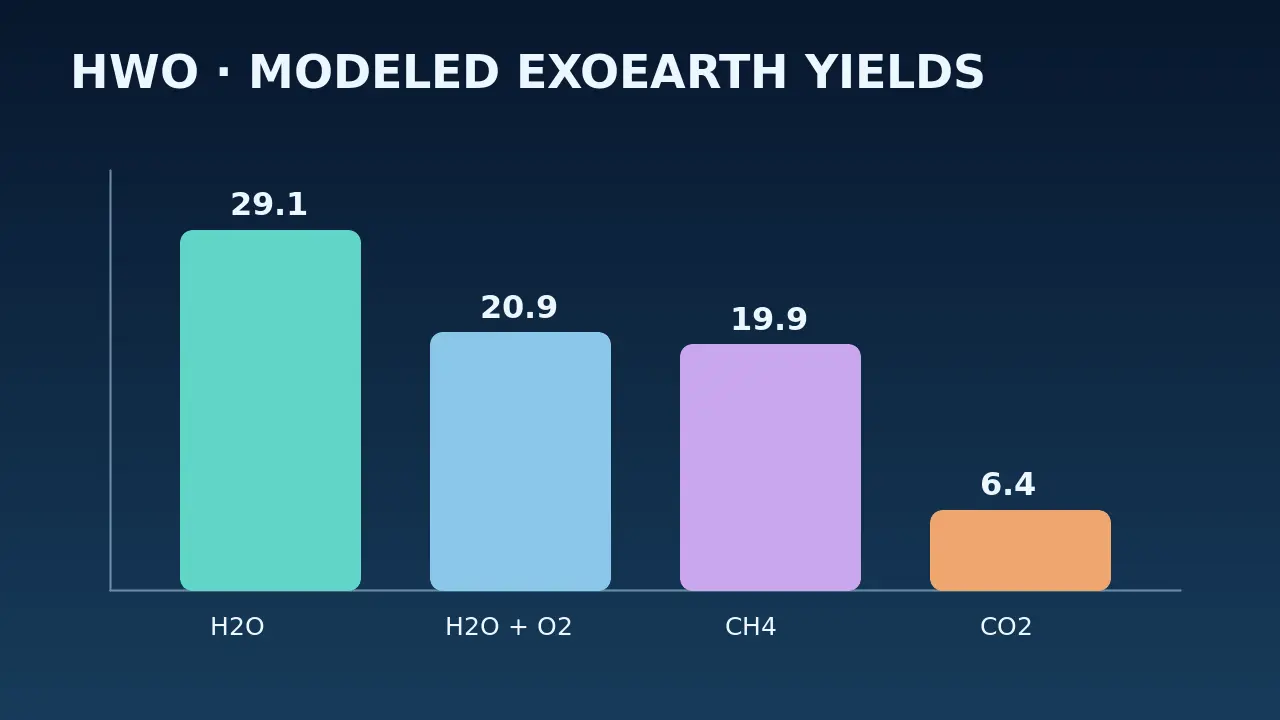
In one wavelength-optimized AYO calculation, water at 0.9 microns gives an expected yield of 29.1 exoEarth candidates. Requiring both water and oxygen lowers the modeled yield to 20.9, methane characterization to 19.9, and carbon dioxide to 6.4. These are expectation values under astrophysical and engineering assumptions—not promised planet counts, confirmed biosignatures, or a final observing plan.
Why it matters
Mission architecture determines which questions a flagship telescope can answer; stating the molecule-versus-yield tradeoffs now makes future design choices more transparent.
What the source establishes
Accepted mission-strategy study comparing eight sequences. Yield numbers are simulator expectations that will change with assumptions, hardware, target knowledge, and the final survey design.
Published by Aliens in the Clouds. These AI-assisted summaries link to their sources and distinguish reported claims from established findings. Skinny Ed is a fictional mascot; High Thoughts are comedy. Send a correction with its source.