Exoplanet Atmospheres
Worth Revisiting: Hubble watches a lava world disappear
Hubble's first rocky-planet secondary eclipse measures a 2,524-kelvin dayside while leaving rock vapor and reflected light entangled.
Briefed November 5, 2026 · Aliens in the Clouds
Worth Revisiting · Peer-Reviewed Result
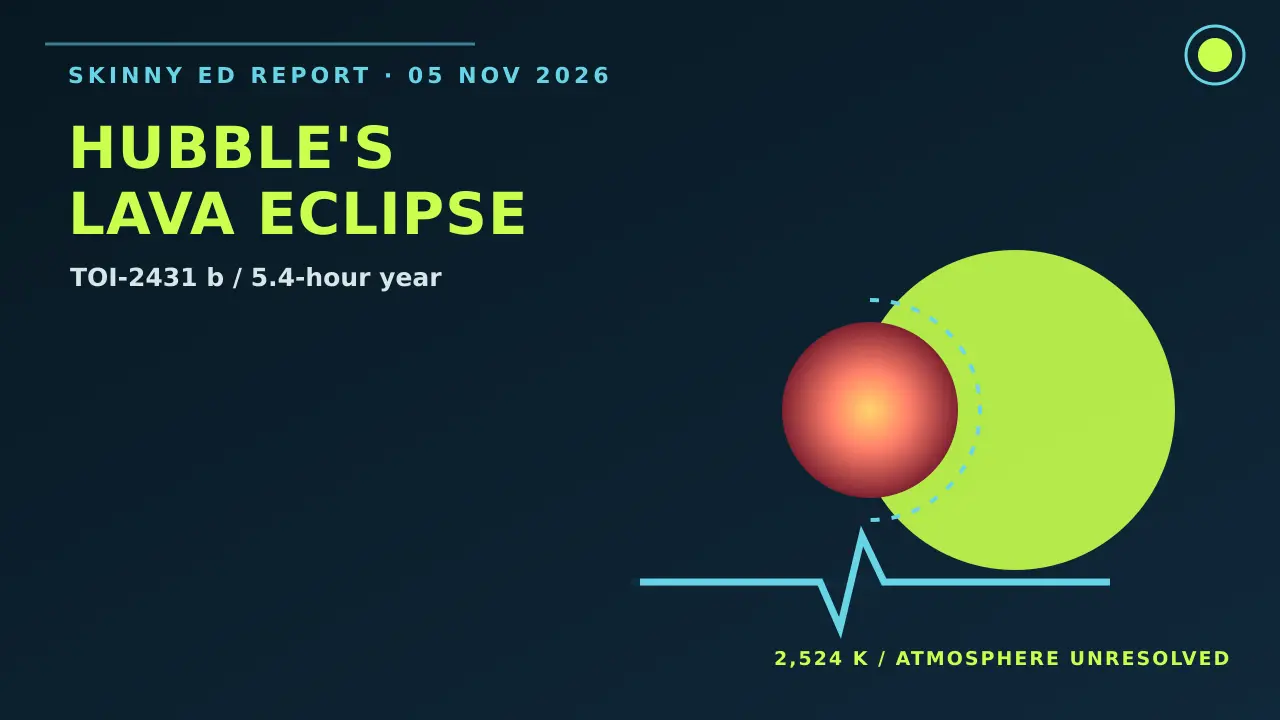
Sebastian Zieba and colleagues used Hubble's WFC3 instrument to measure the near-infrared secondary eclipse of TOI-2431 b, the moment the planet passes behind its star. Combined with TESS optical data, the signal constrains the dayside of this 1.54-Earth-radius world, which circles its star every 5.4 hours and has a measured mass of about 6.2 Earth masses.
Assuming little reflected light, the joint fit gives a brightness temperature near 2,524 kelvin and is consistent with negligible heat reaching the nightside. At Hubble and TESS wavelengths, however, reflected starlight and thermal emission remain partly degenerate, and models with or without a rock-vapor atmosphere look similar. Planned Webb observations at longer wavelengths should provide a cleaner atmospheric test.
Why it matters
Secondary eclipses let astronomers measure a planet's own light rather than only the shadow it casts. Extending that method to rocky worlds creates a direct path toward testing surfaces, heat transport, and mineral atmospheres.
What the source establishes
Worth Revisiting. The peer-reviewed result was accepted September 25 and received a new AAS Nova feature November 4. The eclipse is detected; an atmosphere is not. The quoted temperature depends on how reflected and thermal light are separated.
Published by Aliens in the Clouds. These AI-assisted summaries link to their sources and distinguish reported claims from established findings. Skinny Ed is a fictional mascot; High Thoughts are comedy. Send a correction with its source.