Debris-Disk Observation
Sauron's eye may be ringed with processed iron-sulfide dust
New polarimetric imaging and laboratory comparisons tie HR 4796's unusually bright debris ring to large, absorptive grains altered by space weathering.
Briefed September 24, 2026 · Aliens in the Clouds
Measured Polarization · Composition Interpreted
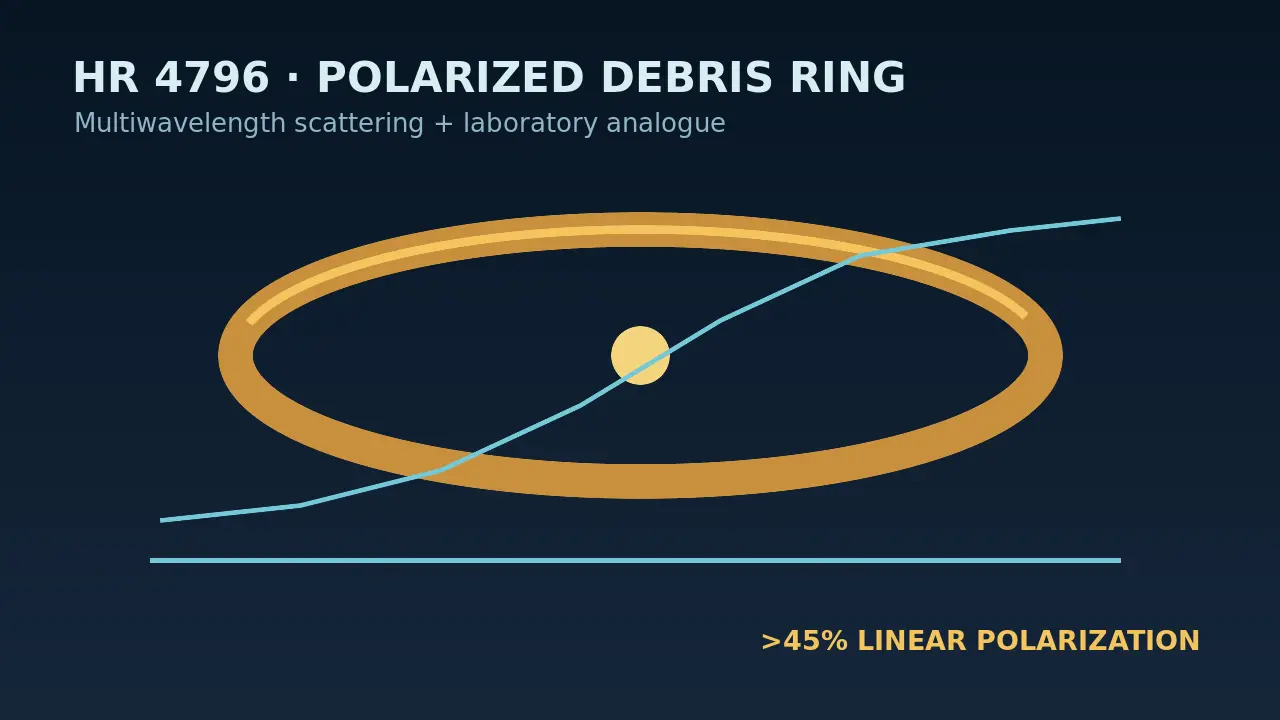
Researchers combined new SPHERE/ZIMPOL and IRDIS observations of HR 4796's narrow debris ring at 0.63, 0.79, and 1.25 micrometers. Their models recover the ring's scattering phase function and degree of linear polarization across angles from 13 to 167 degrees, including polarization above 45 percent at scattering angles below 55 degrees.
The ring shows a red reflectance slope but a blue polarization slope at 90 degrees. Among laboratory materials tested, large iron-sulfide grains provide the closest match, and the disk's polarization resembles some processed near-Earth asteroids more than Solar System comets. The authors interpret that as evidence for large absorptive particles, perhaps altered by devolatilization or melting; it is a compositional inference from light scattering, not a direct sample or sign of technology.
Why it matters
A debris ring preserves the collision and weathering history of a young planetary system, and linking telescope polarization to laboratory grains makes that history materially testable.
What the source establishes
Fresh observational preprint using multiwavelength polarimetry and laboratory analogues. The unusual scattering is measured; iron sulfide and its processing history are the best-match interpretation.
Published by Aliens in the Clouds. These AI-assisted summaries link to their sources and distinguish reported claims from established findings. Skinny Ed is a fictional mascot; High Thoughts are comedy. Send a correction with its source.