Exoplanet Formation Research
Stellar companions may help send hot Jupiters onto tilted close-in orbits
A uniform 147-system census finds companion stars unusually common and orbital misalignment nearly twice as frequent in a key separation range.
Briefed September 18, 2026 · Aliens in the Clouds
Submitted Manuscript · Population Correlation
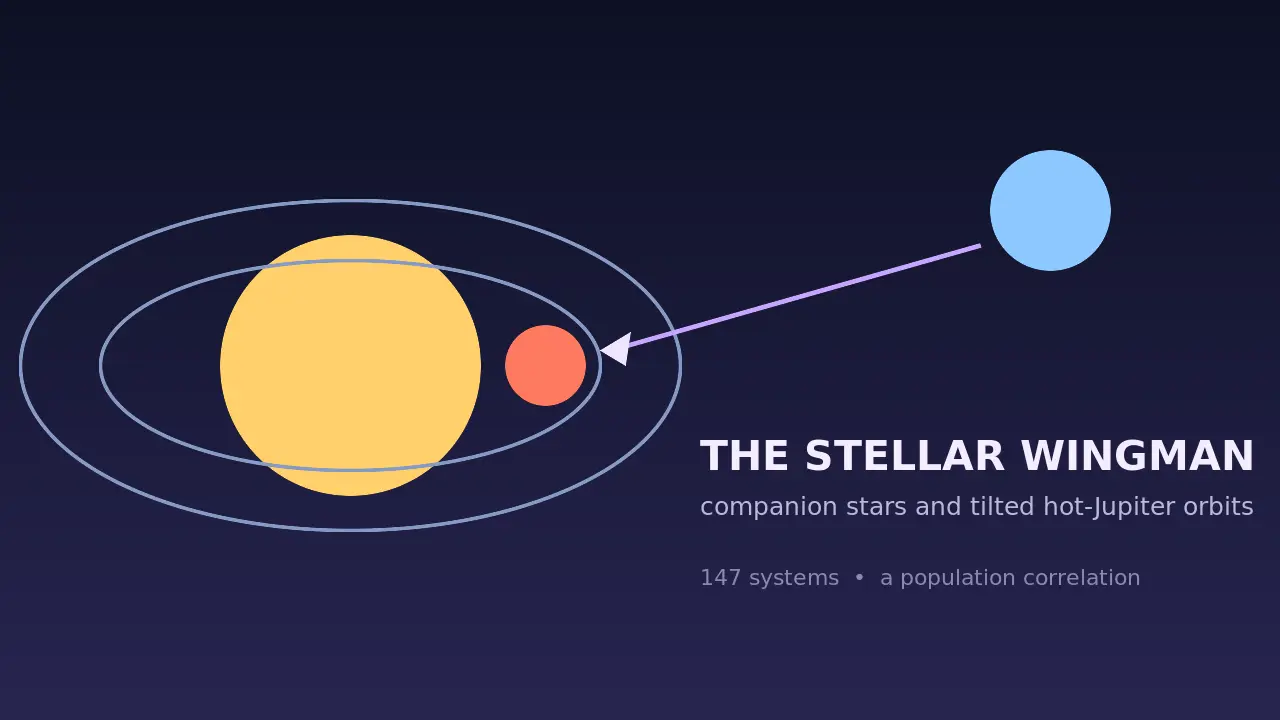
Researchers combined adaptive-optics imaging with Gaia common-motion data for 147 northern hot-Jupiter systems with measured projected obliquities. They identified eight new companion candidates, bringing the observed companion fraction to 48 percent; modeling the survey's selection effects raises the inferred intrinsic fraction to 62 plus or minus 5 percent across the study's mass-ratio and separation range.
Hot Jupiters with resolved stellar companions between 50 and 2,000 astronomical units were misaligned in 46 percent of cases, compared with 24 percent for systems without detected companions. The authors find that many companions could drive eccentric Kozai-Lidov oscillations under suitable orbital configurations. That makes high-eccentricity migration plausible for more systems, but the correlation does not prove one universal formation history.
Why it matters
The survey connects a planet's present-day tilt to the wider architecture of its stellar neighborhood and puts a major migration mechanism on a more testable statistical footing.
What the source establishes
Submitted PASP manuscript with uniform imaging, Gaia associations, and selection-function modeling. The population correlations are statistically reported; individual causal histories remain inferred.
Published by Aliens in the Clouds. These AI-assisted summaries link to their sources and distinguish reported claims from established findings. Skinny Ed is a fictional mascot; High Thoughts are comedy. Send a correction with its source.