Accepted Exoplanet-Atmosphere Model
Hot-Jupiter ions refuse to stay in chemical equilibrium
Accepted simulations find sodium- and potassium-driven ion quenching that alters winds and exposes limits in simplified magnetic-drag models.
Briefed September 23, 2026 · Aliens in the Clouds
Peer-Reviewed Model · Assumptions Tested
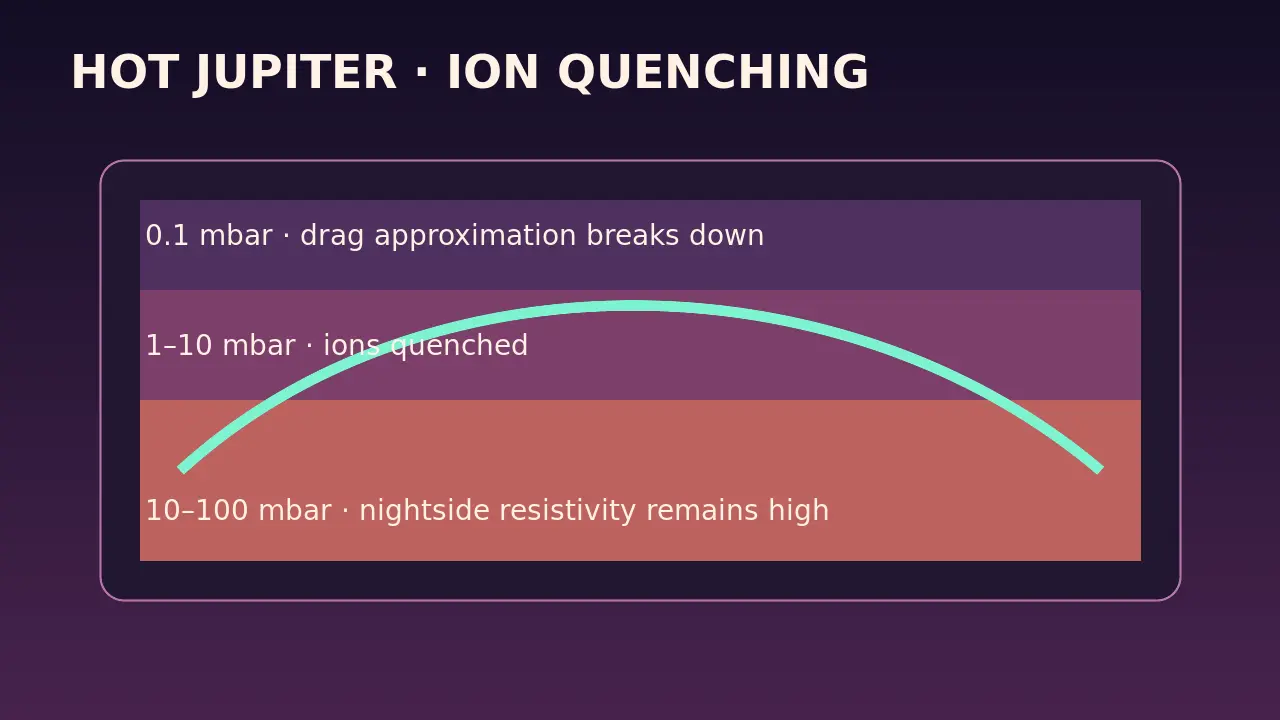
Models of magnetic effects in hot-Jupiter atmospheres often assume that charged sodium and potassium species remain at their local equilibrium abundances. New thermochemical simulations allow those abundances to evolve with transport and find ion quenching between pressures of about 1 and 10 millibars, preserving more ionization on the nightside and at mid-latitudes than equilibrium would predict.
In the study's magnetic-drag approximation, the extra charged material strengthens magnetic interaction, slows the atmospheric jet, and changes global circulation. Yet low electron abundances still create large nightside resistivity deeper down, while higher in the atmosphere the magnetic Reynolds number approaches or exceeds one—the point where the drag approximation itself begins to break down. These are accepted model results, not direct magnetic-field measurements from an exoplanet.
Why it matters
Atmospheric chemistry controls how strongly a hot planet's winds couple to its magnetic field, so assuming equilibrium can misstate circulation and the observables used to test these worlds.
What the source establishes
Accepted thermochemical and circulation modeling. Ion quenching and flow changes are simulation results; no individual planet's field or wind was newly measured.
Published by Aliens in the Clouds. These AI-assisted summaries link to their sources and distinguish reported claims from established findings. Skinny Ed is a fictional mascot; High Thoughts are comedy. Send a correction with its source.