Planet-Formation Chemistry
Webb traces carbon from hot dust into a young star's wind
Warm and cold molecules around HOPS-68 support a proposed pathway that destroys refractory carbon near the star and carries it outward.
Briefed November 5, 2026 · Aliens in the Clouds
Accepted Study · Revised Analysis
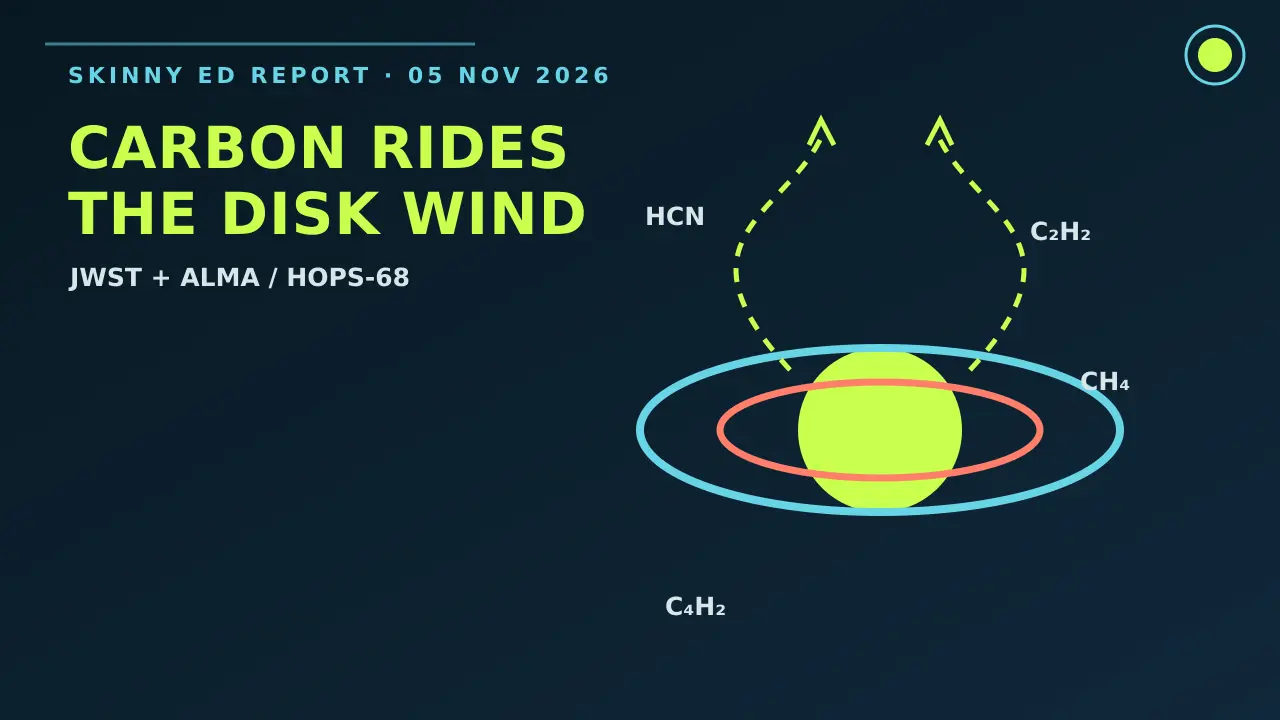
F. J. Ballieux and colleagues model the rich Webb spectrum of the Class I protostar HOPS-68. They detect warm hydrogen cyanide and acetylene near the base of a disk wind, colder carbon-chain species farther out, and additional methane and hydrocarbon signatures; ALMA observations place C2H along the outflow-cavity walls.
The team proposes that high temperatures destroy carbon-rich grains in the inner disk, releasing molecules that a wind transports outward. Ultraviolet chemistry could then build the observed carbon chains in the cavity walls. The sequence offers a possible contribution to Earth's relative carbon depletion and to aliphatic organics in meteorites, but those Solar System connections are not directly demonstrated by this one source.
Why it matters
Rocky planets inherit material processed in young disks. Following carbon from grains into gas and then through a disk wind helps connect star formation chemistry to the ingredients eventually available to planets and small bodies.
What the source establishes
Accepted in The Astrophysical Journal Letters; the arXiv manuscript was revised November 4. The molecules are observed through spectral modeling. Carbon-grain destruction, outward transport, and links to Earth's carbon budget form the authors' interpretation.
Published by Aliens in the Clouds. These AI-assisted summaries link to their sources and distinguish reported claims from established findings. Skinny Ed is a fictional mascot; High Thoughts are comedy. Send a correction with its source.