Accepted Protoplanetary-Disk Study
A warped disk's shadow becomes a chemistry experiment
Fourteen ALMA molecular lines show that gas temperature and photochemistry respond on different clocks around HD 143006.
Briefed September 23, 2026 · Aliens in the Clouds
Multi-Line Observation · Model-Dependent Chemistry
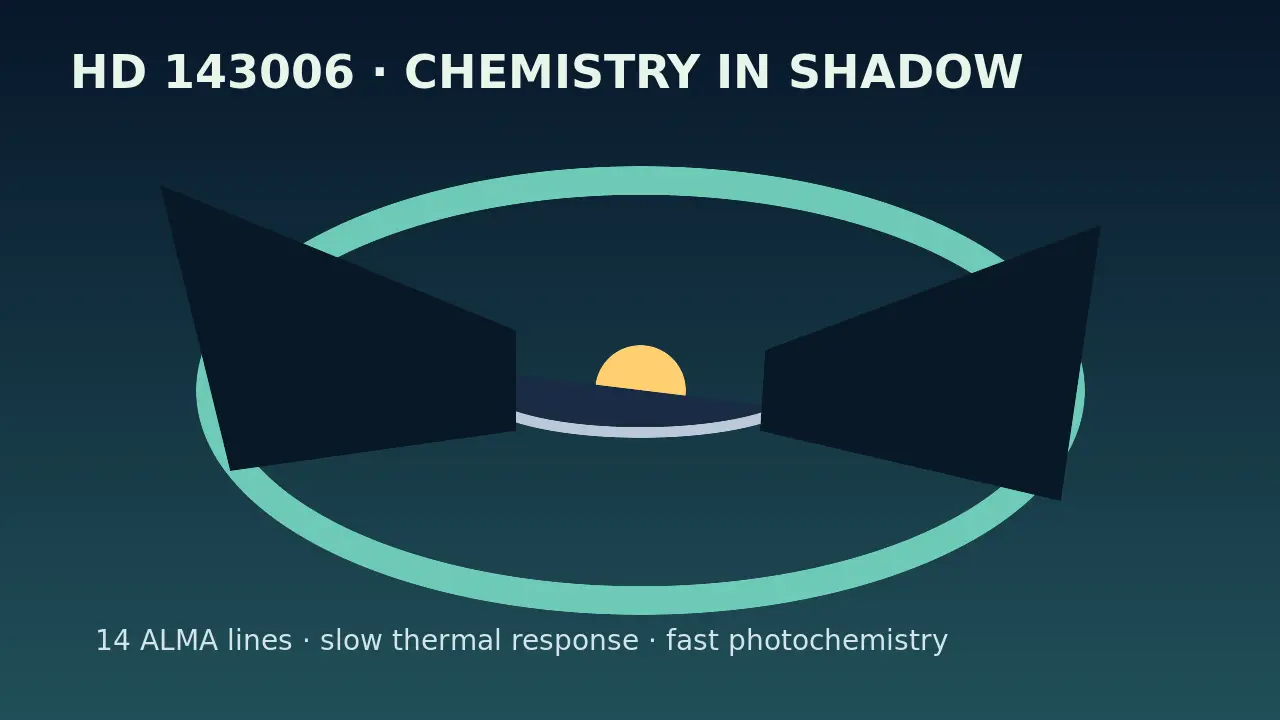
The inner disk around the young star HD 143006 is tilted, casting a broad shadow across part of its outer protoplanetary disk. Researchers combined new ALMA observations of eight molecular tracers with earlier data, then modeled 14 spectral lines on both the illuminated and shadowed sides along with infrared and continuum measurements.
The accepted paper finds only small line-flux contrasts because gas parcels heat and cool slowly as they orbit into and out of shadow, while ultraviolet photochemistry can change molecular abundances much faster. Its best combined model favors a carbon-to-oxygen ratio near 1.05, but disk mass remains degenerate: a low-mass fit and a much more massive alternative both work after other parameters are adjusted. This is a constrained disk-chemistry model, not a direct inventory of planet-forming material.
Why it matters
The natural light-and-shadow geometry lets astronomers separate thermal response from ultraviolet chemistry and exposes where even a rich molecular dataset leaves physical properties uncertain.
What the source establishes
Accepted ALMA study fitting 14 lines and continuum data. The asymmetric illumination is observed; carbon-to-oxygen ratio, disk mass, and chemical pathways depend on the model.
Published by Aliens in the Clouds. These AI-assisted summaries link to their sources and distinguish reported claims from established findings. Skinny Ed is a fictional mascot; High Thoughts are comedy. Send a correction with its source.