Europa Cryovolcanism Model
Snow-like cryolava could build Europa's smooth plains
A new fluid-and-heat model reproduces the scale and shape of Galileo-observed plains and predicts a thermal signature Europa Clipper could seek.
Briefed September 24, 2026 · Aliens in the Clouds
Simulation · Future Observation Proposed
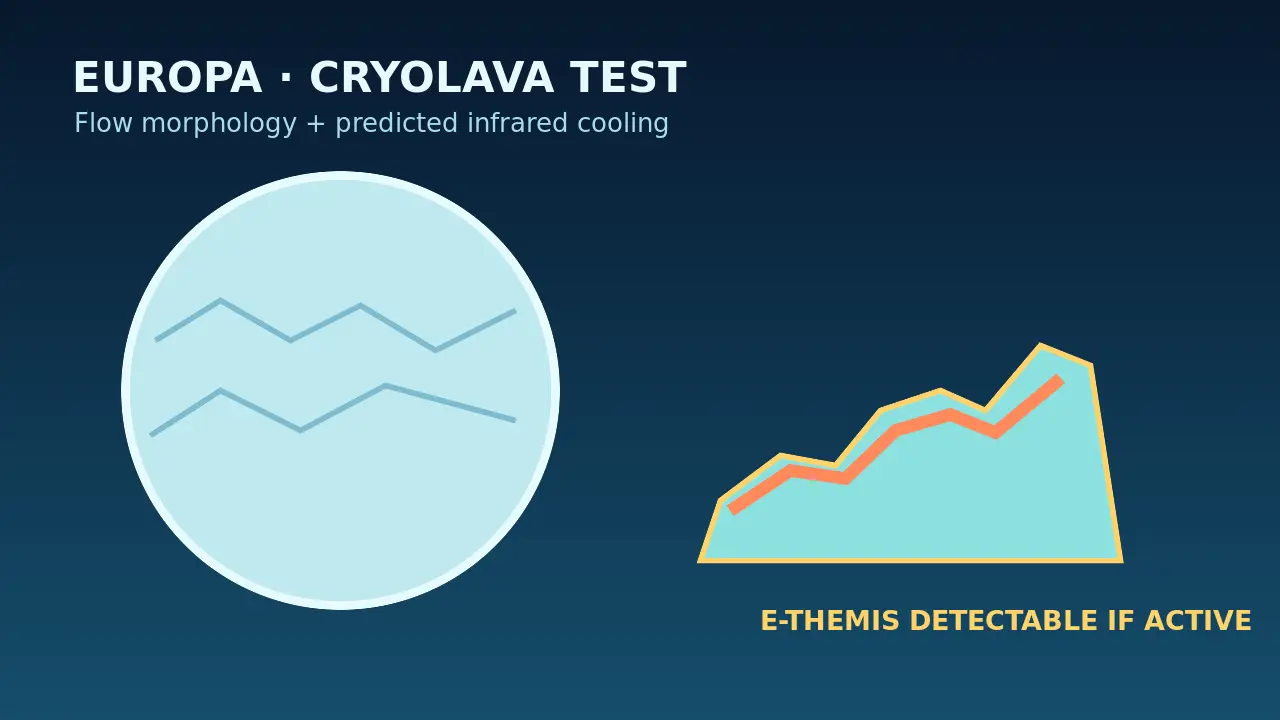
Researchers first modeled how ascending cryomagma would depressurize near Europa's surface, then built CryoPy, a smoothed-particle-hydrodynamics code that follows flow propagation and cooling. In the resulting simulations, a snow-like material behaves as a useful physical analogue for cryolava and produces deposits comparable in extent and morphology to smooth plains imaged by Galileo.
The team also calculated how the deposits' heat signature should change with time and argues that an active event would fall within the detection limits of Europa Clipper's E-THEMIS infrared imager. The study supplies a predictive model, not a newly observed eruption; smooth terrain can have multiple formation pathways, and a future thermal detection would still need geological context.
Why it matters
Turning a geological interpretation into an instrument-level prediction gives Europa Clipper a concrete way to test whether cryovolcanism is actively resurfacing the moon.
What the source establishes
Fresh numerical cryovolcanic model compared with Galileo morphology. The match supports plausibility; no active Europa eruption is reported.
Published by Aliens in the Clouds. These AI-assisted summaries link to their sources and distinguish reported claims from established findings. Skinny Ed is a fictional mascot; High Thoughts are comedy. Send a correction with its source.