JWST Exoplanet Spectroscopy
JWST maps ammonia in one of the coldest directly imaged exoplanets
Cross-correlation separates Epsilon Indi Ab from its bright host and identifies ammonia and water in the 275-kelvin super-Jupiter's atmosphere.
Briefed September 23, 2026 · Aliens in the Clouds
Preprint · Molecules Detected at Unequal Confidence
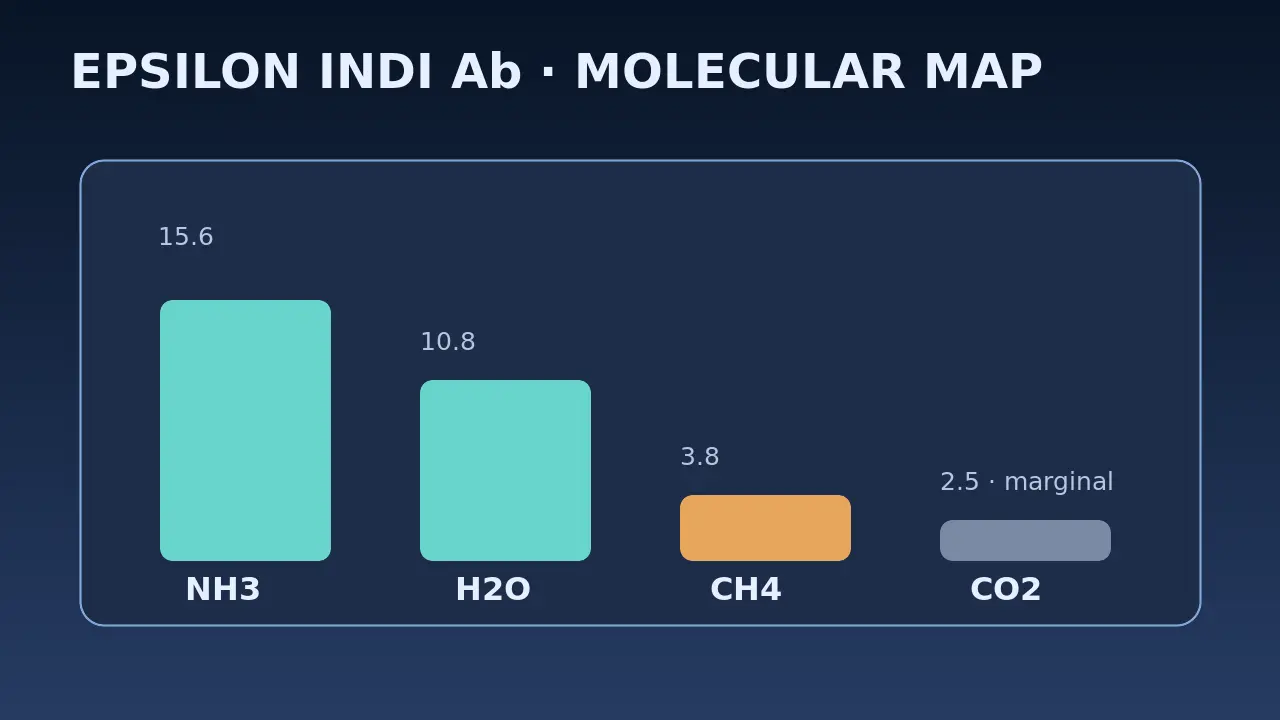
A new preprint combines JWST MIRI spectroscopy from October 2025 with NIRSpec observations from May 2026 to examine Epsilon Indi Ab, a directly imaged super-Jupiter about 3.6 parsecs away. Because light from the nearby bright host star heavily contaminates the planet's signal, the team applied high-pass filtering and cross-correlation against atmospheric models rather than reading an isolated spectrum directly.
The analysis detects the planet at signal-to-noise ratios up to 15.2 and reports ammonia at up to 15.6, water at 10.8, methane at 3.8, and a marginal carbon-dioxide signal at 2.5. Those values support ammonia and water most strongly; carbon dioxide remains tentative. Ammonia in a cold gas giant is atmospheric chemistry, not a biosignature or evidence of life.
Why it matters
The work shows that JWST can extract molecular information from a cold, nearby giant planet even when stellar contamination dominates the raw data.
What the source establishes
Fresh preprint based on public-facing JWST observations and model cross-correlation. Ammonia and water are robustly reported; methane is weaker and carbon dioxide marginal.
Published by Aliens in the Clouds. These AI-assisted summaries link to their sources and distinguish reported claims from established findings. Skinny Ed is a fictional mascot; High Thoughts are comedy. Send a correction with its source.