Exoplanet Radio Astronomy
MeerKAT team reports the first radio emission localized to an exoplanet
Recurring, strongly polarized bursts from Beta Pictoris b may reveal an aurora and a magnetic field at least 1.25 kilogauss strong.
Briefed September 16, 2026 · Aliens in the Clouds
Submitted Preprint · First-Detection Claim
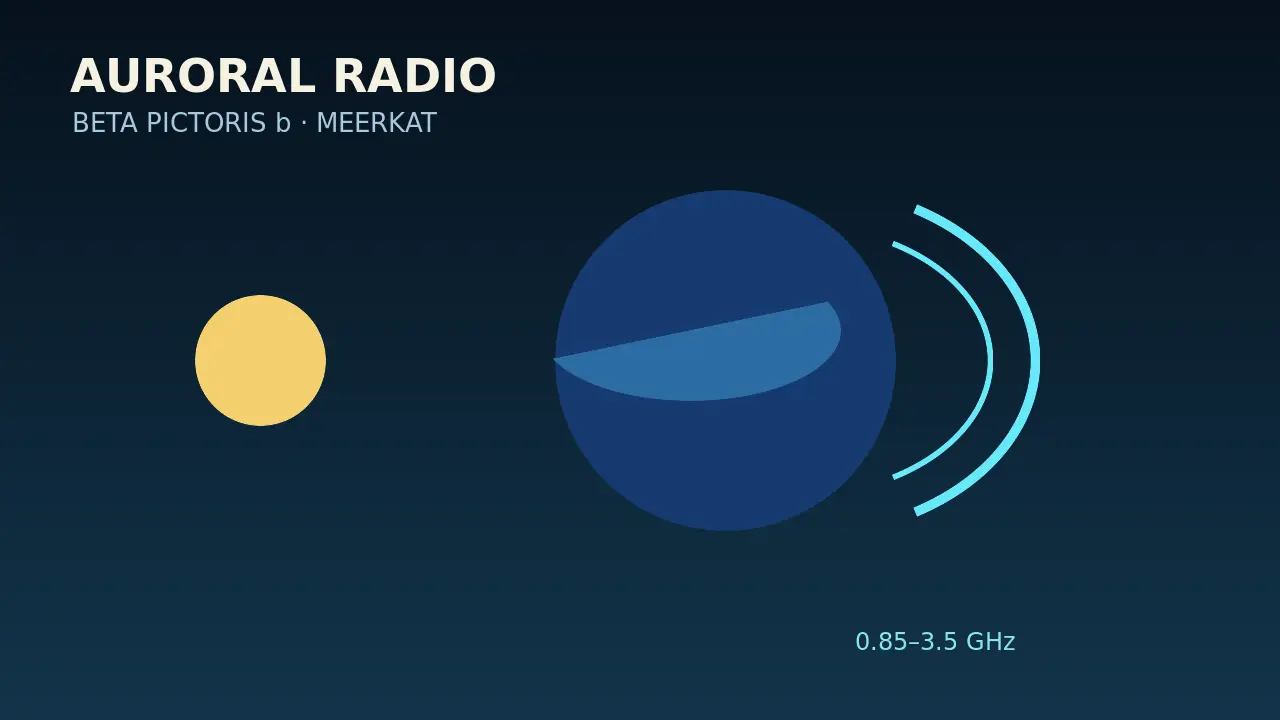
A newly submitted study reports rapid, recurring, highly circularly polarized radio bursts and persistent emission from the giant exoplanet Beta Pictoris b. Using the MeerKAT array, the team detected emission from 0.85 to 3.5 gigahertz and says it could localize the source to the planet rather than the host star.
The authors interpret the signal as electron cyclotron maser radiation—the same basic process behind auroral radio emission in Solar System planets. The highest detected frequency implies a magnetic field of at least 1.25 kilogauss at the source. The manuscript calls this the first direct exoplanetary magnetic-field measurement, but it is newly submitted and has not yet passed peer review or independent replication. Nothing in the observation suggests communication, technology, or life.
Why it matters
A confirmed detection would open a direct way to measure exoplanet magnetic fields, which influence atmospheric loss, stellar-wind interactions, and planetary interiors.
What the source establishes
Submitted preprint reporting a natural auroral process. The radio emission is observationally significant but is not a technosignature; the localization and field inference require review and confirmation.
Published by Aliens in the Clouds. These AI-assisted summaries link to their sources and distinguish reported claims from established findings. Skinny Ed is a fictional mascot; High Thoughts are comedy. Send a correction with its source.