Rocky-Planet Climate
A planet's atmosphere can push back on the clock
An analytical model reproduces how thermal tides accelerate or brake rocky-planet rotation, including resonant effects near synchronous spin.
Briefed November 7, 2026 · Aliens in the Clouds
Accepted Study · Analytical Model
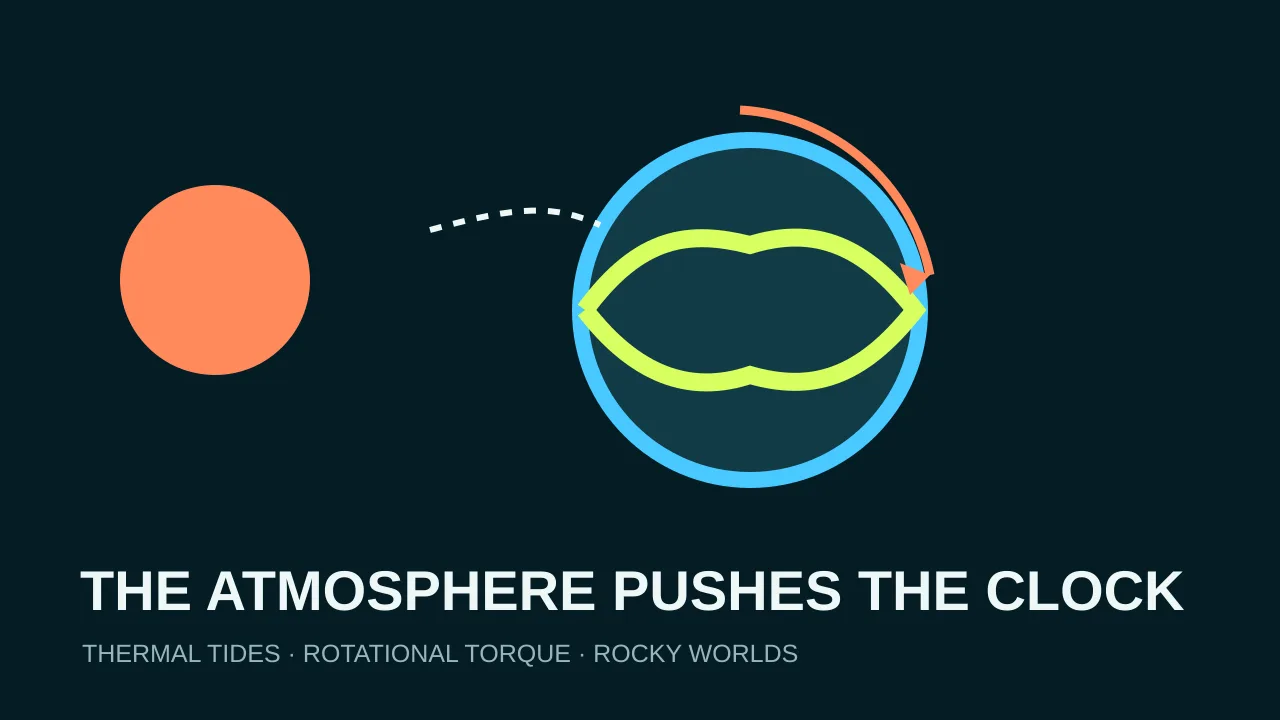
Pierre Auclair-Desrotour and colleagues developed an analytical treatment of semidiurnal atmospheric thermal tides for isentropic and isothermal atmospheres. Uneven stellar heating raises pressure waves whose torque can oppose gravitational tides, moving a temperate rocky planet away from synchronous rotation and altering its circulation and climate.
The equations reproduce the frequency-dependent torque found in earlier general-circulation simulations for paleo-Earth and modern Earth, including amplification near Lamb-wave resonance. A delayed atmospheric response is needed to match the simulated asymmetry between braking and acceleration. The agreement validates the framework against those benchmarks; it does not measure the spin history of a particular exoplanet.
Why it matters
Rotation controls a world's day-night cycle and climate. A faster analytical model makes it easier to explore when an atmosphere can prevent permanent daysides and nightsides around nearby stars.
What the source establishes
Accepted for publication in Astronomy & Astrophysics and submitted November 4. The model agrees with selected numerical simulations; real exoplanet atmospheres and rotation rates remain largely unconstrained.
Published by Aliens in the Clouds. These AI-assisted summaries link to their sources and distinguish reported claims from established findings. Skinny Ed is a fictional mascot; High Thoughts are comedy. Send a correction with its source.