Near-Earth Asteroid Study
Atira's spectrum points to a hydrated, carbon-rich composition
A coordinated Nordic observing campaign finds a CM-chondrite-like surface on the binary near-Earth asteroid and constrains its reflectance and porosity.
Briefed September 24, 2026 · Aliens in the Clouds
Measured Spectrum · Meteorite Analogue Inferred
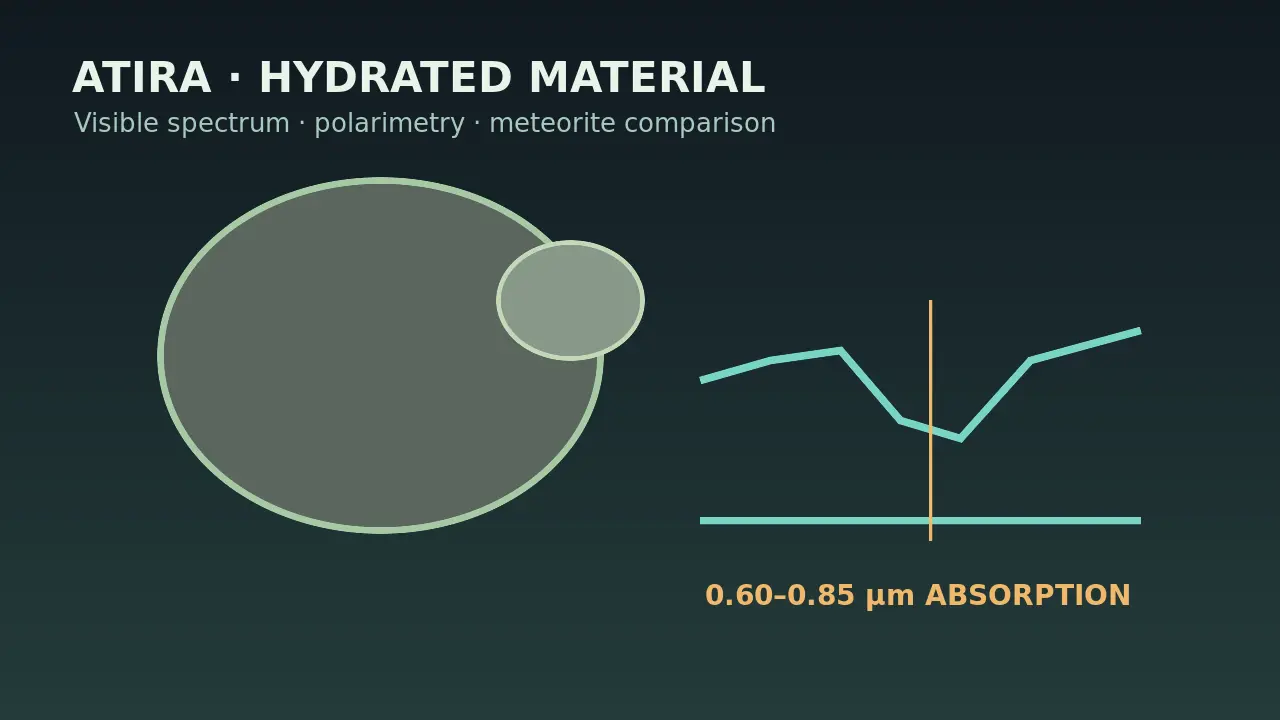
Observers tracked binary asteroid (163693) Atira for nearly eight hours from Metsähovi Observatory and obtained visible spectroscopy and linear polarimetry with the Nordic Optical Telescope. After correcting flux lost to a misaligned spectrograph slit, the reflectance spectrum shows a roughly 7.4-percent-deep absorption spanning 0.60 to 0.85 micrometers and is classified as the primitive Cgh type.
Laboratory meteorite comparisons most closely match hydrated CM carbonaceous chondrites. The team also measured strong linear polarization at an 83-degree phase angle and, using an assumed CM-chondrite density, estimated bulk porosity at 51 percent with a very large 31-percentage-point uncertainty. The hydration signal is observationally grounded; the porosity remains limited mainly by uncertainty in the primary asteroid's volume.
Why it matters
A hydrated body orbiting mostly inside Earth's path expands the compositional picture of the difficult-to-observe Atira population and helps connect asteroid surfaces with meteorite samples.
What the source establishes
Fresh photometry, spectroscopy, and polarimetry. Hydrated CM-like material is the favored spectral match; bulk porosity is model-dependent and imprecise.
Published by Aliens in the Clouds. These AI-assisted summaries link to their sources and distinguish reported claims from established findings. Skinny Ed is a fictional mascot; High Thoughts are comedy. Send a correction with its source.