Accepted Mission Strategy
Ariel's chemistry roadmap turns a thousand atmospheres into one experiment
An accepted community paper defines the disequilibrium, haze, stellar, sulfur, and phosphorus questions ESA's survey is designed to compare across worlds.
Briefed September 24, 2026 · Aliens in the Clouds
Peer-Reviewed Roadmap · Observations Pending
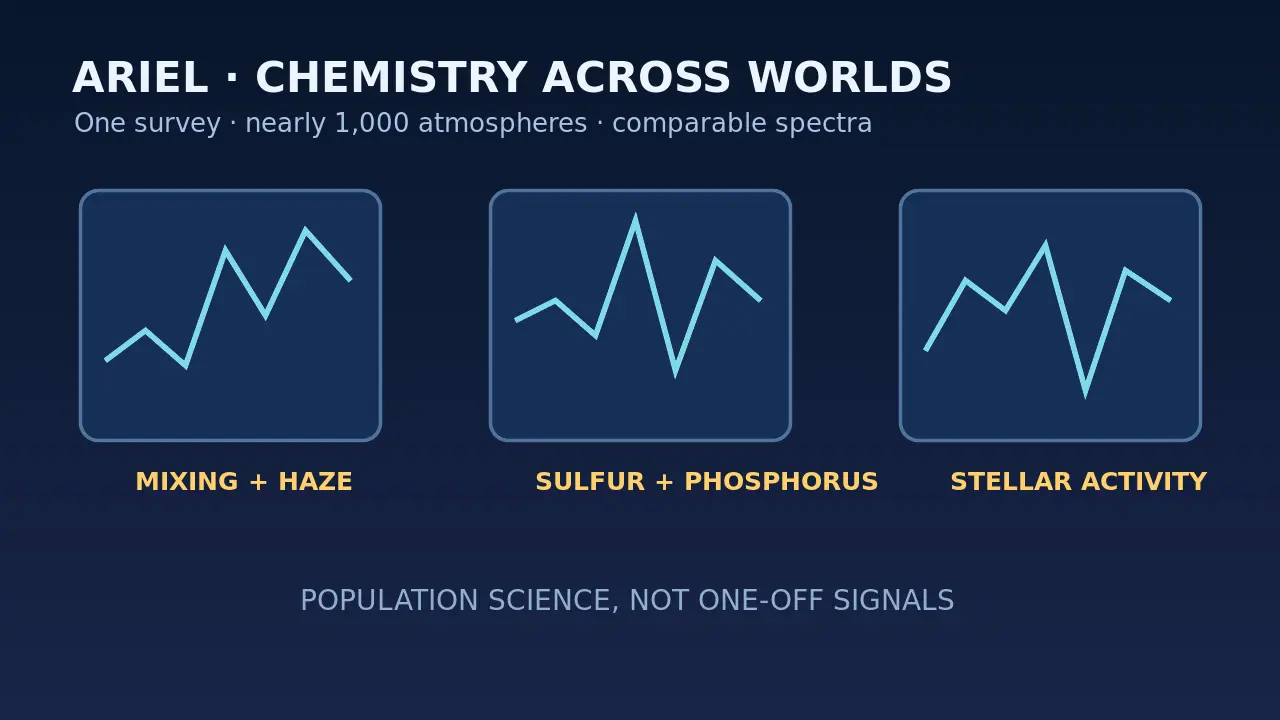
The Ariel Chemistry Working Group has assembled a strategy for interpreting the European Space Agency mission's planned homogeneous survey of nearly one thousand exoplanet atmospheres. The accepted paper focuses on why individual spectra often depart from thermochemical equilibrium and how vertical mixing, photochemistry, circulation, and clouds can produce those differences.
Priority themes include sulfur- and phosphorus-bearing molecules, haze precursors, stellar activity, and how atmospheric chemistry changes across stellar ages and types. The paper links each theme to Ariel's spectral capabilities and representative targets already in the mission candidate sample. It is a science and observing roadmap—not a detection catalog, final target list, or forecast of biosignature discoveries.
Why it matters
A large, consistently observed population can reveal chemical patterns that one-off detections cannot, while exposing where stellar contamination and nonequilibrium processes imitate simpler stories.
What the source establishes
Accepted mission-strategy paper synthesizing current chemistry and proposed observations. The survey and its comparative findings are prospective.
Published by Aliens in the Clouds. These AI-assisted summaries link to their sources and distinguish reported claims from established findings. Skinny Ed is a fictional mascot; High Thoughts are comedy. Send a correction with its source.