
Three tracers reveal a planet still being built
Hubble, VLT, and ALMA data converge on EK Cha b, a candidate young giant whose carbon-monoxide footprint fits a circumplanetary disk.
Accepted Study · Protoplanet Candidate
Read the story & sourcesTHE SKINNY ED REPORT · ARCHIVED EDITION
Friday's edition leads with a young world still under construction: archival Hubble, VLT, and ALMA observations reveal a multi-wavelength source around the M star EK Cha whose carbon-monoxide kinematics are consistent with a circumplanetary disk, making EK Cha b a strong protoplanet candidate rather than a confirmed planet. The official UAP lane remains quiet, with no new AARO case resolution or federal file tranche. Five additional primary studies keep the focus on what instruments can actually establish. A 25,000-track survey measures how often satellite constellations exceed recommended brightness limits; Webb spectra trace gaseous silicon monoxide and silicate clouds in three L dwarfs; an occultation plus Hubble imaging constrains Weywot as a dark, triaxial rubble pile; nineteen years of infrared spectra map a factor-of-16-to-27 swing across Io's sulfur-dioxide atmosphere; and a fast climate model shows how rotation, eccentricity, and thermal inertia can give the same rocky planet several stable climate futures. None of today's stories detects extraterrestrial intelligence, life, or technology.
Hubble, VLT, and ALMA data converge on EK Cha b, a candidate young giant whose carbon-monoxide footprint fits a circumplanetary disk.
Accepted Study · Protoplanet Candidate
Read the story & sources
An uncued survey logs 25,000 tracks and finds large operator-to-operator differences, with one in three Rubin twilight exposures predicted to carry a trail.
Preprint · Satellite Foreground Measured
Read the story & sources
Spectra of three benchmark L dwarfs reveal gaseous silicon monoxide alongside model-dependent silicate and iron cloud layers.
Preprint · Molecular and Cloud Retrieval
Read the story & sources
A stellar occultation and eleven Hubble orbits constrain Weywot as a 73-kilometer, triaxial body with an unusually low reflectivity.
Preprint · Shape and Albedo Constrained
Read the story & sources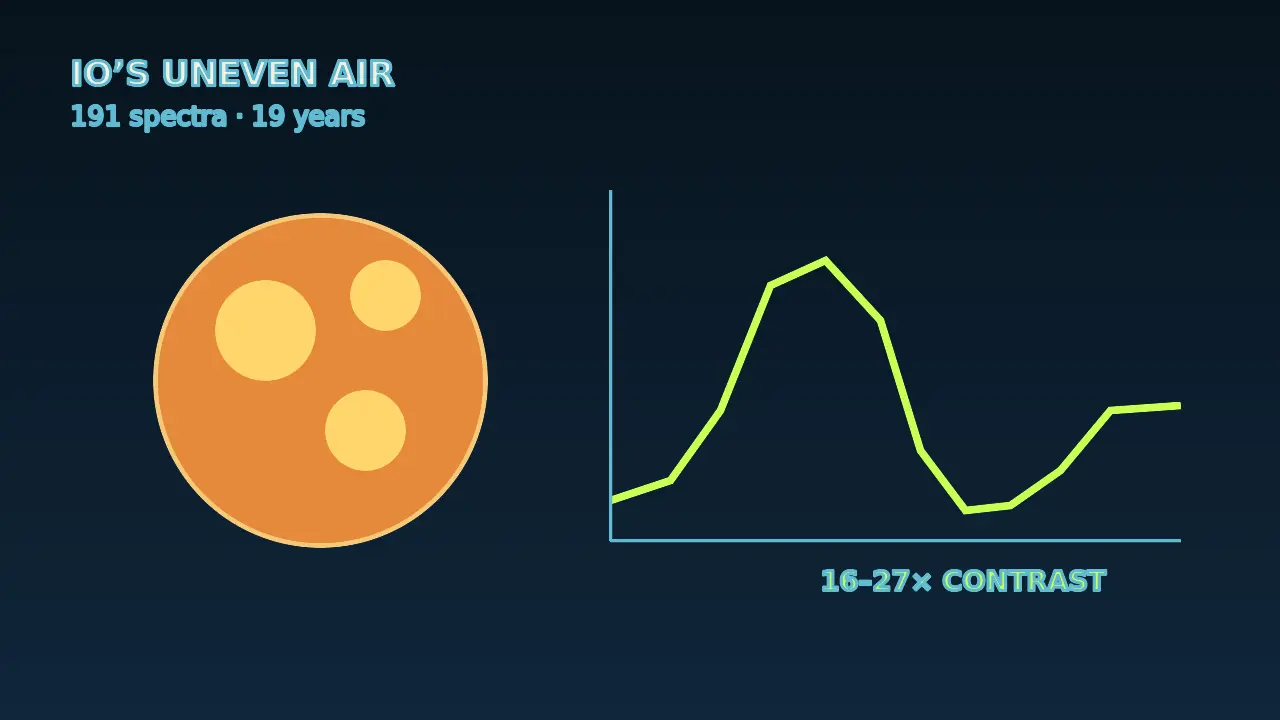
Nineteen years of infrared spectra map a persistent dayside asymmetry that eclipse cooling cannot explain on its own.
Accepted Study · Long-Term Atmospheric Map
Read the story & sources
A new fast model spans snowball, temperate, runaway-onset, and post-runaway states to map how rotation, eccentricity, and oceans alter tipping points.
Accepted Model · Climate Attractors Mapped
Read the story & sourcesGood morning, investigators. Today's lead is a useful lesson in how a candidate becomes interesting without becoming overclaimed. EK Cha b appears in optical light, millimeter continuum, and spectrally resolved carbon monoxide; the gas motion fits a compact disk around a forming companion. That agreement across independent tracers is much stronger than a lone bright pixel, but the authors still ask for deeper observations before calling the object fully confirmed. The same evidence discipline runs through the rest of the board. A large uncued survey turns satellite brightness from anecdote into operator-by-operator rates and predicts a trail in roughly one of every three Rubin twilight exposures. Webb sees silicon-bearing gas and cloud signatures in L-dwarf atmospheres, but mineral recipes depend on the retrieval model. Weywot's occultation and Hubble light curve reveal a surprisingly dark, stretched little moon, not a photograph of its interior. Io's long record shows a persistent atmospheric asymmetry that eclipses alone cannot explain. And the new Gen-EBM maps climate attractors efficiently without pretending a one-dimensional model can replace a full atmosphere. The universe remains dramatic; today's evidence is better because every result keeps its verbs proportional to its data.

ED’S HIGH THOUGHT · FICTIONAL HUMOR
Whoa, dude… brown dwarfs have silicate clouds, which means somewhere the weather is made of future glass. An alien can get caught in a storm and come home as a window. That's why flying saucers have no visible windshield: the pilot sneezed during weather and became the windshield. Every UFO is just one extremely embarrassed extraterrestrial staring at Earth through his own transparent butt.
Published by Aliens in the Clouds. These AI-assisted summaries link to their sources and distinguish reported claims from established findings. Skinny Ed is a fictional mascot; High Thoughts are comedy. Send a correction with its source.