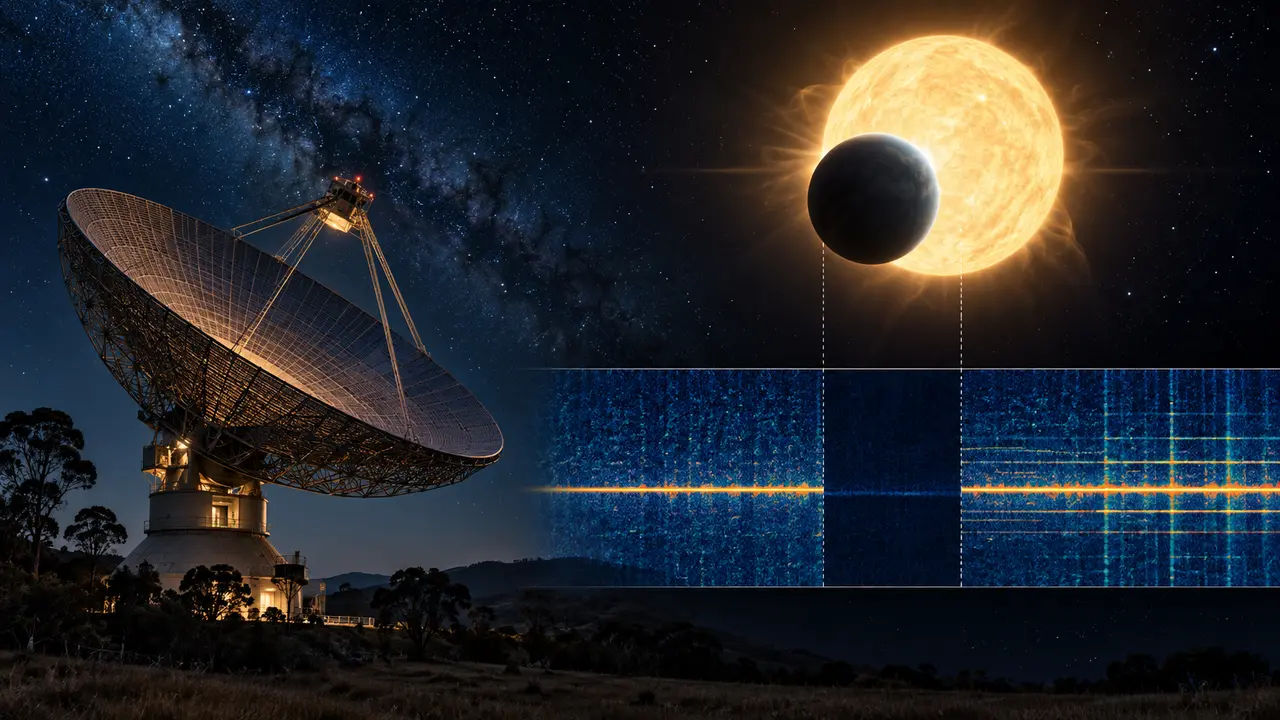
Tuesday's lead is a real aerospace milestone with a real engineering caveat. Starship reached orbit and deployed 26 Starlink V3 satellites on its fourteenth flight, but an engine shut down early and the planned ten-hour mission ended after roughly three hours. Two peer-reviewed Enceladus studies add strong astrobiology: one shows an Earth methanogen growing in a laboratory simulation of the moon's alkaline, carbon-dioxide-poor ocean chemistry; the other uses about 1,000 Cassini ice-grain spectra, freezing experiments, and thermodynamic calculations to explain how plume grains may sort ocean salts and organics. Neither study detects life beyond Earth. With no new official UAP tranche, case resolution, or independently verified extraordinary evidence after yesterday's cutoff, three clearly labeled Worth Revisiting items return to verification: the Mount Etna balloon reconstruction, distant commercial aircraft mistaken for a formation of lights, and a radio search timed to exoplanet eclipses that found only terrestrial interference.
Cassini spectra, freezing experiments, and models suggest slow-frozen droplets fragment in vents, concentrating different salts and organics into separate particles.
Worth Revisiting: AARO's reconstruction places the object about 170 kilometers from the volcano, moving with the wind rather than through superheated ash.
Official Resolution · Moderate Object ID Confidence
Worth Revisiting: Position data and air-traffic records moved the lights from a suspected restricted-airspace incursion to separate corridors as far as 300 nautical miles away.
Worth Revisiting: Breakthrough Listen used planetary occultations as an extra test, then traced every surviving narrowband event to terrestrial interference.
Good morning, investigators. Starship's first orbital trip did two things at once: it crossed a threshold by delivering an operational payload, and it exposed an engine problem serious enough to shorten the flight by about seven hours. That is progress with telemetry attached, not a clean victory or a catastrophe. Enceladus supplies the day's most consequential science. A terrestrial archaeon grew and made methane in a carefully constructed chemical analogue up to pH 11, showing that one known metabolism can work under a subset of predicted ocean conditions. Separately, Cassini's salt-rich grains split into at least five compositional families that can be reproduced by slow freezing followed by fragmentation in narrow vents. Those grains may make future sampling more informative, but habitability and detectability are still not life. The archival half of the board keeps the same standard on UAP and SETI. AARO's Mount Etna and western-aircraft cases show how range, atmosphere, platform motion, and traffic records can turn extraordinary apparent motion into ordinary objects. Breakthrough Listen's eclipse search shows how 1.95 million radio signals become 14,639 candidates and then zero detections after interference checks. The common theme is glorious and mildly inconvenient: a good instrument can make a mystery sharper, but only the full verification chain can tell us what it is.
ED’S HIGH THOUGHT · FICTIONAL HUMOR
Whoa, dude… Enceladus is Saturn's broken snow-cone machine. Its vents slowly freeze ocean spray, sort the salts, then fire the grains into space at highway speed—exactly how a cosmic convenience store would season snacks. If microbes live down there, every plume is technically a billion-mile sneeze, and humanity's grand astrobiology plan is to chase Saturn with a microscope and yell, ‘Open your mouth, we need a culture!’ Somewhere an alien health inspector is already stapling a giant CLOSED sign across the rings.
Published by Aliens in the Clouds. These AI-assisted summaries link to their sources and distinguish reported claims from established findings. Skinny Ed is a fictional mascot; High Thoughts are comedy. Send a correction with its source.