Interstellar Comet Research
JWST finds gritty water ice in interstellar comet 3I/ATLAS
Three observing epochs reveal water-bearing grains mixed with refractory material and possible changes in grain size or ice structure.
Briefed September 18, 2026 · Aliens in the Clouds
Accepted Manuscript · Grain Properties Inferred
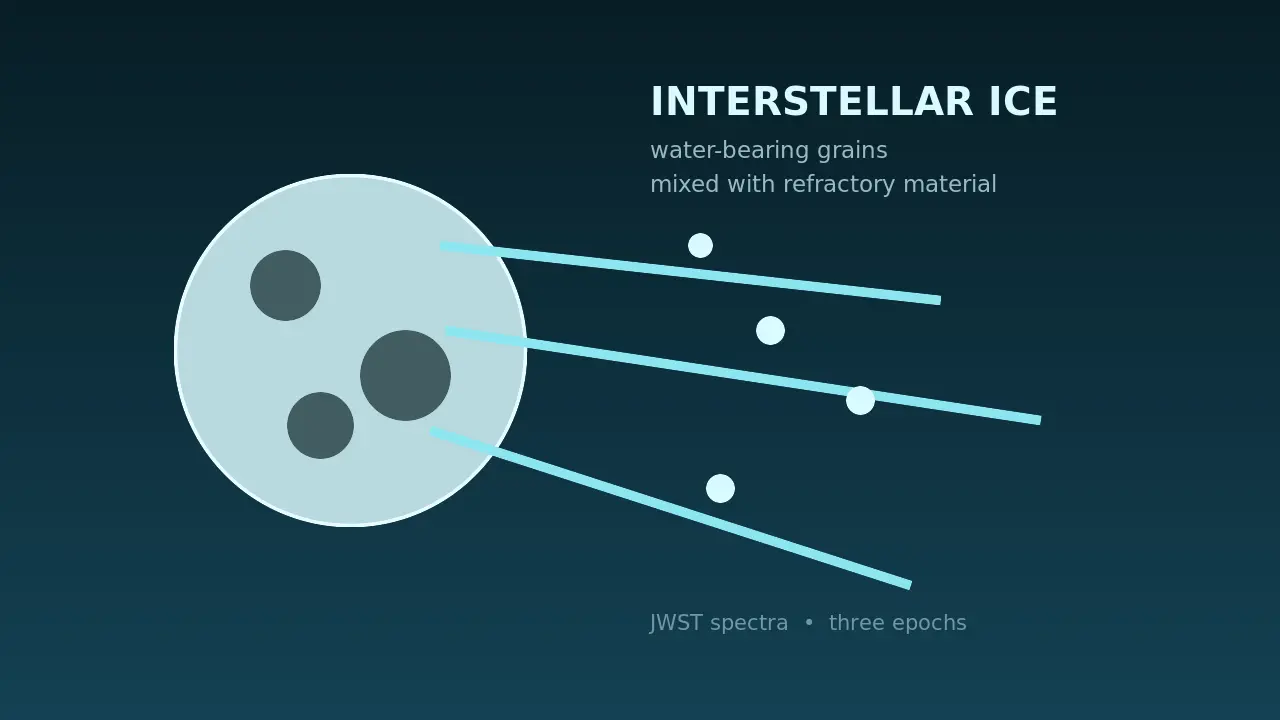
JWST/NIRSpec observed interstellar comet 3I/ATLAS at three epochs spanning eight months around perihelion. The spectra show water, carbon dioxide, and carbon monoxide gas along with a broad three-micron absorption feature, but the shorter water-ice bands familiar from many Solar System comae are weak or absent.
Spectral models favor submicron-to-micron aggregates containing both water ice and refractory material. The final epoch also supports a population of larger ice-rich grains and a feature consistent with crystalline water ice. The data can be explained either by crystalline ice at both epochs with changing grain properties, or by an evolution toward a more crystalline state; the paper does not establish which path occurred.
Why it matters
The result provides a direct comparison between the icy building blocks of another planetary system and comets or trans-Neptunian objects formed around our Sun.
What the source establishes
Accepted ApJ Letters study based on three JWST spectra. Water-bearing refractory aggregates are the favored interpretation; the detailed ice state and its evolution remain model-dependent.
Published by Aliens in the Clouds. These AI-assisted summaries link to their sources and distinguish reported claims from established findings. Skinny Ed is a fictional mascot; High Thoughts are comedy. Send a correction with its source.