Interstellar Comet Modeling
A layered comet model explains 3I/ATLAS's late methane
Twelve thousand simulations favor deep methane surviving beneath a cosmic-ray-processed surface, with a model-derived exposure age of 0.87 to 3.1 billion years.
Briefed September 19, 2026 · Aliens in the Clouds
Accepted Manuscript · Model-Derived History
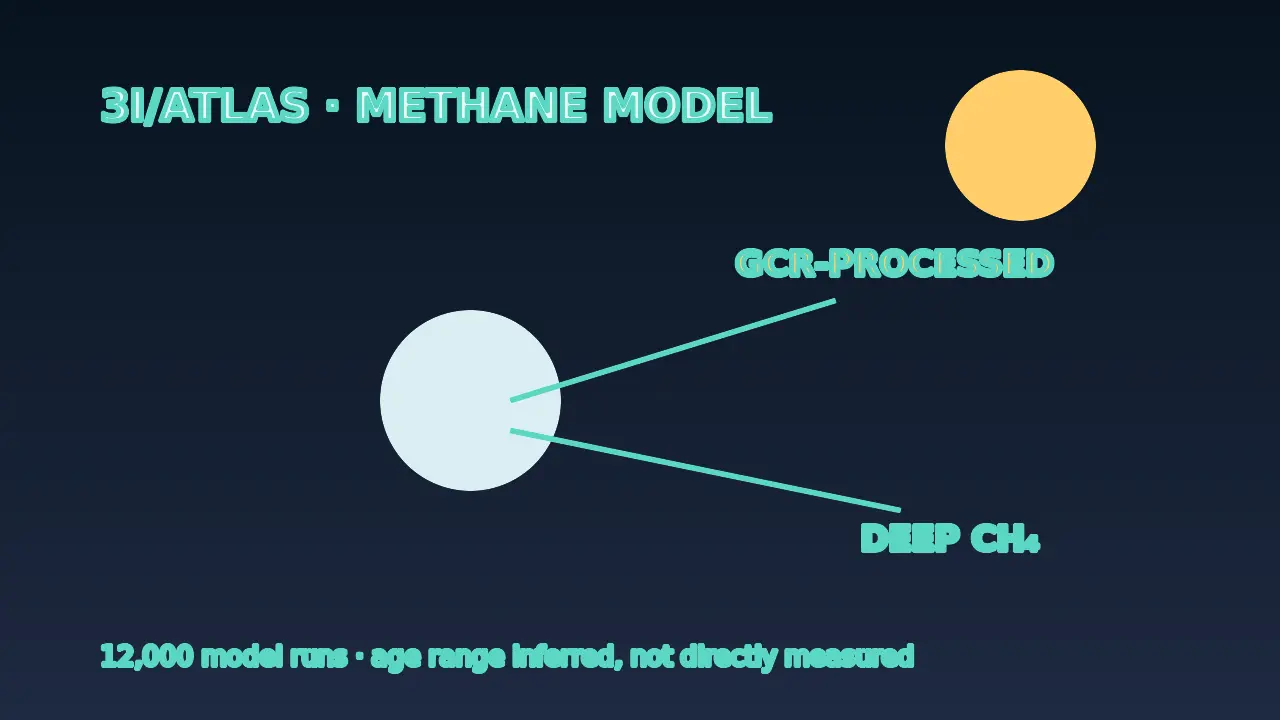
Researchers coupled a shape model of interstellar comet 3I/ATLAS to a thermophysical nucleus model that tracks water, carbon dioxide, carbon monoxide, methane, dust, and processing by galactic cosmic rays. Across 12,000 runs, viable solutions reproduce the observed production rates while placing methane deeper in the water-ice matrix, where it survives until post-perihelion heating reaches it.
The accepted Astrophysical Journal manuscript favors formation below 20 kelvin beyond a carbon-monoxide snowline and an effective cosmic-ray exposure age between 0.87 and 3.1 billion years. The authors also find a degeneracy: dust-rich material with weaker processing can resemble ice-rich material with stronger irradiation. The age and birthplace are model inferences, not direct measurements, and the chemistry supplies no evidence of biology or artificial modification.
Why it matters
The work turns a delayed volatile detection into a test of subsurface layering and interstellar weathering while showing how different evolutionary histories can fit the same data.
What the source establishes
Accepted ApJ manuscript based on observed production rates and 12,000 model runs. Methane stratification, formation temperature, and exposure age are inferred and remain sensitive to composition and dust-processing degeneracies.
Published by Aliens in the Clouds. These AI-assisted summaries link to their sources and distinguish reported claims from established findings. Skinny Ed is a fictional mascot; High Thoughts are comedy. Send a correction with its source.